My sister and I once had a dream that we would work together in our own restaurant in Phuket. But as it turns out, she has her restaurant and I am a culinary instructor here in Seattle. But we do share with each other what we have learned over the years. During my last trip home I learned about an herb in the mint family called Bai Lah. It is an herb used in Thai cuisine. I took a picture of my sister’s Lah plant. I believe that Lah is a Thai word that is short for perilla.
Green Perilla—also called Green Shiso or Beefstalk—is a member of the mint family Lamiaceae, but it doesn’t taste like mint. The Purple Perilla is more common in the markets, but it belongs to a different species in the botanical world. Purple Perilla is also known as Japanese basil or purple mint. It has a very refreshing taste. To me it tastes like lemon verbena, cinnamon and grass.
In Seattle, I was familiar with the plant Green Perilla because I am a Vietnamese food fanatic and I have a passion for herbs. I even made Jerry Traunfeld’s Green Apple & Green Shiso Sorbet once. But seeing Lah in Thai cuisine is a new experience for me.
Thai Bai Lah ~ Green Perilla, my sister’s plant in Thailand
The second unusual ingredient in my stew is stingray. In Thailand, stingray is hard to come by so my mom would be sure to bring some home whenever it appeared in the market. In Phuket, stingray is available in the market already barbecued and ready to be eaten. The venders would grill it in pieces about 2 to 3 inch wide and the length of half of the wing.
We eat stingray with spicy chili and lime dipping sauce and steamed jasmine rice. It is simply delicious. Another delicious way to eat stingray is to cook the flesh from a barbecued stingray in a curry with a flavorful leaf such as wild pepper leaf (please see Pranee’s Blog entree on wild pepper leaf). Stingray is eaten in Southeast Asia in Malaysia, Singapore and Southern Thailand. We eat the wings or flaps and the flesh, but not the bone and skin. Because they have such a strong flavor and aroma, the first thing we do with fish like stingray, tuna and catfish is to barbecue them with salt to temper the strong fishy flavors and aromas.
One day I decided to cook stingray and Green Perilla leaves together in a curry. It turned out to be a splendid idea. The perilla leaves left behind a unique flavor and aroma of lemon, cinnamon and cloves in my new creation of fish curry stew ~ Pla Kraban Kub Bai Lah ~ Stingray Curry Stew with Green Perilla.
Two uncommon ingredients - Stingray and Green Perilla
Through I haven’t had stingray curry for over 20 years, seeing a frozen stingray at Mekong Rainier Asian Market inspired me to cook it for the blog and for myself to revisit the flavor. I bought small portions of the stingray flap at the Asian market, then took them home and baked them instead of grilling or barbecuing them. It needed to be cooked first before I did anything else because we never handle fresh stingray.
Stingray curry with green perilla
This recipe is not hot like most curries. This allows you to enjoy the flavor of the fish more than in a hot curry sauce. But if you wish it to be hot like any curry, follow the steps below, but double the amounts of curry paste and coconut milk.
This recipe is for anyone who might find stingray in the market and be interested in learning how to cook it. It was fun to make this recipe with stingray, but on a regular basis I am more likely to make this recipe using halibut cheeks or grilled catfish.
Place parchment paper on the bottom of a baking sheet and place the stingray on top. Bake stingray for 30 minutes, or until the meat pulls away from the bone as shown in the photo below. Using a fork, remove the cooked fish from the bone and the skin; it should come off easily. Discard the bone and skin.
Heat a heavy bottom pot and stir in canola oil; pan-fry curry paste in the oil until fragrant. Add coconut milk and let it cook on medium-high heat until oil is separated and the curry is fragrant. Stir in coconut milk and water and bring to a boil. Stir in the previously prepared stingray and boil for 3 minutes. Add green perilla. Let it boil for 1 more minute to allow the flavor of perilla into the soup, but not so long that the fresh herb flavor disappears. Serve with steamed jasmine rice.
I love having a stew cooking on my stove top while I am catching up with a pile of work. I have had a frozen pork belly in my freezer for a month now, waiting for the time when it will become Moo Palo, or Stewed Pork Belly with Cinnamon and Star Anise in Soy Sauce, a delightful dish of Thailand. I could no longer make excuses that I was too busy too cook—I can accomplish both working and cooking: Just let it stew.
I worked at my home office all last week to meet my deadline for editing recipes and writing a proposal. When I saw the frozen pork belly in my freezer I pulled it out to thaw so that I could cook it the next day. The rest was simple. I cut the pork belly into pieces, placed them in a Dutch oven and sprinkled the remaining ingredients randomly on top. Then I let the stove top (or you can use the oven) do the work of cooking. I took a break from work from time to time to check on the stew. While it cooked itself on the stove top for 2 hours, in my office I enjoyed the aroma of soy and cinnamon and star anise interacting with each other.
Stewed Pork Belly with Cinnamon and Star Anise in Soy Sauce, Moo Palo
This dish is similar to Thai Moo Palo but I omitted the hard-boiled eggs and instead of using five spice powder, I used Vietnamese cinnamon and star anise. What I was looking for was a sweeter and more delicate flavor than from the Vietnamese version with cinnamon and dark soy sauce. It was surprising good and sophisticated. When I checked with my family they had no idea that there was a tablespoon of black pepper in it. It had just a hint of black pepper deepening the sauce.
In Phuket, this dish is called by its Phuket Hokkien name: Moo Hong – หมูฮ้องสูตรภูเก็ต. I cooked it the same way my mother would, with the fat and skin attached to the pork belly to keep it sweet and moist. The important ingredients that give Moo Palo or Moo Hong Phuket its unique flavor are dark soy, crushed garlic cloves, black pepper, cinnamon powder, cinnamon sticks and star anise.
This slideshow requires JavaScript.
Stewed Pork Belly with Vietnamese Cinnamon and Star Anise in Soy Sauce
Moo Palo
หมูพะโล้
Serves 4
Preparation time: 10 minutes
Stewing time: 2 hours on medium heat on stove top
2 pounds pork belly (aka side pork) with fat and skin attached, cut into 1½-inch thick pieces2 tablespoons dark soy sauce (Bengal)3 tablespoons light soy sauce, more as needed2 tablespoons Vietnamese cinnamon powder1 tablespoon whole black peppers, crushed8 cloves garlic, crushed and peeled (don’t chop, keep them whole)3 star anise, whole5 cloves, whole2 cilantro stems, see Pranee’s explanation on cilantro root2 teaspoons brown sugar
Place cut up pork belly in a dish and stir in the dark soy sauce, light soy sauce, Vietnamese cinnamon powder and black pepper; mix well. Marinate overnight or for several hours.
Place the pork belly and marinade in a Dutch oven over medium-high heat, then add garlic, star anise, cloves and brown sugar on top of pork. Brown the meat a little, then add water to cover the top of pork by 1 inch. Bring to a boil, then turn heat down to medium or medium low (depending on the burner) to create a nice gentle boil. Let it cook for 1 hour. Stir occasionally and add water if needed.
After an hour and a half, cover the Dutch oven with a lid and let the pork simmer for about a half hour, or until tender. (It is tender when you can cut it with a fork and it breaks up nicely without an effort.) Reduce the sauce to 1 cup, about ¼ cup per serving.
Serve warm with steamed jasmine rice.
Pranee’s note:
Vietnamese Cinnamon or Saigon Cinnamon has more essential oils and 25 percent more Cinnamaldehyde than other kinds of cinnamon.
You may add 4 shelled hard boil eggs during the last 1 hour of stewing time. It is also delicious served with cooked thin rice noodles.
An alternative cooking method is to braise the stew in the oven at 300°F for 3½ hours.
When I was growing up, in the mornings my grandma would often drop a few coins in the palm of my hand and tell me to go purchase Tao Gua (Tofu), Tao Nge(Mung Bean Sprout), and Guiy Chai (garlic chives) from a mobile market—a pick up truck filled with ingredients. I would return with a bag full of three pieces of tofu cake, mung bean sprouts, and a bunch of garlic chives. Together they made the cheapest and best stir-fry and we ate it about once a week. We would usually stir-fry them later for lunch; if it were for dinner, my grandma would soak the bean sprouts in cold water to keep them fresh in the tropical climate. This was back before we had a refrigerator. When I was at the Asian Market yesterday, I purchased these three ingredients in almost the same quantities as I did then and it came up to $ 2.75, only a few dollars and some coins.
Thais call bean sprouts Thua Ngok (ถั่วงอก), but in my hometown of Phuket we call them Tau Nge, a Phuket Hokkien word. Hokkien is a Chinese dialect spoken by many Chinese throughout Southeast Asia. Tauge, is the word for mung bean sprouts in Chinese Hokkien and in Indonesian and Malaysian languages as well. Perhaps not surprisingly, the Dutch also use taugé for bean sprouts, probably a holdover from the time when they occupied Indonesia.
Mung bean sprouts, tofu and garlic chives are long-time favorite vegetables of Chinese Hokkien cuisine and culture, even though bean sprouts are actually native to Bangladesh.
Green onions or regular chives are usually a good substitute for garlic chives, but in this case I strongly recommend that you use garlic chives in order to maintain the flavors and authenticity of this dish. Garlic chives are available all year round at the Asian Market and it is a perennial herb in the Northwest. You may find other recipes where you will want to use them as well.
The other day when I was dining with a friend, I was so impressed to find a similar dish served at the Tamarind Tree Restaurant in Seattle. Their dish was almost identical in flavor, but instead of tofu, it used shitake mushrooms. I hope when you are at the Tamarind Tree Restaurant, you will please try Nấm xào giá ~ Bean sprout mushroom.
Phuket Stir-fried Mung Bean Sprouts and Tofu with Garlic Chives
Stir-fried Mung Bean Sprouts and Tofu with Garlic Chives
Phad Tao Gua Tao Nge Phuket
ผัดถั่วงอกกับเต้าหู้ภูเก็ต
5 minutes total preparation and cooking time, 3 ingredients and less than $3. It is my all time favorite stir-fry.
Serves: 4
3 tablespoons canola oil, divided
1 (16 ounce) package firm tofu, cut into large pieces about 1/4-inch thick
1 cup garlic chives cut into 1-inch lengths (about 15 garlic chives),
6 cups mung bean sproutss, washed with cold water and strained
2 tablespoons soy sauce, or 1 tablespoon soy sauce plus one tablespoon oyster sauce
1 teaspoon sugar
Heat the wok on high heat, then test it with a few drops of water. If the water evaporates in two seconds, pour in 1 tablespoon canola oil. Cover the surface with oil by using a spatula or other utensil, then spread out tofu in the wok and fry on medium heat until they firm up and turn a golden color. This will take 1 to 2 minutes. Transfer to a plate.
Heat the same wok on high heat and add the remaining canola oil and the garlic; stir until golden, about 10 seconds. Stir in bean sprouts and cook on high heat for 45 seconds to 1 minute, stirring constantly. It will sound really interesting and steaming. It is the moisture from the bean sprouts creating the sounds against the hot wok. You will see steam, but not smoke. Then stir in garlic chives to cook lightly, about 45 seconds. Stir in tofu, soy sauce and sugar. Mix together, then serve promptly with hot steamed jasmine rice.
Pranee’s note:
The bean sprouts should not cook longer than 2 minutes, or they will lost their crunch. This dish is very simple and the flavors depend on having the freshest bean sprouts, tofu and chives—and that is enough! I love this dish because it has a clean and simple flavor and texture. The moisture released from the bean sprouts makes a sauce. If that doesn’t happen, add one or two tablespoons of water.
Another variation of this dish that you might see in Thailand substitutes calamari, prawns or pig blood cake for the tofu.
Please don’t think that I always play cat and mouse with my food before eating it. But when I am teaching myself how to cook something new, I often think of it as playing with food. And that is what I did with my very first fresh garbanzo beans.
I had never seen fresh garbanzo beans before. I found them at the store in a 10-ounce package. They were in a plastic container for $2.99 on the shelf among many vegetables. I purchased them thinking they would provide a good opportunity to learn something new.
In my kitchen, I enjoyed opening up the individual beans to see how they looked on the inside. A beautiful rounded bean was snuggling in the pod. Some pods had one large bean and some had two smaller beans. I pressed some beans between my fingers and found that they were pretty airy—less dense and not creamy like edamame or peas. Another night I dropped a few beans in boiling water while cooking spaghetti; 12 minutes was way too long for the beans. Finally I felt I knew enough to make an educated guess about a better cooking time and method. Yes, I steamed the whole package of beans as-is for 10 minutes. Then I placed them in a bowl and sprinkled on generous amounts of sea salt and ate them like edamame. They turned out just perfect for eating warm or cold.
Fresh Garbanzo Beans from Mexico
In Thailand we don’t use garbanzo beans—fresh, dried or canned—in Thai cuisine. But we do use them when cooking Indian or middle eastern dishes. The beans are grown in India, but in Southern Thailand many Indian or Bengal merchants sold a variety of spicy legumes from village to village. When we were kids at a festival or open-air movie, I always loved cracking and eating dried, salted, spicy chickpeas. They were served in a paper bag, just like popcorn, and were good for sharing with friends.
A beautiful bean in a green pod, garbanzo beans, also known as chickpeas, belong to the legume family. They are full of protein and fiber. Interestingly, the flavor of garbanzo beans is mild and unassertive and they have a soft (not dense) texture that holds it shape well in gentle cooking, like in a rice soup or a salad. It is healthier to snack on steamed garbanzo beans than anything else. So if you happen to see fresh garbanzo beans, don’t hesitate to take some home to try. It is fun and everyone is kept busy opening the pods while they enjoy the conversation.
Celebrating New Year with Thai Sticky Rice and Alms Giving
Alms Giving with Jasmine Rice or Sticky Rice
Yesterday, April 17, 2011, I celebrated Thai New Year’s Day~ Songkran~ with Thai and American friends at the Songkran Festival at the Washington Buddhavanaram (Buddhist temple in Auburn, Washington ) It was so much fun, Sanuk.
First, we started with the alms-giving ritual. We gave offerings to the monks of steamed jasmine rice and steamed sticky rice, and for the first time I offered Chicken Biryani Rice (Kao Mok Gai) instead of the two other kinds of cooked rice.
Som Tum ~ Green Papaya Salad
Outside in the yard there were tents with prepared street foods of Thailand, just like at festivals in Thai villages. I sampled almost everything including grilled Thai sausage (Sai Grok Isan), sticky rice (Khoa Neow), green papaya salad (Som Tum), and noodle soup (Kuey Tiow Nahm), to name a few.
A majority of the guests at the festival were from Laos, northeastern Thailand and Cambodia. Steamed Sticky Rice (Khao Neow) is an important part of the day at many Thai gatherings, and Khao Neow and Som Tum are well-loved dishes for Thais who live abroad. As I have mentioned before, these two dishes are a good cure for homesickness for Thais.
Thai Chili Dip ~ Nam Prik
We walked around, enjoying the sunny day and buying street food like Thai Chili Dip (Nam Prik) to take home. I got three different versions of this red-hot chili paste to season my steamed jasmine rice: Red Eye Chili Dip (Nam Prik Ta Daeng), Tilapia Chili Dip (Nam Prik Pla Nill) and Crunchy Pork Chili Dip (Nam Prik Moo Grob). Now these three Nam Prik are in my freezer for days when spicy hot food will comfort my mood.
Bathing and Placing Gold Leaves On the Buddha Image
In Burma, Laos, Thailand, Southern China and Cambodia, a part of celebrating Solar New Year is bathing and cleaning an image of Buddha. I celebrated this ritual here in Washington with many people from these countries.
Flags on Sand Mount
Building a sand hillock and decorating it with flags is also a common practice.
Dancing to the Laotian Music
Eating a lot of sticky rice and dancing to Laotian live music was a perfect “sanuk” day to welcome the new year.
Steamed Sticky rice
Khao Neow Nueng
ข้าวเหนียวหนึ่ง
Serves 6 to 8
Sticky rice is a long-grain rice with a sticky and soft texture. There are several names for sticky rice, including sweet rice and glutinous rice. Sticky rice is ideal for desserts as well as for serving with Northeastern dishes such Som Tum (green papaya salad) and Laab Neua (beef mint salad). There are also main dishes on my blog that are great to serve with steamed sticky rice, such as Green Papaya Salad with Smoked Salmon, Grilled Fish Sauce Chicken Wings (Peek Gai Nam Pla Yang), and Green Papaya Salad with Salted Crab and Rice Noodle (Som Tum Sua). This last recipe includes a video of my sister-in-law preparing the salad.
After 30 minutes, flip the sticky rice over
I hope you have a chance to learn how to cook steamed sticky rice. You may use a double boiler/steamer or purchase a bamboo steamer.
2 cups sticky rice
Cover sticky rice with room temperature water at least 3 inches above the rice. Let rice sit for 2 hours or overnight, then drain off any excess water.
Steam sticky rice in a steamer with a lid over high heat for about 30 minutes, or until the rice is soft. Flip the rice over so that the sticky rice on the top will go on the bottom and steam with the lid on for 5 more minutes. You can keep the rice warm for a few more minutes with the steamer on simmer, or remove it and keep it in a thermal-controlled container.
The steamed sticky rice is ready to serve with main dishes or to use in a dessert that requires steamed sticky rice.
Sanuk Mai? This is a question Thais ask each other when they share experiences of any activities you do in life.
สนุก-Sanuk means to have a good time, to enjoy or to get pleasure and joy from anything we do. Tiew hai sanuk means travel and have a good time. Tum Ngan hai snuk, is to work and to enjoy working. When making choices in our life,“Sanuk” is a factor in our decision making: some pleasure has to be combined with whatever we do. And when life is lacking Sanuk, then let’s plan it. This week in Seattle, I am going to do something I actually planned a month ahead to “Sanuk” with friends and that is to celebrate Thai New Year’s Day, or Songkran, with friends at the Washington Buddhavanaram.
Songkran is Thai New Year’s Day. It is is a national holiday in Thailand celebrated on April 13th. It is also a New Year’s Day for Lao, Burma and Cambodia. The Thai New Year is a solar new year, and not to be confused with the Chinese New Year, which is a lunar new year. In Seattle, the Thai community celebrates the holiday on Sundays so that locals can take time off on the weekend to celebrate. Please click here to see how these countries celebrate: Cambodia, Laos, Mon-Burmese and Thai. Many westerners know this celebration in Southeast Asia as the Water Festival.
Songkran is such a special day that we can’t complete our Sanuk without sharing food. Everyone brings food to share, which is set out on the table, then a bell is rung to signal lunch time. Sticky rice is well-loved, and the most popular dish to share.
Thai Community Potluck in Washington
I decided to do Kao Mok Gai (Phuket Baryani Rice) as a main dish, and sticky rice in bamboo tubes (my version with parchment paper in the oven) for a dessert. I chose these recipes because I wanted to do something that was easy to cook in large quantities and also something that is a traditional dish and a crown pleasure. Kao Mok Gai is a special dish from Phuket for a special event. In Cambodia,sticky rice in a bamboo tube, known as Kralan, is a traditional dish to be eaten on New Year’s Day. Here are links to recipes for these dishes that are already available on this blog: Kao Mok Gai and Kao Lam.
Phuket Chicken Baryani Rice--Kao Mok Gai Phuket
Thai Kao Lam, Sticky Rice in Bambo Tube
I hope to get some more recipe ideas at this event as well as some photos to share with you.
May I wish you a Happy Thai New Year and have a lot of Sanuk in the coming year.
Pandanus leaf (Bai Toey), a Thai Culinary Treasure
Something about spring made me want to share my favorite cup of tea recipe with you. Maybe it is the fragrance of fresh pandanus leaf, which is like fresh green grass, or jasmine rice that makes me anticipate more spring. The long narrow leaf looks like a gladiolus leaf however pandanus belongs in the screw pine genus. It is known in Southeast Asia as Pandan. Besides using the leaf for cooking, I grow Bai Toey as a decorative plant and use it in flower arrangements. In my village in the old days, every household grew them near a damp place in their garden. If you are interested in growing Pandan as a house plant, please check with your local nursery. The scientific name for Bai Toey is Pandanus Amaryllifolius.
Pandanus Leaf-Bai Toey
Thai cooking depends on Bai Toey much like Westerners depend on vanilla. That is a simple comparison I often use when I introduce this plant in my cooking classes. But pandanus leaf has so many uses I would need many pages and recipes to show and tell you all of them. But I will try to make it short and just highlight the plant’s significant qualities. Over time I will provide recipes in upcoming posts that highlight the broad uses of Bai Toey.
Below are pictures and short descriptions of how I have used pandanus during the past four months while I was in Thailand and in my classroom and my kitchen here in Seattle.
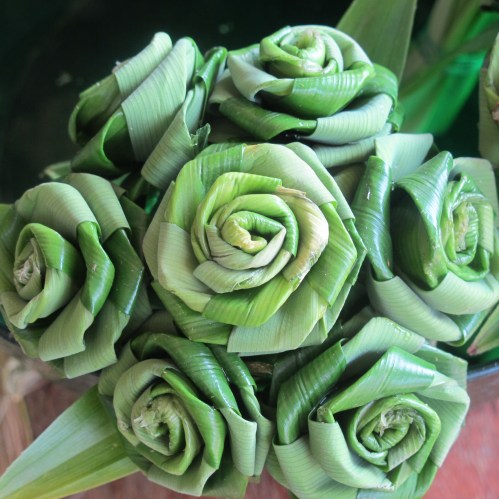
Roses made from Pandanus leaves for worship or air freshener
Thais use pandanus leaves to make rose flowers for worship or to use as an air freshener.
Please click the picture to see Pranee’s YouTube video and learn how to make rose flowers from pandan leaves.
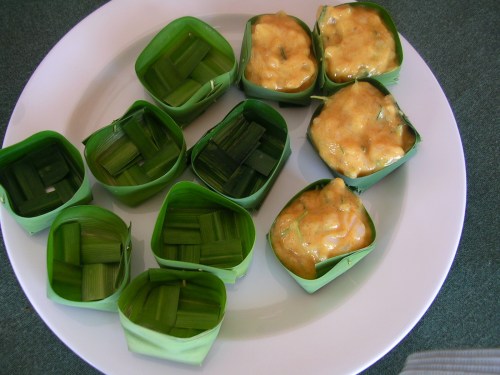
Pandanus leaf cups
Thais use Pandanus leaves to make decorative containers.
Adding green color extract from pandanus leaf to pearl tapioca pudding
Thais extract the green color from Pandanus to use as food coloring in Thai desserts.
This slideshow requires JavaScript.
A Perfect Thai Herbal Tea
My usual cup of tea is a light tea that I brew from a combination of pandanus leaf and jasmine tea. I grew up with this tea in a village where, in addition to the famous Thai Ice Tea, it seemed to be available everywhere, rain or shine, in everyone’s kitchen, or to welcome guests at a big gathering. For funerals or other large functions, this tea is brewed in large quantities, steeped in a pot that can serve up to 100 people. I love this tea both warm and cold. The fragrance and flavors of pandan leaves and jasmine tea seems to be a perfect pair – my favorite combination. Not to mention that my favorite hand lotion from Thailand is a combination of pandan leaf and jasmine—classic Thai aromatherapy. Please click here to learn more about pandan leaves and their medicinal benefits.
Pandan leaf is available fresh or frozen at Asian markets.
Jasmine Pandanus Tea
Cha Mali Toey Horm
ชามะลิใบเตย
Jasmine and pandanus is a classic fragrant infusion for Thai tea and desserts. This tea is very popular, but it is served mostly at large group functions such as funerals. In my village it is prepared in a large pot three feet in diameter by three feet tall, ready to serve tea for the whole village. It can be served with a snack, dinner or dessert. Serve plain without sugar. The tip is don’t make the tea too strong.
1 to 2 teaspoons loose jasmine tea
1 pandanus leaves, torn lengthwise into narrow strip and tied in a bun, or folded to fit the teapot
2 cups boiling water
Place jasmine tea and pandanus leaf in a teapot. Pour boiling water over all and let it steep for 5 minutes. Serve right away.
I have finally found my place to have oodles of noodles. And I have to thank to my friend Ron who introduced me to his favorite restaurant: Hue Ky Mi Gia, a Chinese Noodle House in in the Seattle International District’s Little Saigon. My first visit with Ron was in October 2010, then we went again in November to explore more noodle dishes right after the restaurant celebrated their first anniversary. Each visit we enjoyed the personal touch of a friendly conversation with the owners. That’s how we learned that they are now planning to open a new restaurant soon in another location.
Egg Noodle Dry Style at Hue Ky Mi Gia, Chinese Noodle House
I loved my first bowl of noodles there and knew that all of their dishes would be good. After a few visits and many oodles of noodles, I am sure that noodle fans will appreciate this review. The noodle dishes at Hue Ky Mi Gia are simply delicious and satisfying. The flavors are authentic and provide the same tastes that one could savor while traveling in Southeast Asia. The dishes are not prepared to Americans tastes, but according to Asian soup traditions, from preparing the broth to using real ingredients in each dish that truly represent the original dish. Tiu, the owner, told us that most dishes on the menu are prepared here the same way that they are made in their restaurant in Vietnam, which also operates under the same name “Hue Ky Mi Gia.” “We cook according to tradition,” Tiu says with pride. I love the fact that they use garlic chives to heighten the broth; the pungent mellow broth left behind a delicious sweet and sophisticated aroma. I love the use of fried garlic, crunchy pork rind, garlic chives and freshly sliced green onions and lettuce in the soup. The noodles come in two versions, soup style or dry style. I always end up choosing the dry style with the broth on the side.
My favorite noodle dish here is Egg Noodle Dry Style (pictured above). It reminds me so much of my hometown cookery of Mee Hang. Tiu said a family ancestor was originally from China and found a new home in Vietnam. Her family is Vietnamese but the restaurant features mainly Chinese noodle soups, recipes that have been passed on in families for generations. Perhaps now I could make a connection; Chinese descendants my hometown also came from the same part of China. When I eat her egg noodle dry style it feels like being in Phuket. Most of all, I am thankful to her for preserving the authenticity of the dish.
Without hesitation, I recommend Hue Ky Mi Gia to you highly. I judge the noodle restaurant by the broth and the noodle quality, and the rest is all about the authenticity. The price is very reasonable and the service is warm from this family owned business.
I recommend going to the restaurant before the lunch crowd. The setting is casual, so don’t worry if occasionally there are slurping sounds accompanying the meal.
Braised Duck Egg Noodle-The Signature Dish
Appetizers: Deep Fried Tofu, Honey Walnut Prawns, Crab Wonton with Tangy Sweet & SourSauce
I hope that you will help me celebrate spring with the Sunset Magazine April 2011 issue. Not only does the magazine bring a lot of bright and fresh ideas to us foodies and gardeners, it also features an article on Homeschooling: Cooking classes in the Seattle area. It is an honor to be in the article: For the next best thing to a trip to Thailand……a private class in Seattle. I hope you have a chance to check out the article and to learn how other local chefs/instructors are cooking. The magazine provides many lively ideas for your spring inspirations.
For me, spring is a warm welcome to local crops and a time to enjoy the fresh abundance from your gardens and local farms. My three favorite spring herbs and vegetables, the ones that excite me to get out into the garden and the kitchen, are garlic chive, lovage and asparagus.
If you are looking for new ideas for cooking with asparagus and lovage, the three easy and delicious recipes below will be ones that you can depend on countless times during the spring and summer. More recipes to celebrate spring are to come.
Mango season is early this year and mangoes are abundant at the supermarket. I hope you enjoy this recipe over the weekend and indulge yourself with the fresh tropical flavors. You may substitute wild shrimp or scallops for the crab.
Eat Southeast Asia. Traveling through Vietnam in 2009 as a culinary tour leader was an interesting and heartwarming experience. The local people are so eager to share their country’s wonderful cuisine and culture and spend time with you. You’re treated more like a welcome guest than a tourist. Back home in Phuket with my traveling companion, we rested and strolled on the beach and enjoyed the best food in Phuket, local seafood. We were lucky to be … Read More
Stir-fried Fresh Grated Coconut with Phuket Curry Paste and Chapoo Leaf
I uncovered a mystery about my grandmother’s cooking during my last trip to Phuket. I asked around about Phad Maprow Khub Kruang Gaeng, a stir-fried, fresh grated coconut with Phuket curry paste. During my childhood and adult life, I had never seen it cooked or eaten or even mentioned by anyone except members of my family. And it was only my grandmother who always asked me to assist her with it when I was young. I always wondered if it was served for health or economic reasons, or simply a food that the women of the house put on the table for their large extended family. It was never served alone, but with other main dishes and steamed jasmine rice.
I described the dish to my family to refresh their memories. My mom said that mostly we prepared it with a special kind of coconut (out of a thousand different kinds of coconuts, we used one that has an interesting texture with more like a virgin coconut oil). Then my sister-in-law, who was born in Phang Nga (80 kilometers away from Phuket), recalled eating the dish in her hometown. She said she had prepared it before, but not often. Luckily for me, she was very happy to prepare this for me while I took notes and photographs. She did it exactly the way I remember my grandmother preparing it. Thank you to my sister-in-law Tim, who helped me preserve the history of this lost recipe.
We shared the dish afterwards and more than anything else, more than its just being an interesting dish, it was a moment of rediscovery of the old time flavors of the south. We bonded again with foods. I hope that some of you will try this recipe so it won’t be lost forever.
Curry paste and fresh grated coconut in a mortar mix with pestle
First, Tim pounds the Phuket curry paste. When it became a fine paste she mixed in the freshly grated coconut and pounded to combine all of the ingredients. Then she stir-fried the mixture in a wok.
Coconut and turmeric—the colors and flavors of Southern Thailand
Stir-fried Fresh Grated Coconut Meat with Phuket Curry Paste
Phad Maprow Khub Kruang Gaeng Phuket
ผัดเนื้อมะพร้าวสดขูดกับเครื่องแกงภูเก็ต
Serves: 8 (as a side dish)
Yield: 2 cups
1/2 to 1 recipe Phuket Curry Paste (please click here for the recipe)2 cups freshly grated coconut meat, or frozen (thaw before cooking)1 tablespoon sugar, or to tasteSalt to taste32 chapoo or wild pepper leaves
Combine curry paste and grated coconut by hand or with a mortar and pestle. Place in a wok (without cooking oil) over medium heat, and stir constantly to allow the coconut and curry mix to become one texture. Continue stirring until the moisture in the coconut dries up and the curry paste is well-incorporated, about 5 to 8 minutes. It should be flaky with a little bit of moisture left, neither too dry nor too oily. Serve at room temperature with wild pepper leaves on the side.
Enjoy this as a tidbit by placing about 1 tablespoon on a wild pepper leaf, then wrapping it up so you can eat it in a single bite. Or simply mix it with warm jasmine rice and enjoy it as an accompaniment to curry and vegetable dishes.
Pranee’s Note:
This recipe has not been tested yet in my kitchen, so pay attention to spicy, salty and sweet when trying this recipe.
Cassava-Sweet Potato Pancake, a delicious Thai Dessert
I noticed recently that I have told my students to play with food in almost every class. I hope they have. After learning all the essential tips and techniques, the way to become a good cook is by experiencing the ingredients and having fun.
On the weekends, I clean up the fridge and cook creatively. This weekend I had fresh cassava and sweet potato leftover from my class. While I was holding them in my hand, I heard an echo of Rösti. Rösti is a fried, grated potato dish made in Switzerland. I made a quick decision and at almost the same time my hand reached to turn on the oven to 450°F. I will heat up my well-seasoned 8-inch cast iron pan and make this quick & easy Thai dessert, Rösti style.
Cooking with cassavas is not hard at all. After grating the cassava, Thai simply add enough sugar to sweeten to taste, and some salt to bridge the flavor; a bit of coconut milk can also be added to heighten the flavor. Then the mixture is steamed and grilled until it is cooked and translucent. But something new today that I haven’t tried before is adding grated sweet potato. Why not? It was perfect. I used about 2 parts cassava to 1 part sweet potato. The glutinous property of cassava helps the sweet potato hold up nicely, and the sweet potato gives a nice orange color and sweet compliment to the dish.
Learn something new while playing with food and discover a new excitement and a sweet reward to the lesson. Cassava-Sweet Potato Pancake makes a perfect snack or dessert with light herbal tea.
Cassava - Sweet Potato Pancake
Cassava – Sweet Potato Pancake
Khanom Man Sumpalang Oop
มันสำปะหลังมันเทศแพนเค้ก
Servings: 6-8
2 cups grated cassava, fresh or frozen (if fresh , use a 10-inch-long cassava and remove the skin before grating)
1 cup grated sweet potato, about 1 small or medium
1/2 cup palm sugar or brown sugar
1/2 teaspoon salt
6 tablespoons coconut milk
2 tablespoon rice flour, optional
1 tablespoon cooking oil
Preheat the oven to 450 F.Combine grated cassava, sweet potato, sugar, salt, coconut milk and rice flour in a large bowl; stir until well mixed.Heat 8-inch cast iron pan on medium heat and cover the entire surface with cooking oil. Pour cassava-sweet potato pancake mixture into the pan and spread out evenly. Place uncovered in the center of the oven and bake for 20 minutes, until the bottom is crusty brown. Then turn the oven to broil and place the pan right underneath. The top of the pancake should be 6 inches below the heat source. Remove when the top is brown, about 3 to 5 minutes. Keep an eye on it! A nice crusty brown is the most delicious part of the cake. Let the pancake rest for 5 to 10 minutes before serving. Serve warm or cold.
Image via Wikipedia
Pranee’s Thai Kitchen note:
Cassava is a root from the Cassava or Tapioca Plant(Manihot esculenta Crantz). It is a bushy plant that grows to about 3 meters tall. It is an annual plant with underground food-storing root-tubers. The tuber is large and long with a dark brown skin and pink underneath to protect and keep the white flesh moist. In Thailand, cassava is usually boiled or roasted and serve with sugar. It also is made into various sweets combined with grated coconut and/or coconut milk and sugar. Raw cassava is poisonous, but when cooked it became a delicious dessert. Pearl tapioca and tapioca starch and flour are all products of cassava roots.
I just returned home from three weeks of savoring Thailand. I still have a little jet lag and a lingering sense of all the flavors from Thailand. My first day in Bangkok was spent with my nieces and nephew who knew the best places to eat in Bangkok. First we intended to go to Thip Samai, but the restaurant was closed. Thip Samai is open evening hours from 5:30pm till 1:30 am, but we were not in luck. Next to Thip Samai is the Lueng Pha Phad Thai restaurant, which is very good. We savored every menu item and were very happy with our lunch—we all know that good Phad Thai can make one happy! We then continued exploring the neighborhood, and decided to walk up to the top of the Golden Mountain Temple, Phu Khao Thong. It was a very pleasant day, cool and sunny, and I spent a good time bonding with my two nieces and nephew.
For Thai foodies, I strongly recommend that when you visit Bangkok, plan to go for more than a week and include Lueng Pha or Thip Samai Phad Thai on your to-do list. They are in a great location with interesting tourist sites nearby such as: San Chao Pho Suea, Sao Chingcha, Kao San Road, and the Golden Mountain Temple.
After having a good time at the Golden Mountain Temple, we were able to enjoy our afternoon visiting San Chao Pho Suea and Khao San Road. Of course, in Bangkok there were plenty of street foods to enjoy. As we walked, we tasted all of the good looking snacks along the way. It was a perfect day and a wonderful first day to welcome myself back home. We joked that it was an “Eat Pray Love” kind of day.
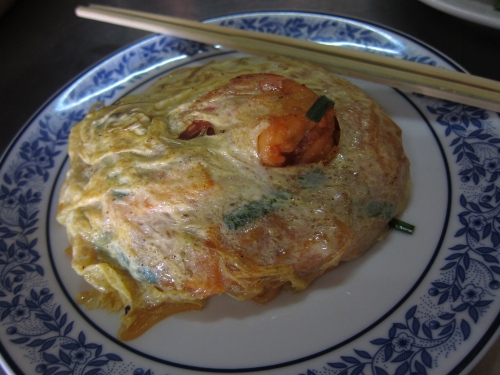
Please enjoy the video below showing how Phad Thai is prepared and wrapped in an omelette.
Omelette wrapped Phad Thai with Prawns
Phad Thai with Shrimp Fat, Fresh Shrimps and Egg
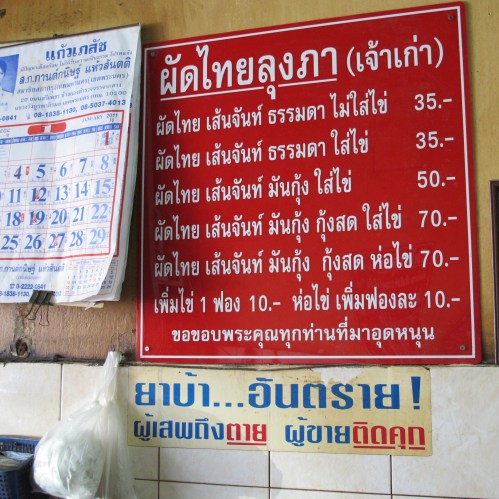
Phad Thai Lueng Pa (Jao Gao)
Phad Thai Regular without egg, 35 Baht ($1)
Phad Thai Regular with egg, 35 Baht
Phad Thai with Shrimp Fat and Egg, 50 Baht
Phad Thai with Shrimp Fat, Fresh Shrimp and Egg, 70 Baht
My love for mushrooms was born when I was in my teen years in my Thai village. The village is surrounded by mountains on one side and rice fields on the other. It was a perfect place for wild foods. I learned to gather wild vegetables such as bamboo shoots and green and ginger family rhizomes, and of course I picked some wild orchids for myself on the way home. There were also many rubber plantations. The dried falling branches from the rubber trees were a source of firewood and rubber tree mushrooms called Hed Kreng. They are a typical mushroom that grows only on the old rubber trees which cover most of the southern peninsula of Thailand.
In Seattle, I enjoy various mushrooms and we are in luck, there are plenty of fresh mushrooms from local mushroom growers.
If you are hesitant to cook this recipe for any reason, I want to reassure you that this dish is packed full with flavors and received a five star rating from an admirer on yelp.com.
Grilled Spicy Phuket Mushroom - Rubber Tree Mushroom
We used to gather Hed Kreng mushrooms from old rubber tree trunks and bring them home for my mom to make my childhood favorite, Hed Mok (Grilled Mushrooms). I recreated this recipe by using brown button mushrooms that have a flavor similar to Hed Kreng. While creating this recipe, I recalled my vivid memories of how my mom prepared them, and the taste and aroma that I used to savor. The intense flavors of basil, chili, and earthy mushrooms come alive. An important part of this recipe is to grill or bake the mushrooms over high heat to intensify the flavor. Also, use coconut cream rather than coconut milk so the mixture won’t get too wet.
1 teaspoon fish sauce1 tablespoon red curry paste½ teaspoon sea salt¼ cup coconut cream¼ cup shallots, sliced1 pound brown button mushrooms, brushed and sliced1 cup Thai purple basil leaf4 Thai chilies, halved4 parchment papers (12”X16”) or banana leaves
Preheat oven to 400°F.
In a large bowl, mix fish sauce, red curry paste, salt and coconut cream together until blended. Stir in shallots, mushrooms, and basil until mixed.
Divide mixture into four batches, and place each batch in the center of a piece of parchment paper. Fold the parchment paper over to make a bag; try to make it as flat as you can so the heat will distribute equally. Lay the bags of mushrooms on the baking sheet and bake for 20 minutes. Serve with warm steamed rice.
Pranee’s note: Oyster, button, or Portobello mushrooms would all be great for this recipe, or you can use a combination of them. Wrapping the mushroom mixture in banana leaves and then grilling them creates another depth of taste and aroma.
When I was growing up I was always fond of the pungent flavor of Phuket Muslim cooking—it must have been the aroma and the ritual that came with this food that I experienced in the diverse culture of Southern Thailand. The flavors and aromas were different and exciting compared to my family’s traditional Thai-Chinese cooking.
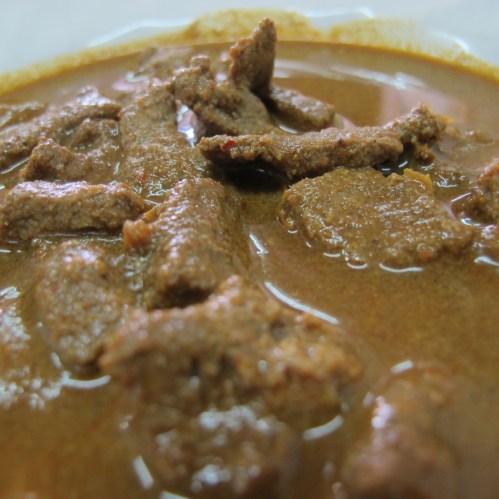
While visiting Phuket just two weeks ago, my dream came true when Varunee, my long time friend and a chef for my culinary tour, shared many of her family’s recipes with me. The one that I am sharing with you today is a Sa Curry with Buffalo Meat and Sa Spice Mix. This recipe is part of her family’s traditional cooking and has been passed on for many generations.
Varunee
Our meeting Point, Bangtao Mosque
I waited for Varunee at the Bangtao Mosque, a famous Phuket landmark, then followed her through the roads that snaked behind the mosque near the foot of the hill. My lesson on Aharn Muslim (Muslim food) began in her home with beautiful birds singing in the background.
Sa powder from Bangtao Village, Phuket
We started by making an aromatic Sa spice mix (Krueng Sa), the heart of the cuisine. The Thai name for cumin is Yee Rah, but Phuketians call it Sa. Varunee called cumin “Sa Lek” (meaning small Sa), and fennel is “Sa Yai” (big Sa). Cumin has a pungent hot Sa feeling (numbing) and the fennel is cooling and sweet after the numbing sensation. Thais use cumin to reduce the meaty smell. The rest of the spices are typical Southeast Asian ones such as turmeric, black pepper, coriander and dried chili. You may toast the spices before grinding to intensify their flavor.
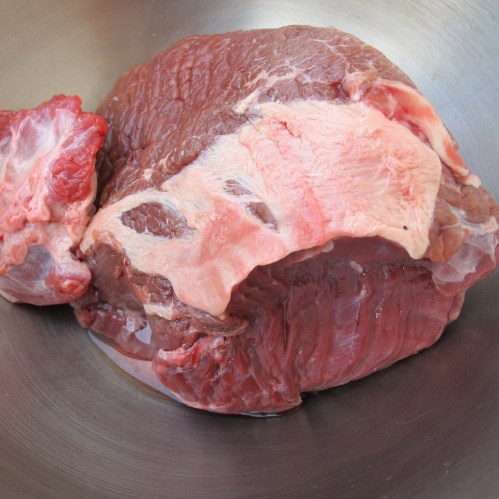
Water Buffalo Meat
Water Buffalo meat is a more common meat in the Southern part of Thailand, especially in Phuket. Sa Curry with Buffalo Meat with Sa Spices is a stand out among Phuket Thai Muslim dishes.
Heat canola oil in a medium pot over medium heat. Stir in shallots and garlic and cook until fragrant, about 2 minutes. Then add Sa spice mix and stir for 1 minute. Stir in buffalo meat and cook for 2 more minutes. Stir in coconut milk. Let cook until the meat is tender, about 10 minutes. Stir in palm sugar, salt and fish sauce. Serve with warm jasmine rice and a vegetable side dish.
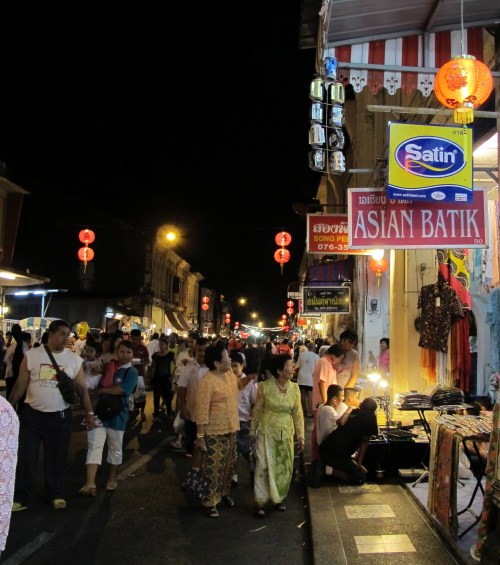
Last night I had a great experience traveling back to my old Phuket lifestyle with the first day of the 12th Annual Phuket Old Town Festival. We started the evening around 8pm. The first visit was to the Blue Elephant Restaurant and Cooking School. I had a chance to visit a cooking class at the restaurant which is located at the West end of the festival on Krabi Road. A block further down that road we crossed Yaowarat to get to Thalang Road where the festival takes place every year. The buildings on both sides are in the Sino-Portuguese style that was built in the 19th century.
Thalang Road, Old Phuket Festival 2011
We walked on Thalang Road where the street was full of activities related to foods and crafts that reflect the Phuket Paranakan Culture. We listened to live music. We found the Kopitiem Restaurant which has an entire menu of old Phuket foods. My niece and I ordered three dishes to share. Salad Kaek is a salad with peanut dressing with Phuket-Muslim cooking flavors. Phad Bee Htun is stir-fried rice noodles with Choy Sum and egg that looks and tastes like Singaporean Noodles. Another noodle dish that we had is Phad Mee Sua (stir-fried thin wheat noodle with seafood).
Kopitiem~Restaurant on Thalang Street, Phuket
The evening was complete when I savored the taste of home and a taste of culture. I took in the whole experience and felt my old sense of connection to our heritage. I was lost between places and tastes like a time traveler. One moment I was eating on the streets in Singapore and a few minutes later in Penang, Malaysia. But it all makes sense. Please see an excerpt below from the Thai Paranagan Association
“Baba-Paranakan culture is beautiful in both spirit and expression. It deeply blends several customs and traditions from Thai, Chinese, Malay and Western into Phuket culture, throughout many civilizations for hundreds years.”
Stir-fried Thin Rice Noodle with Choy Sum, Phad Bee Htun Phuket
Phad Bee Htun was my favorite noodle dish when I was growing up. I am proud to share this recipe with you. I hope that you can taste the flavor of Southeast Asia and the culture in that region of Paranakan.
Stir-fried Thin Rice Vermicelli with Pork and Choy Sum
Phad Bee Htun
Servings: 4 to 6
Preparation time: 15 minutes
Cooking time: 10 minutes
½ package Thai Kitchen thin rice noodles or any thin rice noodle
4 tablespoons cooking oil, or more as needed
2 eggs, lightly beaten
6 garlic cloves, minced
½ pound pork chop, sliced
1 tablespoon light soy sauce
1 tablespoon fish sauce
2 cups Choy Sum or Chinese kale
A dash dark soy sauce, optional
4 green onions, sliced diagonally, about ½ cup
4 lime wedges, to garnish
Soak noodles in hot water until softened, about 5 minutes; drain and set aside.
Heat 2 tablespoons canola oil in a wok. Beat two eggs in a bowl and then pour them into the wok. Tilt the wok so the egg will spread to make a thin omelet. Cook for one minute and flip once. Place on the cutting board and shred; set aside.
Heat wok on high heat and add 2 tablespoons canola oil and garlic. When garlic is yellow, stir in pork, light soy sauce, and fish sauce and cook until the pork is cooked. Stir in Choy Sum, cook for 30 seconds, and then stir in noodles. If desired, add a few drops of dark soy or molasses to get a tan color and a little sweet flavor. When the noodles are cooked, stir in green onion and shredded omelet; remove and serve with lime wedges and condiment below.
Condiment:
½ cup rice vinegar
½ teaspoon sugar
1 jalapeno pepper, sliced
Place rice vinegar, sugar and jalapeno pepper in a small bowl, stir.
I love visiting my family during Chinese New Year. It is a festive time, a time for family reunions, reconciliations, and a good time.
On February 1, the day before the New Year, my sister, sister-in-law and my mom were busy like we are every year, cleaning the house to sweep away ill-fortune. Then we spent most of the day shopping, cutting and stocking up the pantry.
It is our family tradition to hold Chinese New Year at my mom’s home, the main house where our ancestors lived long before. We place pictures of our ancestors on an altar and worship. On February 2 we woke up in the morning and were ready to cook our traditional dish feast at the same time the sun was rising, which is around 6:30am.
Ba Mee Phulket for stir-fried Phuket Hokkien Mee: symbol of longgevity
Slowly my nieces and nephews showed up and took part in helping, and the foods were placed on the table in front of the altar as we finished cooking.
Phuket Chinese New Year Feast
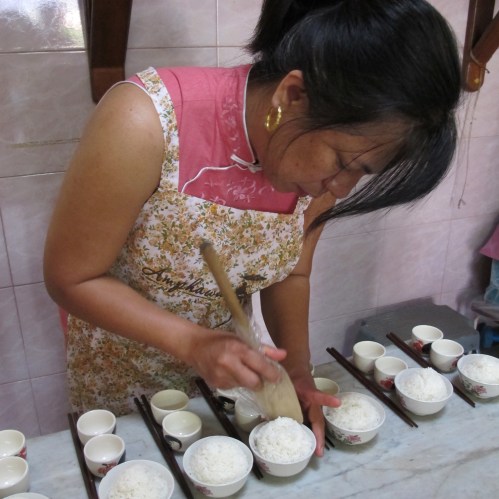
Steamed jasmine rice should have a tall peak for a symbol of wealth
I helped by shaping the steamed jasmine rice into tall peaks. The Thai word for this shape is Poon Pon which means plenty and fruitfulness. It is a symbol of wealth.
This slideshow requires JavaScript.
We offered two feasts, one inside our home in front of our ancestors (paternal side), and one in the back of our house for all departed relatives (maternal side) or people that once were related to us, and any wandering spirits. We invite them all to enjoy the feast.
At the end, we burn the gold paper and money paper to make it available for all the departed spirits.
At the end we had a feast together and while we were sharing the food, we catch up with each other and bond with food and the pride of our tradition.
I left Seattle on January 25 and was excited about visiting home during Chinese New Year. I wanted to record my family traditions and later all will explore food and culture in many provinces around Phuket. This trip is unlike other trips: my focus is on the Southern Cuisine. For 3 weeks my itinerary is planned to make the most with recipes from the villages. After spending 5 days in Bangkok and Amphawa experiencing the incredible regional foods, I am now with my family in Phuket. I arrived at my family home just around noon and my favorite foods are already waiting for me at the table.
This slideshow requires JavaScript.
My mom waited for me in her kitchen with my favorite foods: fish four-way, fried salted croaker and fried fresh turmeric croaker and then steamed Thai mackerel (Pla Tuu) in tamarind sauce and sour curry with croaker, fuzzy melon and taro stem. When I am at home in my mom’s kitchen I eat simple foods.
I have to give credit to my students for introducing me to the Iyara Thai Cuisine restaurant in Redmond. I took their recommendation seriously because the more I talked to them, the more I realized how serious they were about the Thai dining experience. They had mentioned their favorite Thai restaurants throughout America, including Pok Pok, and other renowned Thai restaurants, some of which are owned by people I have taken workshops with at various food conferences.
They said that Iyara may not be as good as the PokPok Thai restaurant in Portland in terms of the ambience, menu and creativity, but it is their favorite when it comes to authenticity close to their home in Redmond.
A week later, two Thai friends and I had lunch together at Iyara Thai Cuisine in Redmond. It is in a convenient location, with plenty of free parking spaces on the street. It has a casual setting; we started with soup, Suki nahm, and then used our fingers to enjoy the rest of our meal of Isaan food (the food from Northeastern Thailand).These were our choices from Iyara’s menu:
Suki nahm: Thai-style hot-pot in a bowl with crystal noodles, chicken and prawns, egg, napa cabbage, and green onion with a chili-bean curd sukiyaki sauce. $10
Sai grog kra prow: grilled homemade pork and spicy basil Thai-style sausage. $7
Muu ping: grilled pork sirloin skewer marinated in garlic, coconut milk, fish sauce and sugar. $7
Som tum and kai todd: deep-fried marinated half Cornish game hen, crispy shallots with a small green papaya salad and sticky rice. $11
Iyara is a great place for you if you love Som Tum (shredded green papaya salad). It is offered with three options. The standard one has lots of crushed peanuts, salted crab and Thai anchovy sauce.
There are many more dishes that I would like to return and check out. All are a rustic style or street foods of Thailand; these are the owner’s new menu items and a concept that they are working on. There are also plenty of standard Thai dishes if you have friends who may not be as adventurous as you are.
For all of you that love to explore new flavors, please check out Iyara Thai Cuisine. I hope that one day Thai foods in America will be as good as in Thailand, then we won’t need to travel to Thailand or Portland to savor the dishes.
Kin Hai Aroy: Bon Appétit
Iyara Thai Cuisine16421 Cleveland St., #ERedmond, WA 98052(425) 885-3043
Pranee’s Thai Restaurant Review is a fun read to help students enjoy the Thai dining experience. I believe that eating Thai foods is a part of learning about Thai food and the Thai culture as well.
I amuse myself in the kitchen every year by discovering new ways to use Kabocha, my favorite squash. Seeing snow on the ground meant no going out today, so I decided to get into the kitchen to play with the Kabocha puree that I made the other day.
I was thinking of a decadent dessert that did not require any cooking on the stovetop. I had classic cream cheese in the fridge and many basic staples in my kitchen, so I started from there. After finding the right ratio between the puree and the cream cheese, I added enough sugar to make a good balance. Then I added spiced rum, one tablespoon at a time. Spiced rum is a Caribbean rum that has an amazing blend of spices, caramel and other natural flavors. I may get a little carried away in my recipe below with the Sailor Jerry Spiced Rum, but when it comes to rum, the amount to add is very personal. At this point, there was still something missing from the recipe, and when I went through my spice rack, the nutmeg was yelling at me. Adding it did the trick—nothing more or less was needed.
While watching the snow melting away, my hand was busy spooning away this decadent dessert. It is pumpkin-creamy, sweet, with rummy-coconut and aromatic nutmeg. Just a perfect way to pamper oneself with comfort—a decadent dessert. Winter will be here for a while.
Pranee’s Spiced Rum Kabocha Mousse with Coconut Cream
Spiced Rum Kabocha Mousse
Serves: 6
8 ounces classic cream cheese
1½ cups Kabocha puree (see note)
⅓ cup evaporated cane sugar
¼ cup Sailor Jerry Spiced Rum, divided
¼ to 1 teaspoon nutmeg
6 tablespoons coconut cream (the thick top layer from a can of coconut milk)
6 Kaffir lime leaves or mint sprigs to garnish
Use an electric mixer to blend cream cheese in a large bowl until soft, about 30 seconds. Add Kabocha squash puree, sugar, 3 tablespoons rum, and nutmeg; blend on medium speed until well-blended and smooth, about 1 minute. Chill mixture in the fridge at least 3 hours before serving.
To make spiced rum coconut cream topping, whisk coconut cream and 1 tablespoon rum in a small bowl for 10 seconds. Set aside in the fridge.
To serve, place equal amounts of the mousse mixture into 6 glasses. Garnish the top with coconut cream and lime leaves or mint sprigs.
Pranee’s Tip on Making Kabocha Puree
A medium size Kabocha squash will yield 3 to 4 cups Kabocha puree. To prepare Kabocha pumpkin puree for dumplings or pie, simply remove the skin and seeds and then cut into 1-inch chunks. Steam about 15 minutes, or until tender. Use a ricer to make a fine mash.





















 iLoveThaiCooking & Pranee's Thai Kitchen








 Pranee's Thai Kitchen