Feeds:
Posts
Comments

Archive for the ‘Thai Recipe for Kid’ Category

A Stir-Fry from the Palm of My Hand

When I was growing up, in the mornings my grandma would often drop a few coins in the palm of my hand and tell me to go purchase Tao Gua (Tofu), Tao Nge (Mung Bean Sprout), and Guiy Chai (garlic chives) from a mobile market—a pick up truck filled with ingredients. I would return with a bag full of three pieces of tofu cake, mung bean sprouts, and a bunch of garlic chives. Together they made the cheapest and best stir-fry and we ate it about once a week. We would usually stir-fry them later for lunch; if it were for dinner, my grandma would soak the bean sprouts in cold water to keep them fresh in the tropical climate. This was back before we had a refrigerator. When I was at the Asian Market yesterday, I purchased these three ingredients in almost the same quantities as I did then and it came up to $ 2.75, only a few dollars and some coins.

Thais call bean sprouts Thua Ngok (ถั่วงอก), but in my hometown of Phuket we call them Tau Nge, a  Phuket Hokkien word. Hokkien is a Chinese dialect spoken by many Chinese throughout Southeast Asia. Tauge, is the word for mung bean sprouts in Chinese Hokkien and in Indonesian and Malaysian languages as well. Perhaps not surprisingly, the Dutch also use taugé for bean sprouts, probably a holdover from the time when they occupied Indonesia.

Mung bean sprouts, tofu and garlic chives are long-time favorite vegetables of Chinese Hokkien cuisine and culture, even though bean sprouts are actually native to Bangladesh.

Firm Tofu, Mung Bean Sprouts and Garlic Chives

Green onions or regular chives are usually a good substitute for garlic chives, but in this case I strongly recommend that you use garlic chives in order to maintain the flavors and authenticity of this dish. Garlic chives are available all year round at the Asian Market and it is a perennial herb in the Northwest. You may find other recipes where you will want to use them as well.

The other day when I was dining with a friend, I was so impressed to find a similar dish served at the Tamarind Tree Restaurant in Seattle. Their dish was almost identical in flavor, but instead of tofu, it used shitake mushrooms. I hope when you are at the Tamarind Tree Restaurant, you will please try Nấm xào giá ~ Bean sprout mushroom.

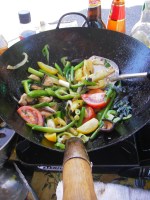
Phuket Stir-fried Mung Bean Sprouts and Tofu with Garlic Chives

Stir-fried Mung Bean Sprouts and Tofu with Garlic Chives

Phad Tao Gua Tao Nge Phuket

ผัดถั่วงอกกับเต้าหู้ภูเก็ต

5 minutes total preparation and cooking time, 3 ingredients and less than $3. It is my all time favorite stir-fry.

Serves: 4
 
3 tablespoons canola oil, divided
1 (16 ounce) package  firm tofu, cut into large pieces about 1/4-inch thick
1 cup garlic chives cut into 1-inch lengths (about 15 garlic chives),
6 cups mung bean sproutss, washed with cold water and strained
2 tablespoons soy sauce, or 1 tablespoon soy sauce plus one tablespoon oyster sauce
1 teaspoon sugar

Heat the wok on high heat, then test it with a few drops of water. If the water evaporates in two seconds, pour in 1 tablespoon canola oil. Cover the surface with oil by using a spatula or other utensil, then spread out tofu in the wok and fry on medium heat until they firm up and turn a golden color. This will take 1 to 2 minutes. Transfer to a plate.

Heat the same wok on high heat and add the remaining canola oil and the garlic; stir until golden, about 10 seconds. Stir in bean sprouts and cook on high heat for 45 seconds to 1 minute, stirring constantly. It will sound really interesting and steaming. It is the moisture from the bean sprouts creating the sounds against the hot wok. You will see steam, but not smoke. Then stir in garlic chives to cook lightly, about 45 seconds. Stir in tofu, soy sauce and sugar. Mix together, then serve promptly with hot steamed jasmine rice.

Pranee’s note:

The bean sprouts should not cook longer than 2 minutes, or they will lost their crunch. This dish is very simple and the flavors depend on having the freshest bean sprouts, tofu and chives—and that is enough! I love this dish because it has a clean and simple flavor and texture. The moisture released from the bean sprouts makes a sauce. If that doesn’t happen, add one or two tablespoons of water.

Another variation of this dish that you might see in Thailand substitutes calamari, prawns or pig blood cake for the tofu.

© 2011 Pranee Khruasanit Halvorsen 
I Love Thai cooking
Pranee teaches Thai Cooking classes in the Seattle area. 
Her website is: I Love Thai cooking.com .


Read Full Post »

Celebrating New Year with Thai Sticky Rice and Alms Giving

Alms Giving with Jasmine Rice or Sticky Rice

Yesterday, April 17, 2011, I celebrated Thai New Year’s Day~ Songkran~ with Thai and American friends at the Songkran Festival at the Washington Buddhavanaram (Buddhist temple in Auburn, Washington ) It was so much fun, Sanuk.

First, we started with the alms-giving ritual. We gave offerings to the monks of steamed jasmine rice and steamed sticky rice, and for the first time I offered Chicken Biryani Rice (Kao Mok Gai) instead of the two other kinds of cooked rice.

Som Tum ~ Green Papaya Salad

Outside in the yard there were tents with prepared street foods of Thailand, just like at festivals in Thai villages. I sampled almost everything including grilled Thai sausage (Sai Grok Isan), sticky rice (Khoa Neow), green papaya salad (Som Tum), and noodle soup (Kuey Tiow Nahm), to name a few.

A majority of the guests at the festival were from Laos, northeastern Thailand and Cambodia. Steamed Sticky Rice (Khao Neow) is an important part of the day at many Thai gatherings, and Khao Neow and Som Tum are well-loved dishes for Thais who live abroad. As I have mentioned before, these two dishes are a good cure for homesickness for Thais.

Thai Chili Dip ~ Nam Prik

We walked around, enjoying the sunny day and buying street food like Thai Chili Dip (Nam Prik) to take home. I got three different versions of this red-hot chili paste to season my steamed jasmine rice: Red Eye Chili Dip (Nam Prik Ta Daeng), Tilapia Chili Dip (Nam Prik Pla Nill) and Crunchy Pork Chili Dip (Nam Prik Moo Grob). Now these three Nam Prik are in my freezer for days when spicy hot food will comfort my mood.

Bathing and Placing Gold Leaves On the Buddha Image

In Burma, Laos, Thailand, Southern China and Cambodia, a part of celebrating Solar New Year is bathing and cleaning an image of Buddha. I celebrated this ritual here in Washington with many people from these countries.

Flags on Sand Mount

Building a sand hillock and decorating it with flags is also a common practice. 

Dancing to the Laotian Music

Eating a lot of sticky rice and dancing  to Laotian live music was a perfect “sanuk” day to welcome the new year.


Steamed Sticky rice

Khao Neow Nueng

ข้าวเหนียวหนึ่ง

Serves 6 to 8

Sticky rice is a long-grain rice with a sticky and soft texture. There are several names for sticky rice, including sweet rice and glutinous rice. Sticky rice is ideal for desserts as well as for serving with Northeastern dishes such Som Tum (green papaya salad) and Laab Neua (beef mint salad). There are also main dishes on my blog that are great to serve with steamed sticky rice, such as Green Papaya Salad with Smoked SalmonGrilled Fish Sauce Chicken Wings (Peek Gai Nam Pla Yang), and Green Papaya Salad with Salted Crab and Rice Noodle (Som Tum Sua). This last recipe includes a video of my sister-in-law preparing the salad.

After 30 minutes, flip the sticky rice over

I hope you have a chance to learn how to cook steamed sticky rice. You may use a double boiler/steamer or purchase a bamboo steamer.

2 cups sticky rice

Cover sticky rice with room temperature water at least 3 inches above the rice. Let rice sit for 2 hours or overnight, then drain off any excess water.

Steam sticky rice in a steamer with a lid over high heat for about 30 minutes, or until the rice is soft. Flip the rice over so that the sticky rice on the top will go on the bottom and steam with the lid on for 5 more minutes. You can keep the rice warm for a few more minutes with the steamer on simmer, or remove it and keep it in a thermal-controlled container.

The steamed sticky rice is ready to serve with main dishes or to use in a dessert that requires steamed sticky rice.

© 2011 Pranee Khruasanit Halvorsen 
I Love Thai cooking
 Pranee teaches Thai Cooking classes in the Seattle area. 
Her website is: I Love Thai cooking.com .

Read Full Post »

泼水节

Image via Wikipedia

Sanuk Mai? This is a question Thais ask each other when they share experiences of any activities you do in life.

สนุก-Sanuk means to have a good time, to enjoy or to get pleasure and joy from anything we do. Tiew hai sanuk means travel and have a good time. Tum Ngan hai snuk, is to work and to enjoy working. When making choices in our life,“Sanuk” is a factor in our decision making: some pleasure has to be combined with whatever we do.  And when life is lacking Sanuk, then let’s plan it. This week in Seattle, I am going to do something I actually planned a month ahead to “Sanuk” with friends and that is to celebrate Thai New Year’s Day, or Songkran, with friends at the Washington Buddhavanaram.

Songkran is Thai New Year’s Day. It is is a national holiday in Thailand celebrated on April 13th. It is also a New Year’s Day for Lao, Burma and Cambodia. The Thai New Year is a solar new year, and not to be confused with the Chinese New Year, which is a lunar new year. In Seattle, the Thai community celebrates the holiday on Sundays so that locals can take time off on the weekend to celebrate. Please click here to see how these countries celebrate: Cambodia, Laos, Mon-Burmese and Thai. Many westerners know this celebration in Southeast Asia as the Water Festival.

Songkran is such a special day that we can’t complete our Sanuk without sharing food. Everyone brings food to share, which is set out on the table, then a bell is rung to signal lunch time. Sticky rice is well-loved, and the most popular dish to share.

Thai Community Potluck in Washington

I decided to do Kao Mok Gai (Phuket Baryani Rice) as a main dish, and sticky rice in bamboo tubes (my version with parchment paper in the oven) for a dessert. I chose these recipes because I wanted to do something that was easy to cook in large quantities and also something that is a traditional dish and a crown pleasure. Kao Mok Gai is a special dish from Phuket for a special event. In Cambodia,sticky rice in a bamboo tube, known as Kralan, is a traditional dish to be eaten on New Year’s Day.  Here are links to recipes for these dishes that are already available on this blog: Kao Mok Gai and Kao Lam.

Phuket Chicken Baryani Rice--Kao Mok Gai Phuket

Thai Kao Lam, Sticky Rice in Bambo Tube

I hope to get some more recipe ideas at this event as well as some photos to share with you.

May I wish you a Happy Thai New Year and have a lot of Sanuk in the coming year.

สวัสดีปีใหม่ค่ะ

Pranee

Read Full Post »

Playing with Food: Cassava

Cassava-Sweet Potato Pancake, a delicious Thai Dessert

I noticed recently that I have told my students to play with food in almost every class. I hope they have. After learning all the essential tips and techniques, the way to become a good cook is by experiencing the ingredients and having fun.

On the weekends, I clean up the fridge and cook creatively.  This weekend I had fresh cassava and sweet potato leftover from my class. While I was holding them in my hand, I heard an echo of Rösti. Rösti is a fried, grated potato dish made in Switzerland. I made a quick decision and at almost the same time my hand reached to turn on the oven to 450°F. I will heat up my well-seasoned 8-inch cast iron pan and make this quick & easy Thai dessert, Rösti style.

Cooking with cassavas is not hard at all. After grating the cassava, Thai simply add enough sugar to sweeten to taste, and some salt to bridge the flavor; a bit of coconut milk can also be added to heighten the flavor. Then the mixture is steamed and grilled until it is cooked and translucent. But something new today that I haven’t tried before is adding grated sweet potato. Why not? It was perfect. I used about 2 parts cassava to 1 part sweet potato. The glutinous property of cassava helps the sweet potato hold up nicely, and the sweet potato gives a nice orange color and sweet compliment to the dish.

Learn something new while playing with food and discover a new excitement and a sweet reward to the lesson. Cassava-Sweet Potato Pancake makes a perfect snack or dessert with light herbal tea.

Cassava - Sweet Potato Pancake

Cassava – Sweet Potato Pancake

Khanom Man Sumpalang Oop

มันสำปะหลังมันเทศแพนเค้ก

Servings: 6-8

2 cups grated cassava, fresh or frozen (if fresh , use a 10-inch-long cassava and remove the skin before grating)
1 cup grated sweet potato, about 1 small or medium
1/2 cup palm sugar or brown sugar
1/2 teaspoon salt
6 tablespoons coconut milk
2 tablespoon rice flour, optional
1 tablespoon cooking oil
 
Preheat the oven to 450 F.
 
Combine grated cassava, sweet potato, sugar, salt, coconut milk and rice flour in a large bowl; stir until well mixed.
 
Heat 8-inch cast iron pan on medium heat and cover the entire surface with cooking oil. Pour cassava-sweet potato pancake mixture into the pan and spread out evenly. Place uncovered in the center of the oven and bake for 20 minutes, until the bottom is crusty brown. Then turn the oven to broil and place the pan right underneath. The top of the pancake should be 6 inches below the heat source. Remove when the top is brown, about 3 to 5 minutes. Keep an eye on it! A nice crusty brown is the most delicious part of the cake. Let the pancake rest for 5 to 10 minutes before serving. Serve warm or cold.
Cassava (yuca) roots, the Taínos' main crop

Image via Wikipedia

Pranee’s Thai Kitchen note:

Cassava is a root from the Cassava or Tapioca Plant (Manihot esculenta Crantz). It is a bushy plant that grows to about 3 meters tall. It is an annual plant with underground food-storing root-tubers. The tuber is large and long with a dark brown skin and pink underneath to protect and keep the white flesh moist. In Thailand, cassava is usually boiled or roasted and serve with sugar. It also is made into various sweets combined with grated coconut and/or coconut milk and sugar. Raw cassava is poisonous, but when cooked it became a delicious dessert.  Pearl tapioca and tapioca starch and flour are all products of cassava roots.

© 2011 Pranee Khruasanit Halvorsen

I Love Thai cooking

Pranee teaches Thai Cooking classes in the Seattle area.

Her website is: I Love Thai cooking.com .


Read Full Post »

You say Pummelo, I say Pomelo, and Thais say ”Som Oh

One of my goals for the New Year is for my blog readers to learn light and easy Thai cooking and some new exotic ingredients. Thai cuisine has been famous for many centuries and I want people to have a more in-depth knowledge of it.

Pomelo, Thai Grapefruit - The Flower Market in Bangkok

One way that I hope I can deepen your culinary skills is simply by showing you some of the techniques that Thais use to handle their ingredients, methods learned from our families, our communities and our ancestors.  I hope the instructions in my video demonstration will help you to open your pomelo.

Pomelos tastes so great by themselves, you don’t need to cook them. I created this simple fun recipe on New Year’s Eve to provide a zing to welcome the year 2011.

Best wishes to you all.

I love pomelo. It is in season around New Year’s time, but you can enjoy it every week to give a zing to your life. There are so many way to create a wow moment with pomelo. My favorite recipe is from Phuket, Thailand, and is made with shrimp, tamarind sauce and caramelized shallots. It is a great dish for teaching my students about the layer of flavors and textures that can be found in a Thai salad.

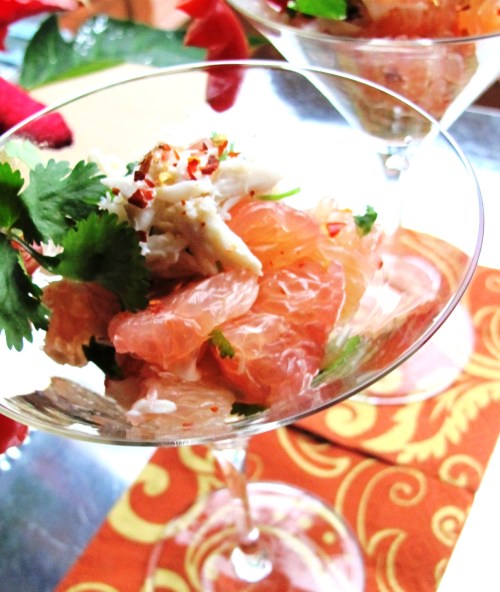
Yum Som Oh, Pomelo Salad with Crab

For my blog visitors, I think learning to open a pomelo is challenge enough, so I am keeping this recipe simple (which is also how I cooked during this past week). This recipe is prepared like a crab or shrimp cocktail rather than the traditional pomelo salad from Thailand.

Pomelo Salad with Crab

Yum Som Oh Khup Phu

ยำส้มโอกับปู

Serves: 6

1 pomelo (prepared as shown in the video above), about 2 cups
1 shallot, peeled and sliced
1/4 cup chopped cilantro, plus 6 cilantro sprigs for garnish
1/2 cup cooked crab meat or cooked shrimp
1 tablespoon palm sugar or brown sugar
1 tablespoon tamarind concentrate
2 tablespoons lime juice, about 1 lime
1 tablespoon fish sauce, or more as needed
1/8 teaspoon chili powder

Place pomelo, shallot, cilantro and crab in a medium size salad bowl. Whisk sugar, tamarind concentrate, lime juice, fish sauce and chili powder until well-blended, then pour over pomelo. Fold all of the ingredients together gently with a salad spoon and serve in a nice glass. Serve at room temperature or chill. Garnish with cilantro sprigs.

Vegetarian option:

Omit crab and use a few pinches of sea salt instead of fish sauce.

© 2011  Pranee Khruasanit Halvorsen
I Love Thai cooking
Pranee teaches Thai Cooking classes in the Seattle area.
Her website is: I Love Thai cooking.com .
 
Related articles

Read Full Post »

Pranee’s Curried Crab Filo for Holiday Entertaining

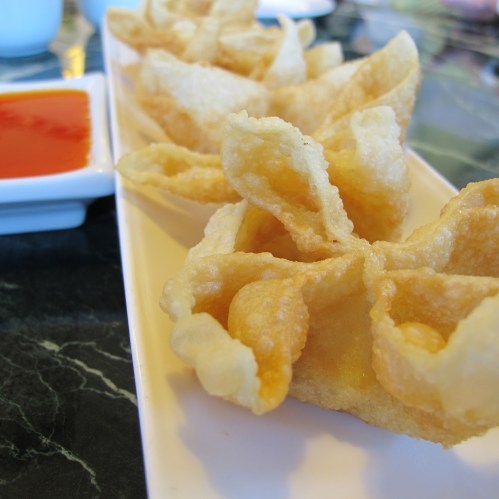
It is not a fusion and there is no confusion, they’re just for fun. Enjoy crab rangoon for a festive time.

Crab Wonton from a Chinese Restaurant

I first tasted crab wonton, or crab rangoon, in a Thai restaurant many years ago. It tasted great, but I was confused because it was not related to any Thai food in Thailand, which left me wondering about its origin. When my assistant suggested that my Thai green chili jam would be great with crab wonton, I started exploring this dish and came up with the following fun version.

I rarely do deep-frying at home, so using filo dough was the way to go for me. It provides the texture of a fried wonton, but it is a crunch with less guilt. I always heighten the flavor of a crab dish with curry powder and green onion, but this time I used pineapple chunks as well to add an interesting sweet experience to a savory dish.

Last week I attended a Girls’ Holiday Appetizer Party. As we all surrounded a dining table filled with many kinds of appetizers, I was happy to see everyone’s expressions when they tried the Curried Crab Filo. It is amazing what flavors can be experienced in just one bite!

I like to make the stuffing the day before and chill it in the refrigerator. It is a good idea to thaw your filo dough then as well. Both will be ready for you the next day. The rest is easy. Just preheat the oven, wrap and bake.

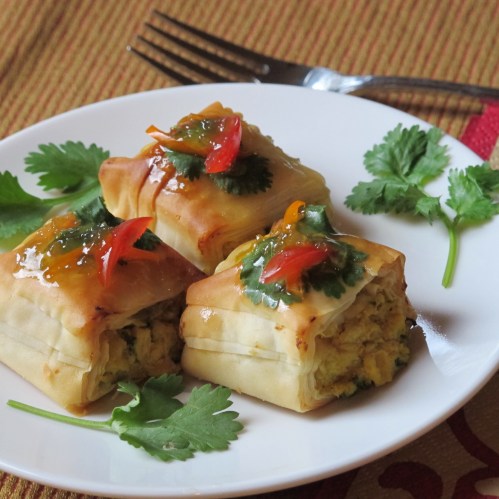
Curried Crab Filo at Home Party

Curried Crab Filo with Thai Lime-Green Chili Jam

Yield: 36 pieces

Preparation Time: 20 minutes

Baking time: 10 minutes

1 cup cream cheese
1 cup chopped fresh or canned pineapple, squeeze out excess liquid to get about ⅔ cup of pineapple
⅓ cup sliced green onions (about 5 green onions)
4 teaspoons Madras curry powder
A dash of Thai chili powder
8-ounces crab meat (about 1 cup), squeezed lightly to drain out excess water
9 (17 by 12-inch) sheets filo dough, thawed if frozen
½ cup cooking oil
3 tablespoons Thai Lime-Green Chili Jam (see blog recipe)
36 cilantro leaves
36 sliced red peppers or red loganberries

Preheat oven to 375°F.

To make the filling, combine cream cheese, pineapple, green onion, Madras curry powder, and chili powder in a medium size bowl; mix well. Gently fold in crabmeat until combined. Yield: about 2 cups filling.

Take one filo sheet from the stack and lay it out on a work surface. Brush well with oil to cover the entire surface. Lay another layer on top and brush with oil again. Add a third layer and brush with oil again.

With the length facing you, place one-third of the cream cheese filling along the edge lengthwise from left to right to make a line of filling 1 inch by 17 inches. Fold the edge forward to make a roll. As you continue to roll, brush the dry surface of filo dough with oil. The finished roll should be about 1 inch in diameter. Using a knife, cut the roll into 12 pieces and place them on a greased baking sheet.

Repeat these steps to make two more rolls, for a total of 36 pieces. Place on the same baking sheet and bake until golden, about 10 minutes.

Transfer to a platter and place a ¼ teaspoon Thai lime-green chili jam on each curried crab filo and garnish with cilantro leaves and sliced red pepper or loganberries.

Enjoy warm or at room temperature.

© 2010 Pranee Khruasanit Halvorsen
I Love Thai cooking
Pranee teaches Thai Cooking class in Seattle areas, her website is: I Love Thai cooking.com

Read Full Post »

Sticky Rice in a Bamboo Tube, Kao Lam

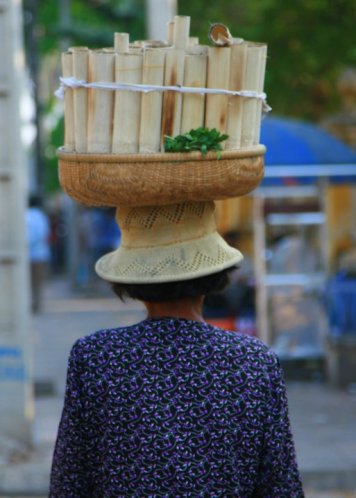
I have fond memories of sticky rice in a bamboo tube—it looks so cool! At every festival in my village when I was growing up, there was a man who made and sold this Kao Lam. We would eat some at the festival then bring home a few for family members who couldn’t go. It is a perfect take-home food, since it is already packaged in a bamboo tube.

Sticky Rice in a Bamboo Tube, Cambodia

The sticky rice is cooked in a segment of bamboo, the kind that has a thin wall so the heat can penetrate to cook the rice inside the tube. After it is filled with the sticky rice ingredients, the bamboo is plugged with a piece of coconut husk wrapped with banana leaf to keep in the steam for cooking the rice. Then the bamboo tubes are placed over charcoal. When it is done, the outer skin of bamboo is removed and a thin wall left behind to protect the rice inside. All Southeast Asian countries have some version of this, and they are all cooked in a similar way. The photo below is from Cambodia. In Thailand this dish is called Kao Lam; in Malaysia it’s Lemang.

Thai Sticky Rice in Bamboo Sticks in Cambodia

If you like sticky rice with mango, you will like Kao Lam, too. I love the fact that when you peel the bamboo away (see photo below), the powdery fiber in the bamboo tube leaves a sheen. The rice comes out shaped like a stick and looks like it was wrapped in edible paper. The vendor in my village usually made three varieties: white sticky rice, black sticky rice, and white sticky rice with black beans.

How to open the bamboo tube

In America you can find cooked sticky rice that comes straight from Thailand in the frozen food section in Asian markets. But I would rather you try my sticky rice recipe below. I wrap it up in parchment paper, roll it into a cylinder, and bake it. It is delicious, has a very nice texture, and is as satisfying as the original.

During the summer of 2010, I taught Grilled Sticky Rice with Black Bean and Banana Stuffing in a Banana Leaf (Kao Neow Mad) in my Thai Grill class. Organizing my photos from my recent trip to Cambodia led me to this project, a Kao Lam version baked in the oven. It is not easy to cook sticky rice in a bamboo tube—only a few experts from each Thai village know how. Last August I created this adaptation, wrapping and rolling the sticky rice in pieces of parchment paper and then baking them. The results were good. It was easy, and the flavor and texture were satisfying. Then I made a lot of them in small packages and even put some in the freezer. I microwave them or reheat them in the oven and eat them for a protein snack before teaching my classes. In Thailand, most farmers eat sticky rice before working in the rice field.

Baked Sticky Rice and Black Bean Wrapped in Banana Leaf

Kao Neow Yang

Serveings: 8

2 cups Thai sticky rice, soaked in water for 3 hours or overnight, then drained (see note)
¾ cup coconut milk
¼ cup water
2 tablespoons granulated sugar, optional
1 teaspoon salt
1 cup canned black beans, drained
8 (8×8) inch pieces of banana leaves or parchment paper

Preheat oven to 350°F.

Stir sticky rice, coconut milk, water, sugar and salt in a large pan over medium heat. Stir until all coconut milk is absorbed. Stir in black beans and fold gently to mix.

Put equal amounts of the sticky rice mixture onto 8 banana leaves. Form the rice into a cylinder about 6″ long and lay it in the center of the leaf so that you have about 1 inch left on either end. Fold the banana leaf in half around the rice, then roll it around the cylinder; fold in both ends and secure them with a toothpick, poking down and then up, or you can twist the ends and tie them. When you are done, each bundle will make a round tube about 6 inches long and 1 to 1 1/2 inches in diameter. Grill for 5 minutes on each side until the sticky rice is translucent and cooked, or bake in the oven for 10 minutes.

Pranee’s note:

In Thailand, recipes generally use one of two types of rice: jasmine rice or Thai sticky rice. The starch in rice is made up of two components, amylose and amylopectin. Jasmine rice has more amylose than amylopectin, giving it a puffy appearance, whereas Thai sticky rice has more amylopectin than amylose, creating its sticky texture. Both white and purple Thai sticky rice are long-grain rices with a firm grain and become sticky when cooked. They are tropical rices, and different from Japanese, Chinese or Mediterranean (Arborio and Valencia) rices, which have a medium or short grain and grow in temperate climates.

© 2010 Pranee Khruasanit Halvorsen
I Love Thai cooking
Pranee teaches Thai Cooking class in Seattle areas, her website is: I Love Thai cooking.com


Outer layer of bamboo tube is removed


Read Full Post »

Rice Soup for breakfast

My grandmother loved rice soup for breakfast. And I can recall a memory– I often joined her savoring this soul food before our day began. To this day when I visit Thailand, in my village, I still love having this rice soup but instead of our kitchen, I join local at the breakfast stall.

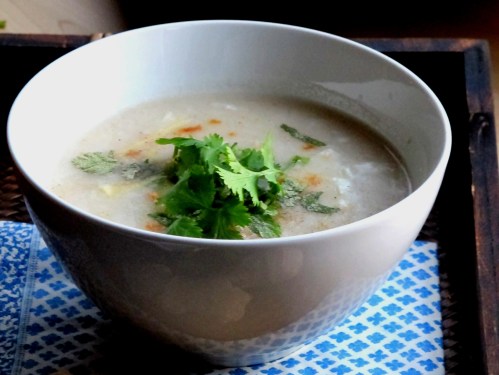
Rice Soup for Breakfast

I like rice soup in another occasion too, in the winter for lunch or dinner, as it is a real comfort food for every occasion and nothing is as good and satisfying as rice soup on a cold day and when one’s body needs gentle food. Just like American enjoys the chicken noodle soup.

Kao Tom, Thai Rice Soup for Breakfast

It is easy to make with either from scratch or use leftover rice. But when one has an extra time, I would recommend to make the rice soup from scratch, please follow the recipe below to make rice porridge. It has a nice softer texture. I never think rice soup as a pot luck dish, however my student once told me that she brought to her office potluck party and it was a hit.

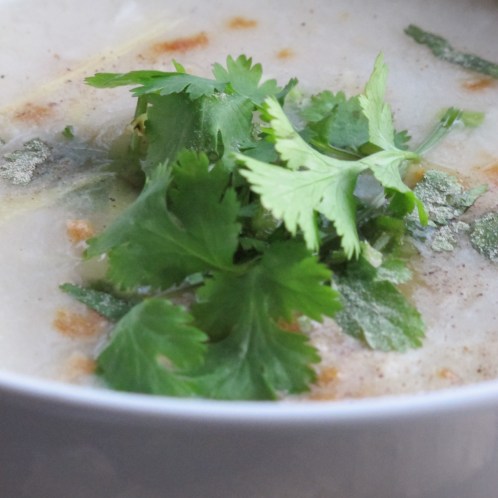
Thai Rice Soup with Chicken & Egg

Kao Tom Gai Sai Kai

Serves: 1 about 2 cups

Cooking Time: 5 to 8 minutes

1 ½ tablespoons canola oil
1 tablespoon minced garlic, about from 3 cloves
¼ cup ground chicken or pork (from chicken thigh or breast)
½ teaspoon salt
2 teaspoons soy sauce
1 ½ cups chicken broth
1 cup steamed jasmine rice or rice porridge (see note)
1 egg
1 tablespoon thinly shredded fresh ginger
1 green onion, thinly sliced
1 tablespoon coarsely chopped cilantro
A dash white pepper powder

Heat canola oil in a medium size pot on medium-high heat and stir in garlic. Stir constantly and when garlic is yellow, remove a half portion of fried garlic for garnish. Stir in chicken and cook with remaining oil and garlic, then season with salt and soy sauce. Pour in chicken broth and jasmine rice and let it cook on medium-high heat for 3 to 5 minutes.

When it reaches the desire texture of soup or porridge like, it is cooked and almost ready to serve. On high heat, crack the egg open and drop in the center of rice soup. You may stir or poach the egg in the hot rice soup; it can take from 30 seconds or 1 minute depending on your preference to cook the egg.

Pour the hot rice soup in a bowl and top with fried garlic, ginger, green onion, cilantro and white pepper powder.

© Pranee Khruasanit Halvorsen

Rice Soup, Kao Tom ideally taste best when made from rice porridge specially prepare for rice soup. For this recipe you may use cold leftover rice or cooked warm rice but the texture will be different. Below is how to make rice porridge for a rice soup. The amount is enough to make 4 rice soups from the recipe above.

Kao Tom Buey

Plain Rice Porridge

Yield: 4 cups

Cooking Time: 20 minutes

1 cup jasmine rice

Bring jasmine rice and 2 cups water to a boil on high heat, and stir often while cooking for 5 minutes. Add 4 cups water and bring to a boil and let it cook on medium heat for 15 more minute. Then cook until it yields 4 cups.

Thai Rice


© 2010  Pranee Khruasanit Halvorsen
I Love Thai cooking
Pranee teaches Thai Cooking classes in the Seattle area.
Her website is: I Love Thai cooking.com .
 

Read Full Post »

Amazing Thai & Vietnamese Flavors with Local Organic Farm Produce from Orting

Last Saturday, October 1st, was my first visit to the town of Orting, which is only one hour from Seattle. It was a beautiful fall day and I had a beautiful drive. I love the town. I was doing a cooking demo for PCC Cooks and PCC Farmland Trust at the Orting Valley Farms. It is PCC Culinary Trust’s latest preserved farm to save local organic farmland forever! It was also Pierce Country Harvest Fest and there were many people visiting, including young kids who decided on the spot that they love Thai and Vietnamese flavors.

At Tahoma Farms, Dan, the owner of the farm, grilled corn and served warm apple cider, while I cooked and  handed out samples of my Northwest Salad with Thai Chili-Lime Vinaigrette and Vietnamese Lemongrass-Scented Eggplant Stew. Groups of visitors came by either before or after taking a hayride,  and live country music was playing in the barn.

It was fun to meet so many people, including many families with young kids. It was great to learn that they all enjoyed my cooking. Therefore, I would like to share one of the recipes with you: Northwest Salad with Thai Chili-Lime Vinaigrette. At the farm I used dinosaur kale, sweet basil, Johnny Nardello peppers, and heirloom tomatoes for the salad. A Roy Dee Kha!

This slideshow requires JavaScript.

Northwest Salad with Thai Chili-Lime Vinaigrette

Yum Pak

Northwest salad with Thai chili-Lime vinaigrette Recipe, Yum Pak

I created this simple recipe this summer using fresh Northwest produce. The Thai-flavored vinaigrette uses olive oil, chili, lime and fish sauce. It makes a bright salad with interesting flavors.
 
 Serves 8 
 
4 tablespoons extra-virgin olive oil or garlic oil
1 teaspoon sea salt or 4 teaspoons fish sauce
1 teaspoon evaporated cane sugar
1/2 teaspoon black pepper
1/2 teaspoon chili powder
2 tablespoons lime juice or lemon juice
2 shallots, peeled and sliced
24 cherry tomatoes, whole, or  2 heirloom tomatoes, sliced
1 cup sweet basil leaves, washed and drained
1 cup kale, washed and chopped
1 cup mixed sweet pepper varieties, julienned
1 cup dill or cilantro leaves (or any Asian herbs such as basil, lemon basil)
2 tablespoons toasted sunflower or pumpkin seeds

Whisk olive oil, sea salt or fish sauce, sugar, pepper, chili powder and lime or lemon juice until well mixed. Fold in shallots, tomatoes, arugula, kale, sweet peppers, dill or cilantro and mix gently. Sprinkle with sunflower seeds and serve immediately.

© 2010  Pranee Khruasanit Halvorsen
I Love Thai cooking
Pranee teaches Thai Cooking classes in the Seattle area. Her website is: I Love Thai cooking.com
 

Read Full Post »

Thai Cooking with Mussels

Steamed Mediterranean Mussels with Sweet Chili Sauce

I love mussels, and Thai cuisine has so many great mussel recipes. Unfortunately, cooking classes with mussels don’t sell well in Seattle. But you can enjoy my recipe without being in my class. This delightful, easy recipe uses fresh Mediterranean mussels that are at their peak season right now. The Taylor Shellfish Farm stall at many Seattle Farmers Markets is a good place to get them.

Cooking Tips from the Expert, Jon Rowley

The Mediterranean mussels, which are just now coming into season and will be very plump, aren’t done when they open. They need to continue cooking after they open until you see the meat contract. This makes a BIG difference in the flavor. If the mussels are not cooked enough, they have an unpleasant, fleshy taste. If cooked properly they are gloriously sweet. These mussels are so fat, you don’t have to worry about overcooking.

Also if some mussels don’t open and the others are done, the ones that are closed will also be done, they just need to be pried open. Bum mussels will be open before cooking and should be discarded. Mediterranean mussels that are still closed after cooking (if you have any) are fine.

This slideshow requires JavaScript.

Steamed Mediterranean Mussels with Lemon Basil and Shallot, and Homemade Chili Sauce

Hoy Nueng Bai Meang Luck

Servings: 8 as appetizer


30 Mediterranean mussels, about 2 pounds
2 tablespoons grape seed oil
3 shallots, peeled and sliced
1 cup lemon basil leaves, or any type of basil
1 Serrano pepper, halved
1 cup sweet chili sauce (see recipe below)

De-beard mussels and clean under running water to remove sand and grit. Discard any mussels that open before cooking.

Heat canola oil in a pan and stir in shallots and basil for 30 seconds on high heat. Add mussels, cover the pan, and shake it back and forth without opening the lid until the mussels start to open, about 2 minutes. Keep cooking until the mussels contract and look plump and round, about 1 more minute.

Serve with sweet chili sauce as a dipping sauce or place ½ teaspoon sweet chili sauce on each mussel. Garnish with lemon basil leaves.

Wine Pairing: Washington Pinot Gris

© 2010  Pranee Khruasanit Halvorsen
I Love Thai cooking
 
 
Pranee teaches Thai Cooking classes in the Seattle area. Her website is: I Love Thai cooking.com

Read Full Post »

Corn and Scallion, a perfect pair

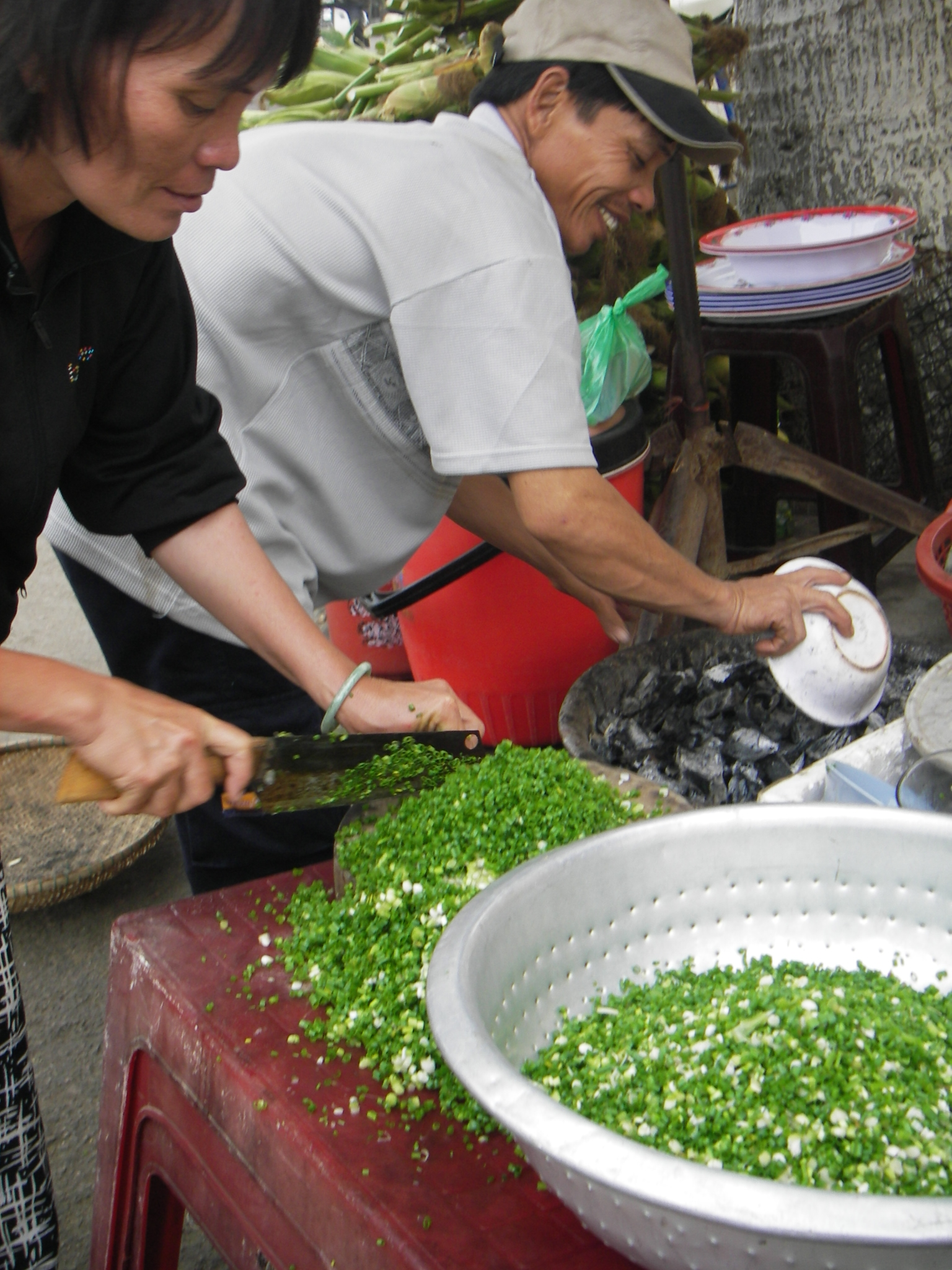
On the street corner of Hoi An, sliced scallion is soon ready for making into scallion oil.

The most memorable time for me in Hoi An was getting up to see the sunrise over the Bon River while drinking Vietnamese coffee shortly before heading for the market.  Then I walked along the street, and the scenery was very beautiful. The aromas and sounds were so enlivening and the taste of the food was phenomenal. I tasted many street foods along the streets and took a lot of it back to the hotel so that I could taste more during the day. This is part of the learning, culture and cuisine. Now, as I look at all my photos, I am getting hungry from the taste of foods that I still remember and long for.

I came to love one particularly famous grilled corn dish in Hoi An, Mo Hanh. It is made of grilled corn with scallion oil. You will see pictures of why the Vietnamese are so fond of this dish by the amount of corn on the street of Hoi An.

This slideshow requires JavaScript.

Yesterday, I was grilling corn for a special event at Magnuson Park in Seattle. About 500 people were there. I have 3 flavors for them to choose from: with spicy coconut sauce, jalapeno sweet and sour sauce and scallion oil. They were all a big hit at the event. I am delighted to share grilled corn with scallion oil recipe with you and hope that you will get a chance to enjoy until the last harvest of local fresh corn.

Grilled Corn with Scallion Oil

Serves: 8

1 cup thin sliced green onion, only green part–about 4 green onions
¼ cup canola oil
1 teaspoon sea salt
1 teaspoon sugar
8 ears of corn, peeled

 Pre-heat the grill to medium-high heat.

To make scallion oil or  Mo Hanh, heat canola oil until very hot and drop in green and let it cook for 40 seconds. Stir in salt. Let it sit until cool. Keep well in refrigerator for a week.

Grill corns over high heat 6 to 8 minutes, until some pope with nice brown cornel. When serve, dip each ear in scallion oil. Enjoy while it is warm.

© 2010  Pranee Khruasanit Halvorsen  
I Love Thai cooking

Read Full Post »

February 2010, Old Quarter in Hanoi

Hanoi Confetti Corn from the street of Hanoi Old Quarter

I love writing recipes from my culinary trip in my kitchen because it is like traveling through time.  And I love to travel, so when the journey ended then I was in pain with nostalgia. I missed the places I have been and the friends I have made. Then I decided to revisit the experience by recreating the food of that land. Like what I did last week with this Hanoi confetti Corn here in my kitchen.

This slideshow requires JavaScript.

This year my culinary trip to Southeast Asia started in Hanoi. After the long flight from Seattle and we arrived in the middle of the day.  After checking into the hotel, we headed off to the famous old quarter of Hanoi. No time for jet-lag, and old quarter is a best to start with exciting sight and sound. I already knew which street we wanted to walk, eat and shop. No time to waste we only have two days in Hanoi.

We came across the mobile foods just before Cha Ca Street, and the aroma of scallion oil and corn that caught our attention and find the confetti corn was cooking. Three of us tried to remember the all of the ingredients: cooking oil, corn, green onion, dried small shrimps, fish sauce and sugar. We ordered one and shared it on the street, it was delicious. Every day in Vietnam, the foods we loved consisted of a few simple ingredients put together in a stunningly simple way but the use of fresh ingredients made all the difference. This was a great welcome to the next world leading culinary destination.

Hanoi Confetti Corn with Shrimp Powder

I purchased the freshest local white corn from PCC Natural Market (in Hanoi, it was glutinous corn), shrimp powder is always in my freezer ready to use, I used chives from my garden instead of green onions and the rest of ingredients were staple foods.  I know how to revisit Hanoi again until the fresh corn runs out.

From Hanoi to your kitchen! Bon Appetite.

Hanoi Confetti Corn    

Serves: 4 

3 tablespoons butter 

2 cups corn kernels cut from 3 ears yellow or white corn 

1/4 cup chopped green onion, from 2 green onions or chives 

3 teaspoons shrimp powder, plus 1 teaspoon for garnish 

1 teaspoon sugar, optional –omit when use freshest corn 

1/2 teaspoon chili powder 

1 to 2 teaspoons fish sauce

Heat the butter over medium heat in a large skillet. Allow the butter to melt, add the corn and cook for 5 minutes. Stir in green onion and shrimp powder and chili powder and let it cook for 1 or 2 more minutes. When the corn loses its starch and  stir in fish sauce and serve right away.

© 2010  Pranee Khruasanit Halvorsen 
I Love Thai cooking  Pranee teaches Thai Cooking class in Seattle areas, her website is: I Love Thai cooking.com  
 

Read Full Post »

Thai Basil Seed Drink, a Fun Summer Time Drink   

When the weather was very hot and dry in my Thai village, I used to run to the drink stand for fresh basil seed drinks with ice floating in a pink rose floral flavored drink. It made the summer day bright and special for me and all the Thai kids back then.   

We sometimes harvested our own lemon basil seeds by shaking and rubbing dry flowers over a cloth until all the seeds came out. Then we would blow out the impurities and dust before soaking seeds in water. Then we added simple syrup or honey, rose-water or flower essences and ice. It was a fun drink to make and enjoy. I loved to make this drink with friends. It was fun to see a black seed changing in water to look like a fish egg, dragon fruit or kiwi seeds like in 10 minutes.  It looks strange but it tastes so good, and has natural fiber. This jelly-like seeds can be added to Thai desserts for texture, just like you do with tapioca pearls in bubble tea drinks. It is great with toddy palm seeds and longan drink also. Similar drinks are known to all Southeast Asian countries such as Vietnam, Malaysia, India.     

Thai Basil Seed Drink -- Nam Mengluck


At home in Seattle, I either made this drink with simple syrup and natural flavor extract or honey. You may use  Hale’s, Torani or Grenadine syrup with your choice of  flavor and color. The hard part for you will be to find basil seeds. They comes in a small package under: Sweet Basil Seed (Med Mengluck) [Thai], and Natural Dried Basil Seed (HOT E) [Vietnam]. Good luck (Chok Dee).   

Thai Basil Seed Drink   

Nam Mengluck   

Serves: 2   

1 tablespoon basil seeds, culinary seeds only
6 tablespoons simple syrup, Grenadine, Torani or Hale’s syrup.
2 cups ice-cubes
1 cup cold water
2 basil sprigs or flowers for garnish 

Combine 1 cup water and basil seeds in a pitcher and let it sit for 15 minutes. Then stir in simple syrup, grenadine syrup or Torani, ice-cube and cold water. Pour in two-chill-tall glasses and garnish with basil sprigs or flowers. Serve cold.   

© 2010  Pranee Khruasanit Halvorsen  
 I Love Thai cooking 
 
Pranee teaches Thai Cooking class in Seattle areas, her website is: I Love Thai cooking.com

Read Full Post »

My Milo  

Most Thai kids grow up with hot milo just like American kids do with hot chocolate. However, growing up in Thailand more than 45 years ago, daily products such as milk, butter and cheese were rare commodities. We grew up with milk powder or UHT milk and of course sweetened condensed milk. There are many ways to make this quick drink for your kids. I have modified the method my mom used to make for us, based on sweetened condensed milk and hot water, to this healthier recipe with a hint of sweetened condensed milk and 2% milk for my kid. Any Thai mom would have done the same back then based on availability and affordability.   

Milo is a chocolate malt beverage mix. It was created by Thomas Mayne, an Australian industrial chemist in 1934. It is marketed in Thailand as an energy food drink. Perhaps that why most parents serve to school children. 


My Milo


This morning, I made some Milo for my son. The sounds I made were not the same as the sounds from when my mom prepared one for me. I remember waiting with anticipation, hearing the sound of a teaspoon whisking around and hitting the side of the glass mug. Here in my kitchen, it was a whisk against a stainless steel sauce pan. But I knew that my son was waiting for his morning drink with an anticipation too.

My Milo Hot Milk 

Khrueng Duam Milo 

1 1/2 cups milk
3 tablespoons milo powder, plus 1/2 teaspoon for garnish
1 tablespoon sweetened condensed milk, optional

Heat milk in a medium-size sauce pan on medium heat until the steam appear, about 5 minutes. Stir in milo powder, sweetened condensed milk and whisk for 30 seconds until it well blended and foamy. Pour in a heat proof glass and garnish with 1/2 teaspoon milo powder on the top. Serve warm or cold over ice. 

© 2010  Pranee Khruasanit Halvorsen  

 I Love Thai cooking 
 
Pranee teaches Thai Cooking class in Seattle areas, her website is: I Love Thai cooking.com

Read Full Post »

Drink for Our Complexion 

I grew up in Phuket, an Island off of Southern Thailand, where I never saw tomatoes until I was a teenager.  We learned to like tomatoes because there was a saying that it was great for our complexion. People from the Northern part of Thailand had the most beautiful complexions due to the fact that they grew and ate a lot of tomatoes. And of course at that time, tomatoes were only known in Northern cuisines such as Nam Prik Ong, Nam Prik Nom and green papaya salad. Howevery, today tomatoes are available at the markets every day in Thailand. And it is a well loved and acquired taste to all Thais.

Tomato-Celery Drink

The Europeans brought tomatoes to Thailand around the 16th century. It is true that ” tomatoes contain lycopene, a powerful antioxidant, which improves the skins ability to protect against harmful UV rays”

Now seeing fresh sweet tomatoes everywhere including from my garden and at the local farmer market. It is appropriate to blend my childhood smoothie that I used to have from Phuket Smoothie Stand.

Now that so many variety of local tomatoes available in the market, I hope that you will enjoy this recipe as much as I do. Cheers to our complexions!  

Tomato & Chinese Celery Smoothie
Nam Makruatade Punt
 

Serve: 1 

1 cup crushed ice
1 cup tomato, diced–sweet variety
1/4 cup chopped Chinese celery or any celery, plus one stem for garnish
1 tablespoon simple syrup
A pinch of  salt
A pinch of chili powder
1 teaspoon of Worcestershire sauce

Place ice, tomato, celery, simple syrup, salt, chili powder and Worcestershire sauce in a blender and blend until smooth. Place in a chilled-tall 12-ounce glass, garnish with a celery stem. Serve cool. 

 © 2010  Pranee Khruasanit Halvorsen
 I Love Thai cooking
 
Pranee teaches Thai Cooking class in Seattle areas, her website is: I Love Thai cooking.com

Read Full Post »

Sunflower Sprouts Salad with Chili-Lime vinaigrette

Yum Med Tan Tawan Ngawk

Sunflower Sprouts by the Alm Hill Gardens Stall – The Columbia City Farmer Market

July 15, 2010 – Yesterday I was at the Columbia Farmers Market. While waiting for my friend, I visited the Alm Hill Gardens stall, and was introduced to sunflower sprouts. I have tasted it before, but these fresh sprouts from the farm I will never forget. It was fresh, buttery and nutty. I brought some home and made a salad for a side dish to accompany my Thai chicken Baryani rice, Kao Mok Gai.

Chili-Lime Vinaigrette, tomato and dill

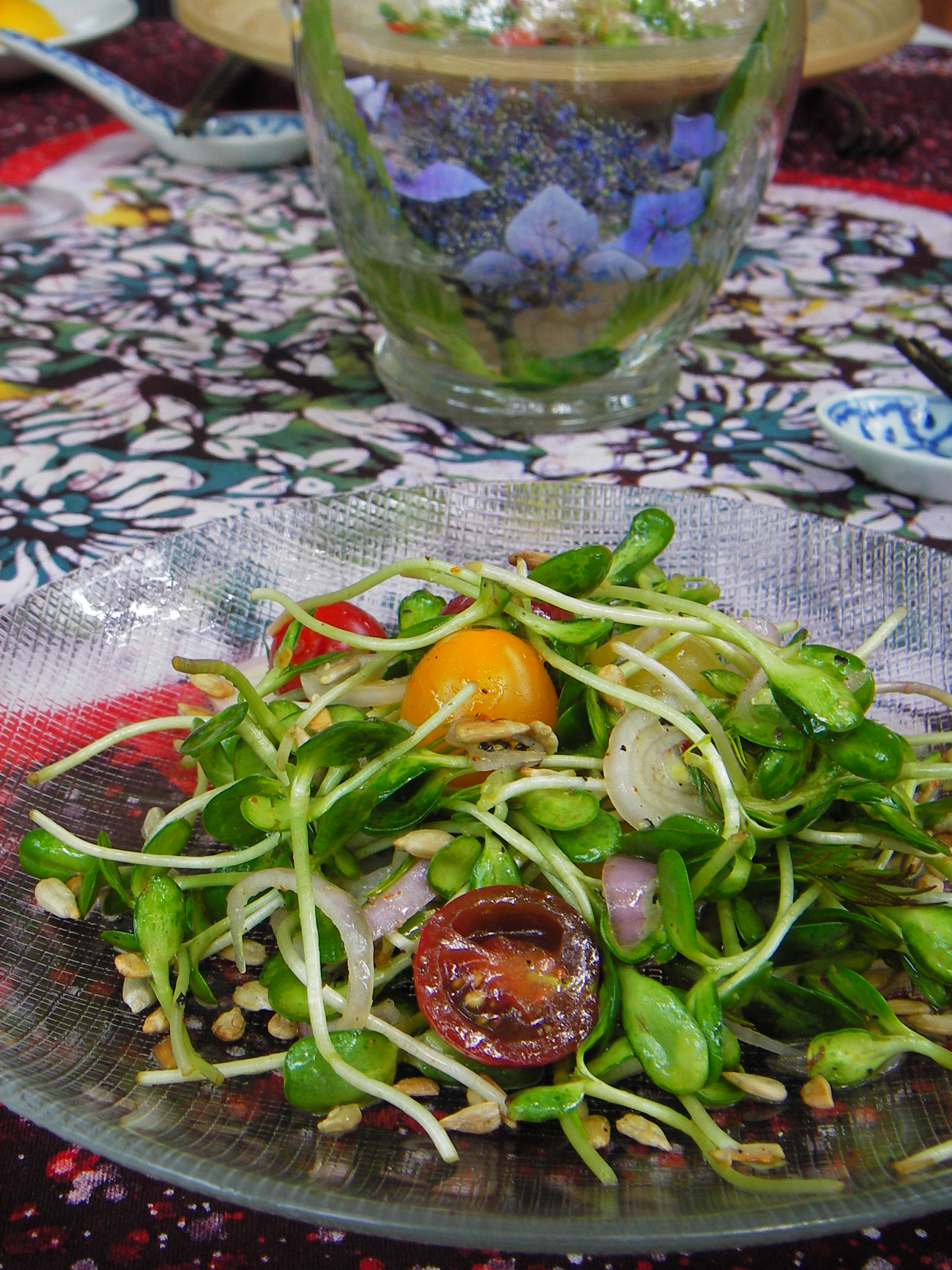
August 4, 2010- My friend Annette came over for lunch today and it is a perfect day for me to perfect my Sunflower Sprout Salad Recipe and do some photos for the blog. As I envisioned to add some texture, and sunflower seed is a perfect theme for salad. I have no reservations about adding the abundant and flavorful mixed heirloom cherry tomatoes. The rest is simple. I hope you like my chili-lime vinaigrette. Interesting and freshest  ingredients in an easy recipe is a way to go.

Sunflower Sprouts S

Sunflower Sprout Salad with Chili-Lime Vinaigrette

alad with Chili-Lime vinaigrette

Yum Dork Tan Tawan Ngawk 

Serves: 4

2 tablespoons extra virgin olive oil or garlic oil
1/2 teaspoon sea salt or 2 teaspoons fish sauce
1/2 teaspoon evaporated cane sugar
1/4 teaspoon black pepper flake
1/4 teaspoon chili powder
1 tablespoon lime juice or lemon juice
1 shallot, peeled and sliced
12 cherry tomatoes, whole or halved
2 cups sunflower sprouts, washed and drained
1/4 dill or cilantro leaves
2 tablespoons toasted sunflower seeds

Whisk olive oil, sea salt, sugar, black pepper, chili powder, lime juice until it is well mixed. Fold in shallot, tomatoes, sunflower sprouts and dill, and mix gently. Sprinkle sunflower seeds  before serving. Serve immediately.

 © 2010  Pranee Khruasanit Halvorsen  

 I Love Thai cooking 

 Pranee teaches Thai Cooking class in Seattle areas, her website is: I Love Thai cooking.com

Read Full Post »

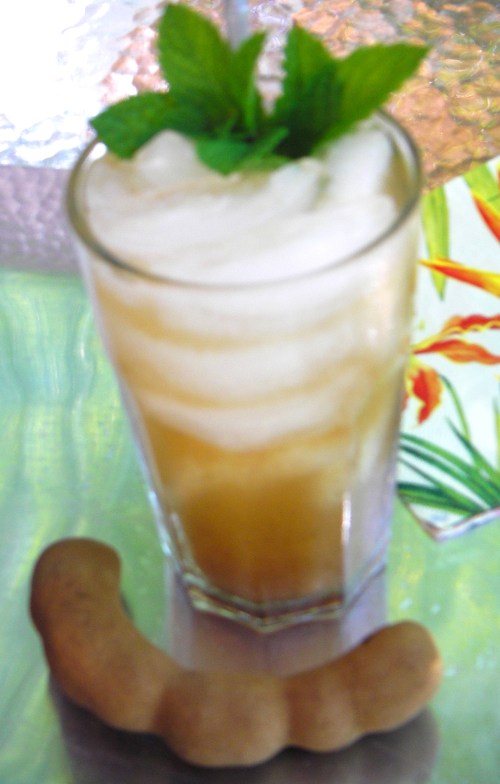
Tamarind Drinks – All Natural Thai Drinks  

During the day, I often open a fridge and look for a drink. My eye was on tamarind concentrate – a leftover from Thai cooking class another day. I spent three minutes making a syrup. Now I have syrup ready for making a tea and soda.

Tamarind syrup is a good recipe to have. I always make one recipe to keep in refrigerator or more if I plan to freeze them. Mostly for the cocktail and soda but in the emergency situation –  it can be a cold remedy – it can be use in Phad Thai or curry. It has a hint of sweet, fruity but not as tart when add sugar. In Thai village we use tamarind and honey as a tea for a cold remedy. It is high in Vitamin C and also good for digestion.      


 Tamarind Syrup  

 Nam Chuem Makham

น้ำเชื่อมมะขาม 

 Yield: 3/4 cup

1/2 cup tamarind concentrate, freshly made or from the can 
1/4 cup brown sugar or honey

Combine tamarind concentrate, brown sugar and water in a pot and bring to a boil on high heat. Stir and let it cook for 2 minutes. Strain into a clean jar, when it is cool then store in the fridge for a week or keep in the freezer for 3 months.

 Tamarind-Honey Tea 

Cha Nampung Makam 

ชาน้ำผึ้งมะขาม

3 tablespoons tamarind syrup, from recipe above 

To make a tamarind tea,  combine 3 tablespoons tamarind syrup (make syrup with honey instead of brown sugar) with 5 tablespoons boiling water in a tea-cup and serve warm.

Tamarind Soda 

 Nam Kham Soda 

น้ำโซดามะขาม

 Serves: 1

 1 cup ice cube
3/4 cup sparking mineral water
3 tablespoons tamarind syrup, from recipe above
1 mint sprig

Place ice cube in a glass, follow by sparking mineral water and tamarind syrup. Stir lightly and serve. Garnish with mint sprig.  

© 2013  Pranee Khruasanit Halvorsen
I Love Thai cooking
Pranee teaches Thai Cooking classes in the Seattle area.
Her website is: I Love Thai cooking.com 
 
Follow Me on Pinterest

Read Full Post »

Thai Village Style Cooking    

Fried fish recipe from the Southern region of Thailand 

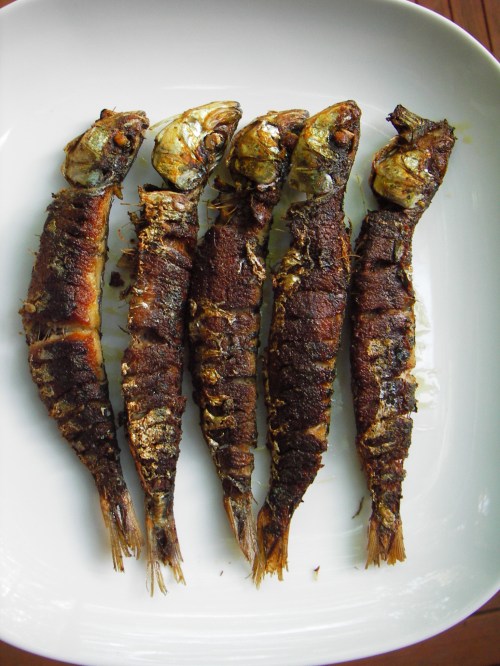
The other day, when I was at Pike Place Market, wandering around almost aimlessly like a tourist. I purchased a pound of sardines, I hadn’t tasted fresh sardines for the longest time perhaps since my grandma’s kitchen. I want to rediscover more Thai village style cooking with local ingredients here in Seattle. This was a good start.  

Thai Fried Sardines--Very Rustic Thai Cooking

The sardines are fresh from the Gulf of California and there is no need to worry about mercury because it is known to be very low. There are many good reasons to eat sardines, they are rich with Omega-3 fatty acids, Vitamin D, calcium and B 12. Perhaps that’s why both of my grandmother hardly saw any doctors in their life time. Every single day growing up, fried fish with turmeric and salt was on the table, besides other fish dishes. It was my grandma’s rule. The fish was the cheapest and healthiest protein that Phuket villagers could provide for their family way back then. I love fried sardines, they have a mouthful flavor and the aroma is unique.

If you are trying this for the first time, the challenge is how you will cook them, so you can eat everything including the soft bone and when crunchy enough, the back bone. It is a calcium intake time. As my rule goes, if it is chewable then it is edible! But trust your judgment and comfort zone also.


This slideshow requires JavaScript.

First I removed the fish guts. That was not fun. The problem is the sardines were so small and the belly was so relatively big. I tried the best I can to make sardines look good in the photos. After I gutted, cleaned and dried the fish, I followed my grandma’s old advice. I cut the flesh through the skin into tiny strips (the knife is perpendicular to the fish back bone) just enough to hit the backbone (please see the slide show). I repeated on the other side. I salted them and seasoned with turmeric. I placed 8 sardines in a food container and kept in the refrigerator for a day. I had something else planned for dinner that evening. When you want to keep the fish for a day in fridge, be generous with salt and turmeric. It is a way that we use to keep the fish fresh for the next day, back when we didn’t have electricity.

You may use the recipe below and cook sardines on the grill on medium heat on both sides until crispy. The problem with frying in your kitchen is the smell of the fish lingers for a day. I just want you to know that, but it tastes divine with hot steamed jasmine rice. Especially good if you eat it with your fingers, and easy way to remove the backbone then mix the fish by hand against the warm jasmine rice before eating,  just like Thais in the Thai village do.

 Thai Fried Sardines  

 Pla Sardine Tod

ปลาซาร์ดีนทอด 

 Serves: 4

 1 pound sardine, about 8 sardines, gutted and cleaned and dried with towels
2  teaspoons sea salt
1/2 teaspoon turmeric
3 to 5 tablespoons canola oil

 Lay the fish perpendicular to you on the cutting board, cut the flesh through the skin into tiny strips (the knife is perpendicular to the fish back bone) just enough to hit the backbone (please see the slide show), Repeated on the other side. Follow the same steps with the rest of the fish. Sprinkle salt all over the fish and follow by turmeric until the fish is evenly cover.

Heat the frying pan on medium heat, when the pan is hot add canola oil. Fry on both sides until they are crispy by the touch and a light brown color. Serve with warm jasmine rice.


 © 2010  Pranee Khruasanit Halvorsen  
I Love Thai cooking 
 Pranee teaches Thai Cooking class in Seattle areas, her website is: I Love Thai cooking.com  

Read Full Post »

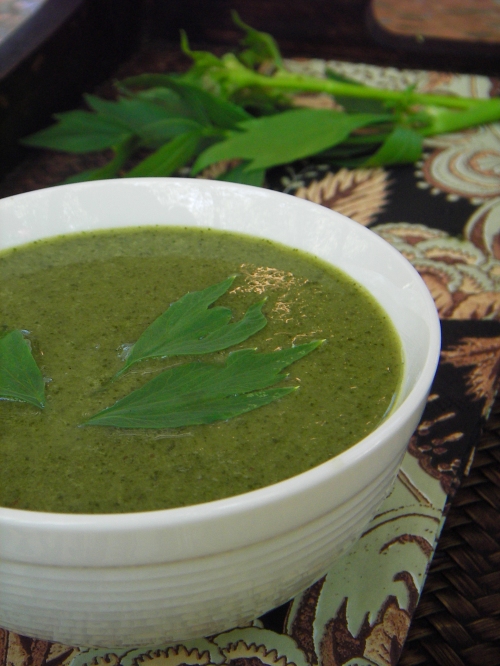
Lovage and Snap Pea Soup

Kaeng Jued Pak

There is no real Thai name for this soup, but I started the process by stir-frying, adding broth and cooking until the vegetables are soft. It’s like a Thai soup that is called Kaeng Jued Pak. I pureed it down like western soup. It is best to enjoy lovage that way. It’s not a typical Thai dish but my grandma would have done the same — a dish from the garden or the nearest farm to the table. The freshness and simplicity were key. I don’t make it a habit to call for take-out or frozen food. I prefer to enjoy real food. When there is nothing else, steamed rice and fried eggs with some soy sauce and cucumber on top is enough. This is a kind of lunch; I enjoy it when I am at home by myself.

Lovage-Snap Pea Soup

Lovage and Snap Pea Soup

This morning while working in the garden, I trimmed overgrown lovage. Some was young and tender; so I decided not to throw it away. Then around lunch break, I made a soup with some snap peas that I got from the farmers market the day before. All I had to do is find the right spice to go with it. I had some freshly ground coriander powder–seeds that I brought from Thailand. I gave it a try, and it was right on. It was a quick and easy summer soup. With a lovage plant, you will receive an annual return every summer with flavorful soup–the best tasting soup that no other restaurants can compete with because you have got the freshest one a few steps from your kitchen. 

Serves: 4

Yield: 2 cups

3 tablespoons canola oil or extra light olive oil
2 cloves garlic, minced
1/2 cup chopped onion
1 cup chopped lovage
1 cup whole snap peas, end trimmed — about 20 snap peas
1 teaspoon sea salt
1 teaspoon freshly ground-toasted coriander powder
2 cups chicken brother or 2 cups water plus 2 teaspoons chicken powder

Heat a frying pan on medium-high heat and when it is hot add canola oil. Stir in garlic and onion until fragrant and onion become translucent. Stir in lovage for 30 seconds before adding snap pea, sea salt and coriander. Pour into a large pot and add chicken broth and bring to a boil. Lets it cook on medium heat until snap peas is cooked. About 8 minutes. Serve as is or use a blend in the blender. Garnish with chopped lovage or lovage leaf.

Vegetarian option: substitute chicken broth with vegetable or mushroom broth.

© 2010  Pranee Khruasanit Halvorsen
 I Love Thai cooking
 
Pranee teaches Thai Cooking class in Seattle areas, her website is: I Love Thai cooking.com

Read Full Post »

My very  first breakfast in Yangon.

Yangon Almond Pancake

When I was in Yangon last year I spent my first morning looking for a market near the hotel. It was a street that had many stalls and breakfast type food stands. Everything in Yangon was very exciting for me, as a neighbouring country to Thailand. I found that our culture and cuisine are very different in many ways. The thing that catched my eye most was a lady making an almond pancake on the street. I stood in line and signalled for some almond pancake, the same one that she just did for the customer in front of me.  First she poured the pancake batter in the pan, sprinkled generous amount of almond on top, then she placed a charcoal heater on top. Like baking, the cake actually rise after a few minutes. She then gave it to me in a plastic bag. I ate there on the street. I really loved it, as its almond flavor and texture were very pronounced, crispy, and aromatic.

This slideshow requires JavaScript.

I asked for permission to take picture and I was glad I did and it is helpful to write this recipe. I still remember the flavors, so here I am trying to duplicate the recipe from the memory– Here in Seattle in my kitchen.

I created Honey-Lime Syrup to go with the pancake. In Southeast Asia, it is typical way of using honey-lime for a syrup in a dessert. Also you can simply add more hot water to melt honey and put over ice as a tonic drink. It is very versatile recipe. I like local pure honey. I use “Twin Peaks”  Mountain Honey from Snoqualmie Valley Honey Farm, located in North Bend, Washington. The bees collect nectar from the local wild flowers the scent of the wild flower is present in the honey. You may use any honey.

I want to tell you that this pancake is beyond breakfast. I popped frozen left-over in the toaster this morning, and the almonds on the pancake were very crunchy and delicious with my Vietnamese coffee. I almost cry, I miss Burma.

Honey-Lime Syrup

 Nam Pueng Ruang Manao

Yield: 1/4 cup

 3 tablespoons honey
1 tablespoon hot water
2 teaspoons lime juice
1 drop almond extract, optional
 

Combine honey and hot water in a microwave save small bowl. Heat in the microwave for 15 seconds and stir until uniform. Stir in lime juice and almond extract. Stir really well and set a side. Store in refrigerator up for a week.

Yangon Almond Pancake

Yields: 1 1/2 cup pancake batter

Make: 4 to 6 pancakes
 
1 cup flour
1 tablespoon baking powder
1/2 teaspoon salt
3/4 cup almond meal flour
1 egg
2-3 tablespoons sugar
2 tablespoons melted butter, plus 4 tablespoons to cook pancake
1 1/4 cups milk
1/2 teaspoon pure almond extract
1/2 cup sliced almonds, toasted
 

Sift flour, baking powder and salt twice and place into a large bowl along with almond meal flour. Beat eggs, sugar and butter in a medium size bowl for 30 seconds. Combine with milk and almond extract. Then pour in the flour mixture, fold it gently just to mix.

To duplicate the technique shown in the pictures, I use a heated cast iron pan as a hot lid. Cover the pancake while cooking.

Heat a pancake pan with 1 tablespoon butter on medium heat when melt pour 1/3 to 1/2 cup batter. Sprinkle 2 tablespoons toasted sliced almond on the surface of the pancake, cover with heated cast iron pan and let’s it cook for 3 minutes. It should rise, when the edge is golden, use spatula to lift the pancake to see if it yellow-brown. If it does, it is ready. Flip with spatula to cook another side. It should take about 30 seconds, more or less. Check the same way if it is done. Don’t let the almond burn, it should take about 3o seconds. Repeat the process to make 3 or 4 more pancakes. Serve right away with Honey-Lime Syrup.

Note: I freeze the uneaten pancake by letting it cool, line with parchment paper and put in the zip lock bag. Freeze. Next time around all you have to do is put in the toaster. 

 © 2010  Pranee Khruasanit Halvorsen
 I Love Thai cooking
Pranee teaches Thai Cooking class in Seattle areas, her website is: I Love Thai cooking.com

Read Full Post »

« Newer Posts - Older Posts »