Feeds:
Posts
Comments

Archive for the ‘Pranee’s Culinary Tales’ Category

Best Phad Thai on Mahachai Road, Bangkok 

The Golden Mount

Image via Wikipedia

I just returned home from three weeks of savoring Thailand. I still have a little jet lag and a lingering sense of all the flavors from Thailand. My first day in Bangkok was spent with my nieces and nephew who knew the best places to eat in Bangkok. First we intended to go to Thip Samai, but the restaurant was closed. Thip Samai is open evening hours from 5:30pm till 1:30 am, but we were not in luck. Next to Thip Samai is the Lueng Pha Phad Thai restaurant, which is very good. We savored every menu item and were very happy with our lunch—we all know that good Phad Thai can make one happy! We then continued exploring the neighborhood, and decided to walk up to the top of the Golden Mountain Temple, Phu Khao Thong. It was a very pleasant day, cool and sunny, and I spent a good time bonding with my two nieces and nephew.

For Thai foodies, I strongly recommend that when you visit Bangkok, plan to go for more than a week and include Lueng Pha or Thip Samai Phad Thai on your to-do list. They are in a great location with interesting tourist sites nearby such as: San Chao Pho Suea, Sao Chingcha, Kao San Road, and the Golden Mountain Temple.

After having a good time at the Golden Mountain Temple, we were able to enjoy our afternoon visiting San Chao Pho Suea and Khao San Road. Of course, in Bangkok there were plenty of street foods to enjoy. As we walked, we tasted all of the good looking snacks along the way. It was a perfect day and a wonderful first day to welcome myself back home. We joked that it was an  “Eat Pray Love” kind of day.

Please enjoy the video below showing how Phad Thai is prepared and wrapped in an omelette.

Phad Thai Lueng Pa Mahachai Road

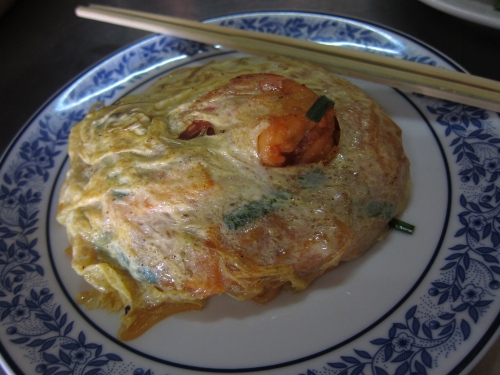
Omelette wrapped Phad Thai with Prawns


Phad Thai with Shrimp Fat, Fresh Shrimps and Egg
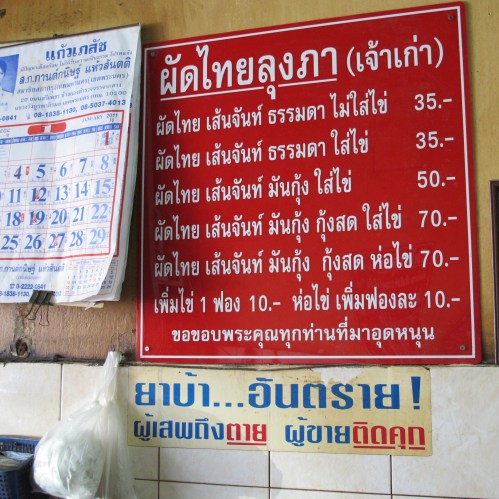
Phad Thai Lueng Pa (Jao Gao)

Phad Thai Regular without egg, 35 Baht ($1)

Phad Thai Regular with egg, 35 Baht

Phad Thai with Shrimp Fat and Egg, 50 Baht

Phad Thai with Shrimp Fat, Fresh Shrimp and Egg, 70 Baht

Phad Thai , Shrimp Fat, Fresh Shrimp, Wrapped with Omelet, 70 Baht

Additional Egg, 10 Baht each

Thank you for your support


The decor inside the restaurant

Lueng Pha Phad Thai (next to Phad Thai Thip Samai on Mahachai Road, Bangkok)

315/1 Mahachai Road
Samran Rat, Phra Nakhon
Bangkok 10200
Thailand


Read Full Post »

The Heart of Phuket Muslim Cuisine

When I was growing up I was always fond of the pungent flavor of Phuket Muslim cooking—it must have been the aroma and the ritual that came with this food that I experienced in the diverse culture of Southern Thailand. The flavors and aromas were different and exciting compared to my family’s traditional Thai-Chinese cooking.

While visiting Phuket just two weeks ago, my dream came true when Varunee, my long time friend and a chef for my culinary tour, shared many of her family’s recipes with me. The one that I am sharing with you today is a Sa Curry with Buffalo Meat and Sa Spice Mix. This recipe is part of her family’s traditional cooking and has been passed on for many generations.

Varunee


Our meeting Point, Bangtao Mosque

I waited for Varunee at the Bangtao Mosque, a famous Phuket landmark, then followed her through the roads that snaked behind the mosque near the foot of the hill. My lesson on Aharn Muslim (Muslim food) began in her home with beautiful birds singing in the background.


Sa powder from Bangtao Village, Phuket

We started by making an aromatic Sa spice mix (Krueng Sa), the heart of the cuisine. The Thai name for cumin is Yee Rah, but Phuketians call it Sa. Varunee called cumin “Sa Lek” (meaning small Sa), and fennel is “Sa Yai” (big Sa). Cumin has a pungent hot Sa feeling (numbing) and the fennel is cooling and sweet after the numbing sensation. Thais use cumin to reduce the meaty smell. The rest of the spices are typical Southeast Asian ones such as turmeric, black pepper, coriander and dried chili. You may toast the spices before grinding to intensify their flavor.

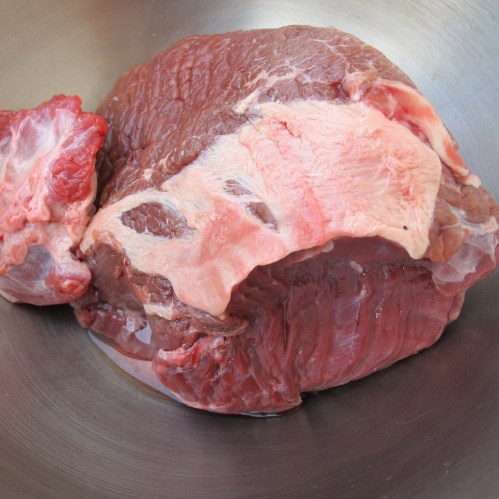
Water Buffalo Meat

Water Buffalo meat is a more common meat in the Southern part of Thailand, especially in Phuket. Sa Curry with Buffalo Meat with Sa Spices is a stand out among Phuket Thai Muslim dishes.

Sa Spice Mix

Krueng Sa

Yield: 4 tablespoons

2 teaspoons cumin seeds
2 teaspoons fennel seeds
3 tablespoons coriander seeds
10 dried Thai chilies (Varunee recommended 20 to 30)
1 teaspoon turmeric powder

Place cumin, fennel, coriander, and Thai chilies in a small pan; toast the spices on medium heat until fragrant.

Let cool, then place them in a spice grinder and grind to a fine powder, or place them in a mortar and pound with a pestle to yield a fine powder.

Store cooled spices in an airtight jar and store for up to 3 months.


Buffalo Curry with Sa Spices Mix


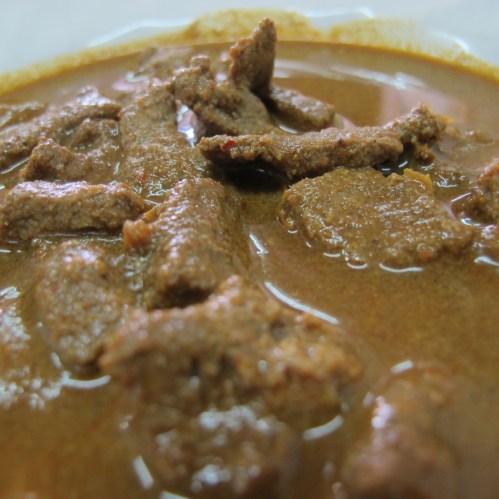
Sa Curry with Buffalo meat

Gaeng Kwai Kab Krueng Sa

Serves: 2 to 4

3 tablespoons canola oil

2 shallots, peeled and sliced, about ¼ cup

4 cloves garlic, peeled and sliced, about 3 tablespoons

4 tablespoons Sa spices mix from recipe above

¾ pound buffalo meat or beef top sirloin, thinly sliced

½ cup coconut milk

1 tablespoon palm sugar

½ teaspoon salt

1 tablespoon fish sauce

Heat canola oil in a medium pot over medium heat. Stir in shallots and garlic and cook until fragrant, about 2 minutes. Then add Sa spice mix and stir for 1 minute. Stir in buffalo meat and cook for 2 more minutes. Stir in coconut milk. Let cook until the meat is tender, about 10 minutes. Stir in palm sugar, salt and fish sauce. Serve with warm jasmine rice and a vegetable side dish.

This slideshow requires JavaScript.

© 2011 Pranee Khruasanit Halvorsen
I Love Thai cooking
Pranee teaches Thai Cooking classes in the Seattle area.
Her website is: I Love Thai cooking.com .


Read Full Post »

Eat Phuket at the 12th Annual Old Phuket Festival

Phuket Old Town Festival 2011

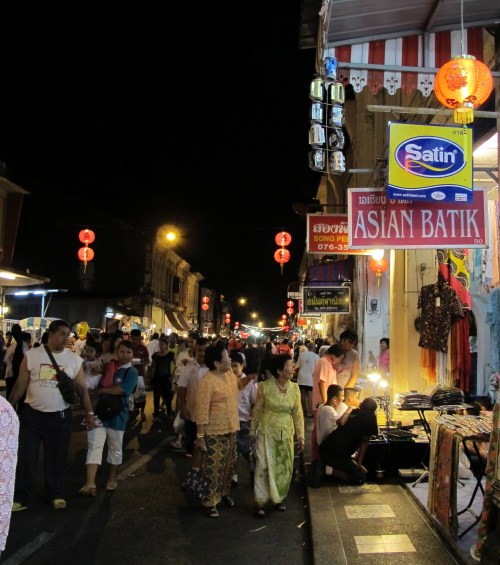
Last night I had a great experience traveling back to my old Phuket lifestyle with the first day of the 12th Annual Phuket Old Town Festival. We started the evening around 8pm. The first visit was to the Blue Elephant Restaurant and Cooking School. I had a chance to visit a cooking class at the restaurant which is located at the West end of the festival on Krabi Road. A block further down that road we crossed Yaowarat to get to Thalang Road where the festival takes place every year. The buildings on both sides are in the Sino-Portuguese style that was built in the 19th century.

Thalang Road, Old Phuket Festival 2011

We walked on Thalang Road where the street was full of activities related to foods and crafts that reflect the Phuket Paranakan Culture. We listened to live music. We found the Kopitiem Restaurant which has an entire menu of old Phuket foods. My niece and I ordered three dishes to share. Salad Kaek is a salad with peanut dressing with Phuket-Muslim cooking flavors. Phad Bee Htun is stir-fried rice noodles with Choy Sum and egg that looks and tastes like Singaporean Noodles. Another noodle dish that we had is Phad Mee Sua (stir-fried thin wheat noodle with seafood).
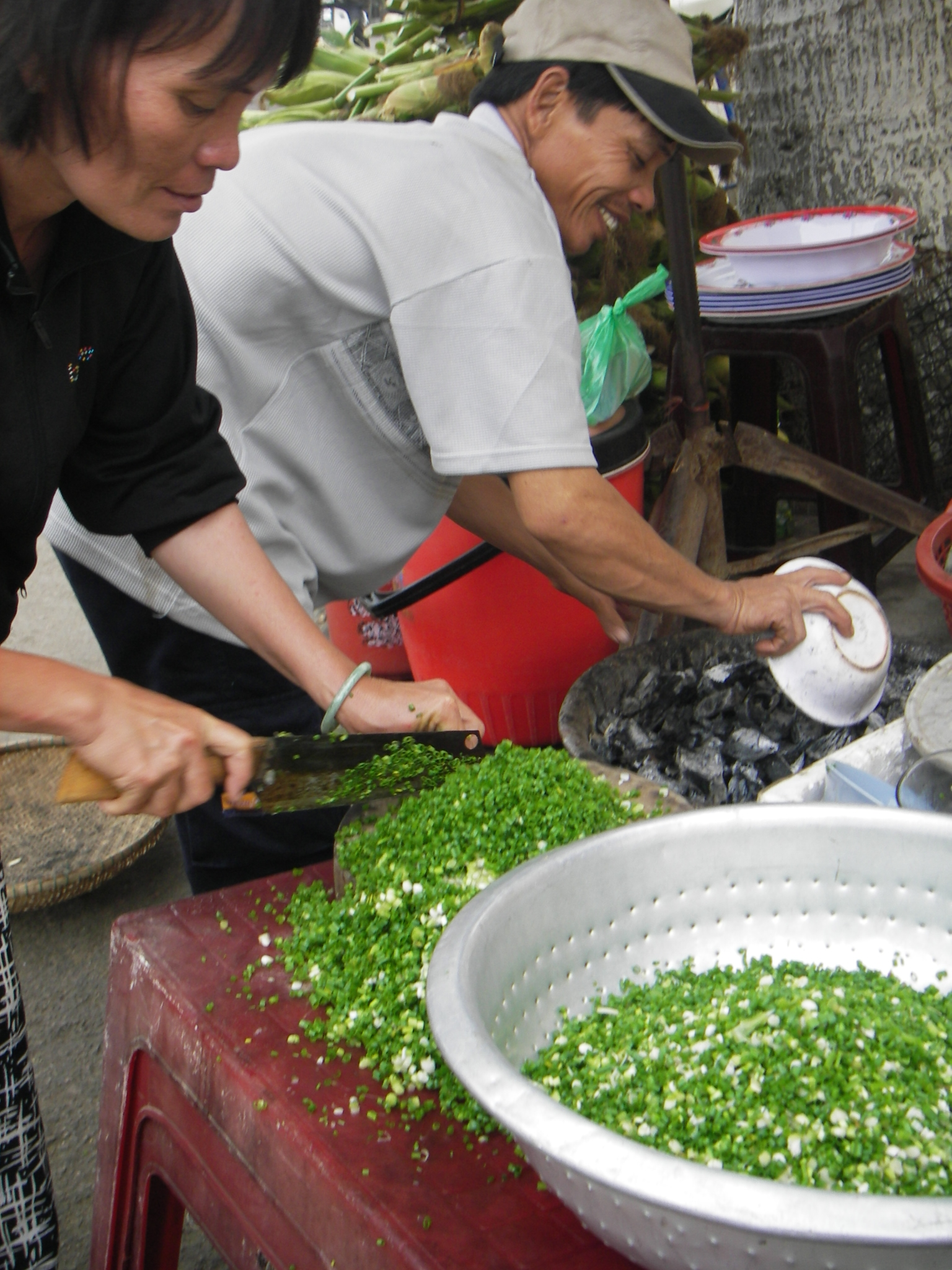
Kopitiem~Restaurant on Thalang Street, Phuket

The evening was complete when I savored the taste of home and a taste of culture. I took in the whole experience and felt my old sense of connection to our heritage. I was lost between places and tastes like a time traveler. One moment I was eating on the streets in Singapore and a few minutes later in Penang, Malaysia. But it all makes sense. Please see an excerpt below from the Thai Paranagan Association

“Baba-Paranakan culture is beautiful in both spirit and expression. It deeply blends several customs and traditions from Thai, Chinese, Malay and Western into Phuket culture, throughout many civilizations for hundreds years.”

Stir-fried Thin Rice Noodle with Choy Sum, Phad Bee Htun Phuket

Phad Bee Htun was my favorite noodle dish when I was growing up. I am proud to share this recipe with you. I hope that you can taste the flavor of Southeast Asia and the culture in that region of Paranakan.

Stir-fried Thin Rice Vermicelli with Pork and Choy Sum

Phad Bee Htun

Servings: 4 to 6

Preparation time: 15 minutes

Cooking time: 10 minutes

½ package Thai Kitchen thin rice noodles or any thin rice noodle
4 tablespoons cooking oil, or more as needed
2 eggs, lightly beaten
6 garlic cloves, minced
½ pound pork chop, sliced
1 tablespoon light soy sauce
1 tablespoon fish sauce
2 cups Choy Sum or Chinese kale
A dash dark soy sauce, optional
4 green onions, sliced diagonally, about ½ cup
4 lime wedges, to garnish

Soak noodles in hot water until softened, about 5 minutes; drain and set aside.

Heat 2 tablespoons canola oil in a wok. Beat two eggs in a bowl and then pour them into the wok. Tilt the wok so the egg will spread to make a thin omelet. Cook for one minute and flip once. Place on the cutting board and shred; set aside.

Heat wok on high heat and add 2 tablespoons canola oil and garlic. When garlic is yellow, stir in pork, light soy sauce, and fish sauce and cook until the pork is cooked. Stir in Choy Sum, cook for 30 seconds, and then stir in noodles. If desired, add a few drops of dark soy or molasses to get a tan color and a little sweet flavor. When the noodles are cooked, stir in green onion and shredded omelet; remove and serve with lime wedges and condiment below.

Condiment:

½ cup rice vinegar
½ teaspoon sugar
1 jalapeno pepper, sliced

Place rice vinegar, sugar and jalapeno pepper in a small bowl, stir.

© 2011  Pranee Khruasanit Halvorsen

I Love Thai cooking Pranee teaches Thai Cooking classes in the Seattle area. Her website is: I Love Thai cooking.com

Read Full Post »

Celebrating Chinese New Year in Phuket

I love visiting my family during Chinese New Year. It is a festive time, a time for family reunions, reconciliations, and a good time.

On February 1, the day before the New Year, my sister, sister-in-law and my mom were busy like we are every year, cleaning the house to sweep away ill-fortune. Then we spent most of the day shopping, cutting and stocking up the pantry.

It is our family tradition to hold Chinese New Year at my mom’s home, the main house where our ancestors lived long before. We place pictures of our ancestors on an altar and worship. On February 2 we woke up in the morning and were ready to cook our traditional dish feast at the same time the sun was rising, which is around 6:30am.


Ba Mee Phulket for stir-fried Phuket Hokkien Mee: symbol of longgevity

Slowly my nieces and nephews showed up and took part in helping, and the foods were placed on the table in front of the altar as we finished cooking.


Phuket Chinese New Year Feast

Steamed jasmine rice should have a tall peak for a symbol of wealth

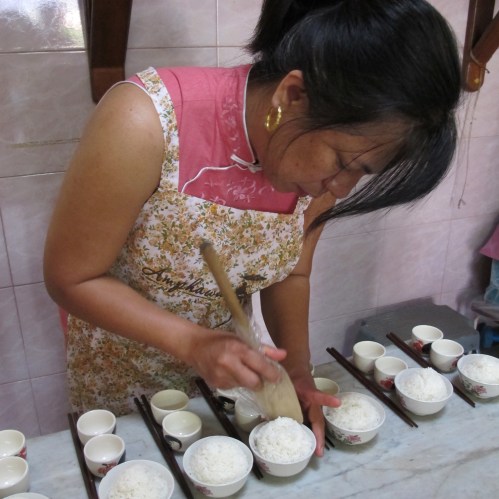
I helped by shaping the steamed jasmine rice into tall peaks. The Thai word for this shape is Poon Pon which means plenty and fruitfulness. It is a symbol of wealth.

This slideshow requires JavaScript.

We offered two feasts, one inside our home in front of our ancestors (paternal side), and one in the back of our house for all departed relatives (maternal side) or people that once were related to us, and any wandering spirits. We invite them all to enjoy the feast.

At the end, we burn the gold paper and money paper to make it available for all the departed spirits.

At the end we had a feast together and while we were sharing the food, we catch up with each other and bond with food and the pride of our tradition.


Family gathering

Read Full Post »

Visiting Home: Four Fish Dish

I left Seattle on January 25 and was excited about visiting home during Chinese New Year. I wanted to record my family traditions and later all will explore food and culture in many provinces around Phuket. This trip is unlike other trips: my focus is on the Southern Cuisine. For 3 weeks my itinerary is planned to make the most with recipes from the villages. After spending 5 days in Bangkok and Amphawa experiencing  the incredible regional foods, I am now with my family in Phuket. I arrived at my family home just around noon and my favorite foods are already waiting for me at the table.

This slideshow requires JavaScript.

My mom waited for me in her kitchen with my favorite foods: fish four-way, fried salted croaker and fried fresh turmeric croaker and then steamed Thai mackerel (Pla Tuu) in tamarind sauce and sour curry with croaker, fuzzy melon and taro stem. When I am at home in my mom’s kitchen I eat simple foods.

I am so happy to be home again.

Read Full Post »

Sticky Rice in a Bamboo Tube, Kao Lam

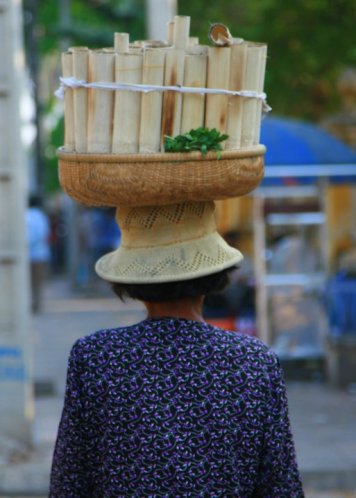
I have fond memories of sticky rice in a bamboo tube—it looks so cool! At every festival in my village when I was growing up, there was a man who made and sold this Kao Lam. We would eat some at the festival then bring home a few for family members who couldn’t go. It is a perfect take-home food, since it is already packaged in a bamboo tube.

Sticky Rice in a Bamboo Tube, Cambodia

The sticky rice is cooked in a segment of bamboo, the kind that has a thin wall so the heat can penetrate to cook the rice inside the tube. After it is filled with the sticky rice ingredients, the bamboo is plugged with a piece of coconut husk wrapped with banana leaf to keep in the steam for cooking the rice. Then the bamboo tubes are placed over charcoal. When it is done, the outer skin of bamboo is removed and a thin wall left behind to protect the rice inside. All Southeast Asian countries have some version of this, and they are all cooked in a similar way. The photo below is from Cambodia. In Thailand this dish is called Kao Lam; in Malaysia it’s Lemang.

Thai Sticky Rice in Bamboo Sticks in Cambodia

If you like sticky rice with mango, you will like Kao Lam, too. I love the fact that when you peel the bamboo away (see photo below), the powdery fiber in the bamboo tube leaves a sheen. The rice comes out shaped like a stick and looks like it was wrapped in edible paper. The vendor in my village usually made three varieties: white sticky rice, black sticky rice, and white sticky rice with black beans.

How to open the bamboo tube

In America you can find cooked sticky rice that comes straight from Thailand in the frozen food section in Asian markets. But I would rather you try my sticky rice recipe below. I wrap it up in parchment paper, roll it into a cylinder, and bake it. It is delicious, has a very nice texture, and is as satisfying as the original.

During the summer of 2010, I taught Grilled Sticky Rice with Black Bean and Banana Stuffing in a Banana Leaf (Kao Neow Mad) in my Thai Grill class. Organizing my photos from my recent trip to Cambodia led me to this project, a Kao Lam version baked in the oven. It is not easy to cook sticky rice in a bamboo tube—only a few experts from each Thai village know how. Last August I created this adaptation, wrapping and rolling the sticky rice in pieces of parchment paper and then baking them. The results were good. It was easy, and the flavor and texture were satisfying. Then I made a lot of them in small packages and even put some in the freezer. I microwave them or reheat them in the oven and eat them for a protein snack before teaching my classes. In Thailand, most farmers eat sticky rice before working in the rice field.

Baked Sticky Rice and Black Bean Wrapped in Banana Leaf

Kao Neow Yang

Serveings: 8

2 cups Thai sticky rice, soaked in water for 3 hours or overnight, then drained (see note)
¾ cup coconut milk
¼ cup water
2 tablespoons granulated sugar, optional
1 teaspoon salt
1 cup canned black beans, drained
8 (8×8) inch pieces of banana leaves or parchment paper

Preheat oven to 350°F.

Stir sticky rice, coconut milk, water, sugar and salt in a large pan over medium heat. Stir until all coconut milk is absorbed. Stir in black beans and fold gently to mix.

Put equal amounts of the sticky rice mixture onto 8 banana leaves. Form the rice into a cylinder about 6″ long and lay it in the center of the leaf so that you have about 1 inch left on either end. Fold the banana leaf in half around the rice, then roll it around the cylinder; fold in both ends and secure them with a toothpick, poking down and then up, or you can twist the ends and tie them. When you are done, each bundle will make a round tube about 6 inches long and 1 to 1 1/2 inches in diameter. Grill for 5 minutes on each side until the sticky rice is translucent and cooked, or bake in the oven for 10 minutes.

Pranee’s note:

In Thailand, recipes generally use one of two types of rice: jasmine rice or Thai sticky rice. The starch in rice is made up of two components, amylose and amylopectin. Jasmine rice has more amylose than amylopectin, giving it a puffy appearance, whereas Thai sticky rice has more amylopectin than amylose, creating its sticky texture. Both white and purple Thai sticky rice are long-grain rices with a firm grain and become sticky when cooked. They are tropical rices, and different from Japanese, Chinese or Mediterranean (Arborio and Valencia) rices, which have a medium or short grain and grow in temperate climates.

© 2010 Pranee Khruasanit Halvorsen
I Love Thai cooking
Pranee teaches Thai Cooking class in Seattle areas, her website is: I Love Thai cooking.com


Outer layer of bamboo tube is removed


Read Full Post »

Rice Soup for breakfast

My grandmother loved rice soup for breakfast. And I can recall a memory– I often joined her savoring this soul food before our day began. To this day when I visit Thailand, in my village, I still love having this rice soup but instead of our kitchen, I join local at the breakfast stall.

Rice Soup for Breakfast

I like rice soup in another occasion too, in the winter for lunch or dinner, as it is a real comfort food for every occasion and nothing is as good and satisfying as rice soup on a cold day and when one’s body needs gentle food. Just like American enjoys the chicken noodle soup.

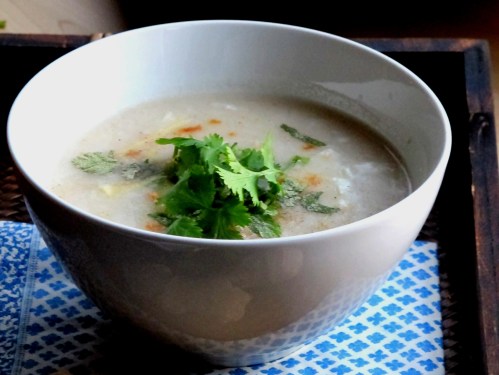
Kao Tom, Thai Rice Soup for Breakfast

It is easy to make with either from scratch or use leftover rice. But when one has an extra time, I would recommend to make the rice soup from scratch, please follow the recipe below to make rice porridge. It has a nice softer texture. I never think rice soup as a pot luck dish, however my student once told me that she brought to her office potluck party and it was a hit.

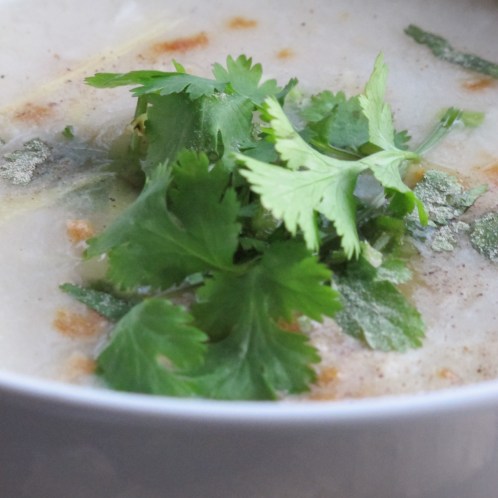
Thai Rice Soup with Chicken & Egg

Kao Tom Gai Sai Kai

Serves: 1 about 2 cups

Cooking Time: 5 to 8 minutes

1 ½ tablespoons canola oil
1 tablespoon minced garlic, about from 3 cloves
¼ cup ground chicken or pork (from chicken thigh or breast)
½ teaspoon salt
2 teaspoons soy sauce
1 ½ cups chicken broth
1 cup steamed jasmine rice or rice porridge (see note)
1 egg
1 tablespoon thinly shredded fresh ginger
1 green onion, thinly sliced
1 tablespoon coarsely chopped cilantro
A dash white pepper powder

Heat canola oil in a medium size pot on medium-high heat and stir in garlic. Stir constantly and when garlic is yellow, remove a half portion of fried garlic for garnish. Stir in chicken and cook with remaining oil and garlic, then season with salt and soy sauce. Pour in chicken broth and jasmine rice and let it cook on medium-high heat for 3 to 5 minutes.

When it reaches the desire texture of soup or porridge like, it is cooked and almost ready to serve. On high heat, crack the egg open and drop in the center of rice soup. You may stir or poach the egg in the hot rice soup; it can take from 30 seconds or 1 minute depending on your preference to cook the egg.

Pour the hot rice soup in a bowl and top with fried garlic, ginger, green onion, cilantro and white pepper powder.

© Pranee Khruasanit Halvorsen

Rice Soup, Kao Tom ideally taste best when made from rice porridge specially prepare for rice soup. For this recipe you may use cold leftover rice or cooked warm rice but the texture will be different. Below is how to make rice porridge for a rice soup. The amount is enough to make 4 rice soups from the recipe above.

Kao Tom Buey

Plain Rice Porridge

Yield: 4 cups

Cooking Time: 20 minutes

1 cup jasmine rice

Bring jasmine rice and 2 cups water to a boil on high heat, and stir often while cooking for 5 minutes. Add 4 cups water and bring to a boil and let it cook on medium heat for 15 more minute. Then cook until it yields 4 cups.

Thai Rice


© 2010  Pranee Khruasanit Halvorsen
I Love Thai cooking
Pranee teaches Thai Cooking classes in the Seattle area.
Her website is: I Love Thai cooking.com .
 

Read Full Post »

Dark Soy Sauce, an Essential in Thai Cooking  

Two years ago my friend Pom arranged for me to visit the Junsaeng soy sauce factory in Thalang, Phuket. I was fortunate to learn firsthand about their establishment and how soy sauce is made. Out of four soy sauce factories in Phuket, it is the only one still in business. I hope the video below will help you understand how soy sauce is made.

There are two types of soy sauce: light and dark. The dark soy sauce is a little-known but very important ingredient in many dishes, such as Phad See Ew, Kee Meo and Lahd Nah Noodles. After Phad Thai, these are the best known Thai noodle dishes for Americans. The secret ingredient in these dishes is a good dark soy sauce. For me personally, I love the flavor of dark soy sauce in Singaporean Noodles and Hainan Chicken. The challenge is that most of my students know how to use light soy sauce, but few have had a chance to experience cooking with dark soy sauce. Moreover, a good dark soy sauce is hard to find in America. My favorite brand is from Indonesia.

Before teaching my Thai Comfort Foods class for PCC Cooks, I decided to create a homemade, gluten-free, dark soy sauce. I didn’t want students to have to turn the world upside down to find dark soy sauce, but even more importantly, is almost impossible to find one that is gluten-free.  After a few experiments at home, I was happy with the results. My dark soy sauce recipe below was a success when I used it in stir-frying the noodles for my class. I hope that this recipe made it easier for you to cook Thai noodles at home. A few drops of dark soy sauce go a long way.

Dark Sauce 

See Ew Dam

In America, good dark soy sauce is hard to find. I created this recipe to make it available for students as a substitute for store-bought dark soy sauce. It is an important ingredient for stir-fried noodles and rice dishes that require a sweet molasses-like soy sauce. 

Yield: ¾ cup 

 ¼ cup water
1 cup dark brown sugar
½ cup wheat-free soy sauce

Place water and brown sugar in a heavy-bottom sauce pan and bring to a boil over a high heat. Stir until the sugar and water mix well together, then stop stirring completely. Let the sugar mixture cook on medium-low heat. Stand and watch the bubble. When it gets dark like coffee or molasses, pour in the soy sauce—be careful as there will be an eruption of bubbling liquid. Keep stirring until it becomes the consistency of molasses. Store in the refrigerator.

© 2010  Pranee Khruasanit Halvorsen 
 I Love Thai cooking   
Pranee teaches Thai Cooking classes in the Seattle area. Her website is: I Love Thai cooking.com .

Read Full Post »

Three Kinds of Pepper Leaves in Southeast Asia

There are three kinds of pepper leaves in the black pepper (Piperaceae) family. They can be easily confused by the inexperienced. This is how I explain the three types to my students when the lesson comes to the use of wild pepper leaf.

Wild Pepper Leaf - Chapoo - La Lot

A wild pepper leaf, or Piper Sarmentosum Roxb, is a common name for cha plu in Thai, Kaduk in Malaysian and la lot in Vietnamese. It is a ground cover in my garden in Phuket. Thais use it in Hua Mok, Miang Kam and tidbits. My favorite of all is when it is put in a stink ray curry.

Black Pepper Plant

A black pepper plant, Piper Nigrum, is in the same family as chapoo and la lot but it is a climbing plant. Only the fruit is edible. Thais love to cook green peppercorns with hot pungent curry dishes. When the pepper corn matures and is sun dried, it can be used to make black peppercorn.

This slideshow requires JavaScript.

Last in the family are betel leaves, or Piper Betle. When I was young, I always picked a fresh betel leaf for my grandmother, who enjoyed chewing the leaf when it was painted with pink limestone and wrapped around a sliced betel nut. Afterwards she would enjoy her afternoon siesta. Betel leaves and betel nut are also used for worship and are special symbols in ritual events.

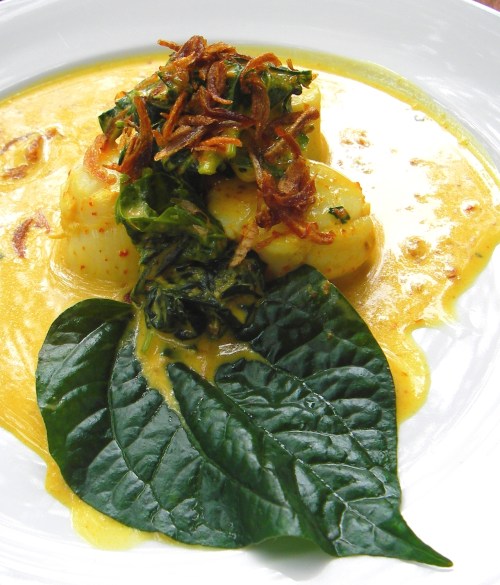
Curried Scallop with Wild Pepper Leaf — Gaeng Hoy Shell Bai Chapoo

I cook professionally during the week but at home on the weekend I cook like any home cook. Sunday is an iron chef day – I use whatever is in my refrigerator. I had some wild pepper leaf, a leftover from a Miang Kam dish during the week, and some Alaskan scallops in the freezer. I like to cook chapoo leaf in a curry with a strong flavored fish or meat; a hint of black pepper from the leaf gives a very interesting flavor to the dish, and coconut milk sweetens the bitter edge. This recipe is very quick. All you have to do is write down the word “la lot” and go to a Vietnamese market.

Curried Scallop with Wild Pepper Leaf

Gaeng Hoy Shell Bai Chapoo

Serves: 2

2 tablespoons canola oil
2 tablespoons red curry paste
2/3 cup coconut milk
1/3 cup water
6 large scallops
30 wild pepper leaves, AKA chapoo in Thai and La Lot in Vietnamese
1 teaspoon sugar
1 teaspoon fish sauce
2 teaspoons fried shallots

Heat canola oil in a medium-size pot on medium-high heat. Stir in red curry paste and fried until fragrant. Stir in 1/3 cup coconut milk and let it cook until oil is separated and fragrant; add the rest of the coconut milk and water and bring to a boil. Stir in scallops and wild pepper leaves and cook until scallops are opaque in color, about 5 minutes. Season with sugar and fish sauce and serve hot. Garnish with fried shallots. Serve warm with steamed jasmine rice.

© 2010  Pranee Khruasanit Halvorsen
I Love Thai cooking
Pranee teaches Thai Cooking classes in the Seattle area. Her website is: I Love Thai cooking.com

Read Full Post »

Ramadan 2010

Follow the Tradition of Thai Muslim Cooking on Phuket Island during the Ramadan

Now

Phuket Chicken Biryani Rice, also known as Kao Mok Gai, is a well known Thai-Muslim rice dish. Southern Thai cuisine gets its distinguished flavor from the neighboring countries of Malaysia and Indonesia. Growing up in Phuket I loved the diversity of our local cuisines. Our family cooked Thai and Chinese cuisines and at the market I enjoyed Thai Muslim cooking. After Persian Muslims settled in Phuket, their descendants took their traditional Biryani Rice and created a Thai variation, Koa Mok Gai. It is cooked for special occasions like weddings or during Ramadan. It is not a common dish to cook at home but most of the time we can purchase it from Kao Mok Gai vendors. If you want to try it when you visit Phuket, stop by an open air market in Bangtao or Kamala.

Phuket Chicken Biryani Rice—Kao Mok Gai Phuket

Over the past 10 years I have stayed in contact with a few chefs from Bangtao and Kamala Village. I learned to cook Kao Mok Gai from Varunee, my Thai chef for the culinary tour in Phuket. Her mom is a renowned caterer among the Muslim population in the Bangtao area. Over the years, I have written down many versions of her Kao Mok Gai.

Kao Mok Gai with Fresh Vegetable, Chile Sauce and Chicken Soup

The other day I wanted an easy lunch, which led to the creation of a quick and easy version of Kao Mok Gai. It took me 10 minutes to make, since I already had the ingredients in the house. It may take you 15 to 20 minutes to prepare the ingredients.

If you have an old-style rice cooker that is easy to clean, I recommend using that. Otherwise place everything in a Pyrex 9″x13″ pan and cover neatly with foil, bake in an oven at 350F for 25 minutes and let rest for 10 minutes before removing the foil and serving.

Phuket Chicken Baryani Rice

Kao Mok Gai

Serves: 4 to 6

Active Time: 10 minutes

2 cups jasmine rice, basmati rice, or any long grain rice
2 1/2 cups water or chicken broth
1 tablespoon fried garlic or shallot, plus 1 tablespoon for garnish
1 tablespoon canola oil, garlic oil or shallot oil
2 tablespoons Madras curry powder
1 tablespoon lemongrass powder
1/2 teaspoon galangal or ginger powder, optional
1 bay leaf
6 pieces fried or baked chicken
 
Rinse the rice and drain, put in a rice cooker with water, fried garlic, canola oil, curry powder, lemongrass powder, galangal powder and bay leaf. Mix well and place cooked chicken in the center of the rice cooker, cover, turn on rice cooker. It takes about 30 minutes to cook and then let it sit for 15 more minutes before serving.
 
Serving suggestions:

Buffet Style: Place rice and chicken on a nice platter and garnish the top with fried garlic or shallot. Served with condiments suggested below (please also see photo).

Individual serving: One cup rice, 1 piece chicken, garnish with fried garlic served with condiment and sauce.

Condiments: Sweet chili sauce, sliced cucumber, sliced tomato, cilantro and green onion.

Thai Vegetarian Option: Saute shiitake mushroom, fried firm tofu, raisin and cashew nut. Thai Cooking for Kids Gluten-Free Recipe


Then

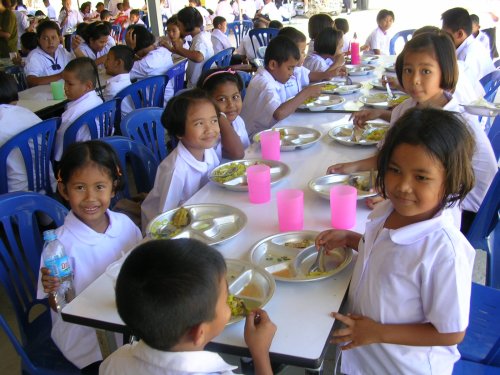
Here is a famous Kao Mok Gai prepared by Varunee’s mom for 250 children. I hosted this event for school children at the Kamala Beach School 6 month after the Tsunami. We served the food at the temporary kitchen in July 2005.


Pranee with Mama Boo, July 2005


Kao Mok Gai, Lunch for Kamala School Students July 2005

© 2010  Pranee Khruasanit Halvorsen I Love Thai cooking

Pranee teaches Thai Cooking classes in the Seattle, Edmonds, Redmond, Issaquah, Lynwood and Olympia areas. Her website is:  I Love Thai cooking.com 
 
To learn more on the history of Biryani Rice: http://en.wikipedia.org/wiki/Biryani

Read Full Post »

Corn and Scallion, a perfect pair

On the street corner of Hoi An, sliced scallion is soon ready for making into scallion oil.

The most memorable time for me in Hoi An was getting up to see the sunrise over the Bon River while drinking Vietnamese coffee shortly before heading for the market.  Then I walked along the street, and the scenery was very beautiful. The aromas and sounds were so enlivening and the taste of the food was phenomenal. I tasted many street foods along the streets and took a lot of it back to the hotel so that I could taste more during the day. This is part of the learning, culture and cuisine. Now, as I look at all my photos, I am getting hungry from the taste of foods that I still remember and long for.

I came to love one particularly famous grilled corn dish in Hoi An, Mo Hanh. It is made of grilled corn with scallion oil. You will see pictures of why the Vietnamese are so fond of this dish by the amount of corn on the street of Hoi An.

This slideshow requires JavaScript.

Yesterday, I was grilling corn for a special event at Magnuson Park in Seattle. About 500 people were there. I have 3 flavors for them to choose from: with spicy coconut sauce, jalapeno sweet and sour sauce and scallion oil. They were all a big hit at the event. I am delighted to share grilled corn with scallion oil recipe with you and hope that you will get a chance to enjoy until the last harvest of local fresh corn.

Grilled Corn with Scallion Oil

Serves: 8

1 cup thin sliced green onion, only green part–about 4 green onions
¼ cup canola oil
1 teaspoon sea salt
1 teaspoon sugar
8 ears of corn, peeled

 Pre-heat the grill to medium-high heat.

To make scallion oil or  Mo Hanh, heat canola oil until very hot and drop in green and let it cook for 40 seconds. Stir in salt. Let it sit until cool. Keep well in refrigerator for a week.

Grill corns over high heat 6 to 8 minutes, until some pope with nice brown cornel. When serve, dip each ear in scallion oil. Enjoy while it is warm.

© 2010  Pranee Khruasanit Halvorsen  
I Love Thai cooking

Read Full Post »

February 2010, Old Quarter in Hanoi

Hanoi Confetti Corn from the street of Hanoi Old Quarter

I love writing recipes from my culinary trip in my kitchen because it is like traveling through time.  And I love to travel, so when the journey ended then I was in pain with nostalgia. I missed the places I have been and the friends I have made. Then I decided to revisit the experience by recreating the food of that land. Like what I did last week with this Hanoi confetti Corn here in my kitchen.

This slideshow requires JavaScript.

This year my culinary trip to Southeast Asia started in Hanoi. After the long flight from Seattle and we arrived in the middle of the day.  After checking into the hotel, we headed off to the famous old quarter of Hanoi. No time for jet-lag, and old quarter is a best to start with exciting sight and sound. I already knew which street we wanted to walk, eat and shop. No time to waste we only have two days in Hanoi.

We came across the mobile foods just before Cha Ca Street, and the aroma of scallion oil and corn that caught our attention and find the confetti corn was cooking. Three of us tried to remember the all of the ingredients: cooking oil, corn, green onion, dried small shrimps, fish sauce and sugar. We ordered one and shared it on the street, it was delicious. Every day in Vietnam, the foods we loved consisted of a few simple ingredients put together in a stunningly simple way but the use of fresh ingredients made all the difference. This was a great welcome to the next world leading culinary destination.

Hanoi Confetti Corn with Shrimp Powder

I purchased the freshest local white corn from PCC Natural Market (in Hanoi, it was glutinous corn), shrimp powder is always in my freezer ready to use, I used chives from my garden instead of green onions and the rest of ingredients were staple foods.  I know how to revisit Hanoi again until the fresh corn runs out.

From Hanoi to your kitchen! Bon Appetite.

Hanoi Confetti Corn    

Serves: 4 

3 tablespoons butter 

2 cups corn kernels cut from 3 ears yellow or white corn 

1/4 cup chopped green onion, from 2 green onions or chives 

3 teaspoons shrimp powder, plus 1 teaspoon for garnish 

1 teaspoon sugar, optional –omit when use freshest corn 

1/2 teaspoon chili powder 

1 to 2 teaspoons fish sauce

Heat the butter over medium heat in a large skillet. Allow the butter to melt, add the corn and cook for 5 minutes. Stir in green onion and shrimp powder and chili powder and let it cook for 1 or 2 more minutes. When the corn loses its starch and  stir in fish sauce and serve right away.

© 2010  Pranee Khruasanit Halvorsen 
I Love Thai cooking  Pranee teaches Thai Cooking class in Seattle areas, her website is: I Love Thai cooking.com  
 

Read Full Post »

Thai Basil Seed Drink, a Fun Summer Time Drink   

When the weather was very hot and dry in my Thai village, I used to run to the drink stand for fresh basil seed drinks with ice floating in a pink rose floral flavored drink. It made the summer day bright and special for me and all the Thai kids back then.   

We sometimes harvested our own lemon basil seeds by shaking and rubbing dry flowers over a cloth until all the seeds came out. Then we would blow out the impurities and dust before soaking seeds in water. Then we added simple syrup or honey, rose-water or flower essences and ice. It was a fun drink to make and enjoy. I loved to make this drink with friends. It was fun to see a black seed changing in water to look like a fish egg, dragon fruit or kiwi seeds like in 10 minutes.  It looks strange but it tastes so good, and has natural fiber. This jelly-like seeds can be added to Thai desserts for texture, just like you do with tapioca pearls in bubble tea drinks. It is great with toddy palm seeds and longan drink also. Similar drinks are known to all Southeast Asian countries such as Vietnam, Malaysia, India.     

Thai Basil Seed Drink -- Nam Mengluck


At home in Seattle, I either made this drink with simple syrup and natural flavor extract or honey. You may use  Hale’s, Torani or Grenadine syrup with your choice of  flavor and color. The hard part for you will be to find basil seeds. They comes in a small package under: Sweet Basil Seed (Med Mengluck) [Thai], and Natural Dried Basil Seed (HOT E) [Vietnam]. Good luck (Chok Dee).   

Thai Basil Seed Drink   

Nam Mengluck   

Serves: 2   

1 tablespoon basil seeds, culinary seeds only
6 tablespoons simple syrup, Grenadine, Torani or Hale’s syrup.
2 cups ice-cubes
1 cup cold water
2 basil sprigs or flowers for garnish 

Combine 1 cup water and basil seeds in a pitcher and let it sit for 15 minutes. Then stir in simple syrup, grenadine syrup or Torani, ice-cube and cold water. Pour in two-chill-tall glasses and garnish with basil sprigs or flowers. Serve cold.   

© 2010  Pranee Khruasanit Halvorsen  
 I Love Thai cooking 
 
Pranee teaches Thai Cooking class in Seattle areas, her website is: I Love Thai cooking.com

Read Full Post »

A Romance in a Thai Granny’s Garden

Thai Country Style Soup with Lemon Basil    

Gaeng Leang Bai Meng Luck    

Every time I visit a Seattle Farmers’ Markets  and see Hmong-farmer stalls that have fresh lemon basil; I get excited and want to cook Gaeng Leang–a Thai country-style soup. It is our Thai ancestor’s creation and a classic soup that is known in every village in Thailand. Any vegetables that grow together in a Thai granny’s garden seem to go together in a pot with a finish touch of lemon basil — a romance of flavor is in the pot. Thais seem to keep it simple with three to five vegetables. If there are five kinds of vegetable with five-different hues of color then the classic name is “Gaeng Leang Benjarong” and one of the vegetables must be Kabocha pumpkin with its yellow-orange color.

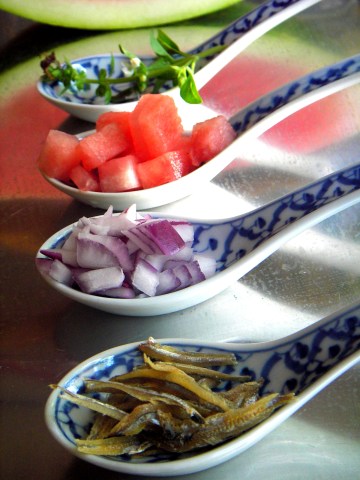
Anchovy, red onion, watermelon rind, lemon basil

Thai food historians believe that the soup base or broth derives from the base of Nam Prik (Thai traditional Chili dip). Making Gaeng Leang Soup base typically it starts with pounding shallot, shrimp paste and chilli in a mortar with pestle to form a paste, and placing it in boiling water, similar to my recipe below. The alternative to a shrimp paste is dried salted shrimp, dried salted anchovy or dried grilled fish–think of it as Dashi, Japanese fish stock.

After making the soup base, the rest is simple. You may use any authentic Asian vegetable of your choice such as luffa, Kabocha pumpkin, young corn, melon, corn kernels or watermelon rind. The final touch is always lemon basil (Bai Maeng Luck).  Lemon basil is inseparable from this soup. In Seattle in the summer I always use lemon basil either from my garden or the farmers’ market.

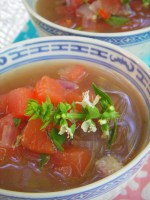
Watermelon Rind Soup with Lemon Basil

I challenge myself to reconstruct a rustic Thai dish in a sophisticated way while keeping the original concept and authenticity. I cut anchovy fillets into small pieces and dice watermelon. The soup is gentle and not as hot and earthy as in Thailand with shrimp paste. Thais generally serve this soup warm. But my recipe is generous with the amount of watermelon rind so it is sweet and sophisticated enough that you can serve either warm or cold.  I love the simplicity of Gaeng Leang — a flavor of fresh seasonal vegetables  in a bowl.

Tomorrow my friend  will drop by for lunch. I want to prepare a summer soup for her, a country-style but elegant for girl lunch. I know she will like it. Our desert will be Yangon Almond Pancake with Berry and honeyed yogurt. All I hope for is a nice sunny day, so we can enjoy in my Thai garden here in Seattle.

Watermelon Rind Soup with Lemon Basil    

Gaeng Leang Pueak Tangmo Kub Bai Meng Luck

Serves: 2

1 tablespoon chopped dried anchovy fillets or dried salted shrimp, pounded
1/4 cup diced purple onion or shallot
1 cup diced watermelon rind or any mixed vegetable (please see list above)
1/4 teaspoon salt
1/8 teaspoon black pepper
Thai chili powder to taste
2 tablespoons lemon basil leaves,  plus 2 sprigs for garnish

Bring 1 1/2 cups water, anchovy and purple onion to a boil and keep it simmer on medium heat for 15 minute to develop the flavors for the soup.

If you don’t want to eat anchovy, you may strain to remove the anchovy and purple onion at this point.

Combine watermelon rind, salt, black pepper powder and chili powder with the soup and let it cook on medium-high heat for 5 minutes. Stir in lemon basil and serve right away. Garnish with lemon basil sprigs.

Note: When lemon basil is not available, I compromise with Thai purple basil and it will not be lemony flavor that finish the soup but licorice instead.     You may use any vegetables from farmer market or your garden such as zucchini, squash, pea leaf, corn and more.

 © 2010  Pranee Khruasanit Halvorsen
 I Love Thai cooking
Pranee teaches Thai Cooking class in Seattle areas, her website is: I Love Thai cooking.com

Read Full Post »

Thai Village Style Cooking    

Fried fish recipe from the Southern region of Thailand 

The other day, when I was at Pike Place Market, wandering around almost aimlessly like a tourist. I purchased a pound of sardines, I hadn’t tasted fresh sardines for the longest time perhaps since my grandma’s kitchen. I want to rediscover more Thai village style cooking with local ingredients here in Seattle. This was a good start.  

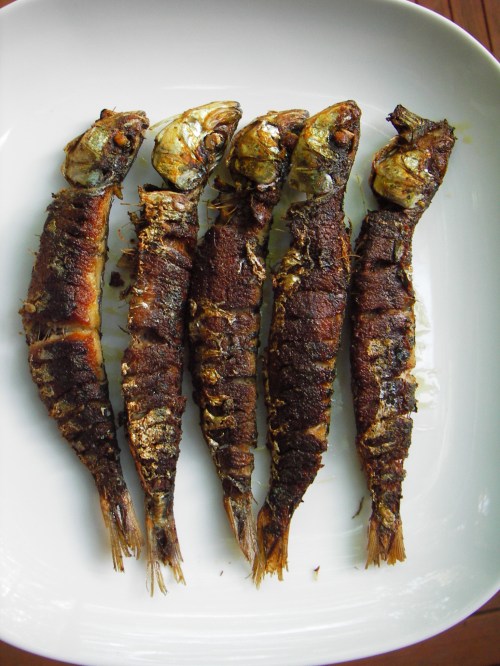
Thai Fried Sardines--Very Rustic Thai Cooking

The sardines are fresh from the Gulf of California and there is no need to worry about mercury because it is known to be very low. There are many good reasons to eat sardines, they are rich with Omega-3 fatty acids, Vitamin D, calcium and B 12. Perhaps that’s why both of my grandmother hardly saw any doctors in their life time. Every single day growing up, fried fish with turmeric and salt was on the table, besides other fish dishes. It was my grandma’s rule. The fish was the cheapest and healthiest protein that Phuket villagers could provide for their family way back then. I love fried sardines, they have a mouthful flavor and the aroma is unique.

If you are trying this for the first time, the challenge is how you will cook them, so you can eat everything including the soft bone and when crunchy enough, the back bone. It is a calcium intake time. As my rule goes, if it is chewable then it is edible! But trust your judgment and comfort zone also.


This slideshow requires JavaScript.

First I removed the fish guts. That was not fun. The problem is the sardines were so small and the belly was so relatively big. I tried the best I can to make sardines look good in the photos. After I gutted, cleaned and dried the fish, I followed my grandma’s old advice. I cut the flesh through the skin into tiny strips (the knife is perpendicular to the fish back bone) just enough to hit the backbone (please see the slide show). I repeated on the other side. I salted them and seasoned with turmeric. I placed 8 sardines in a food container and kept in the refrigerator for a day. I had something else planned for dinner that evening. When you want to keep the fish for a day in fridge, be generous with salt and turmeric. It is a way that we use to keep the fish fresh for the next day, back when we didn’t have electricity.

You may use the recipe below and cook sardines on the grill on medium heat on both sides until crispy. The problem with frying in your kitchen is the smell of the fish lingers for a day. I just want you to know that, but it tastes divine with hot steamed jasmine rice. Especially good if you eat it with your fingers, and easy way to remove the backbone then mix the fish by hand against the warm jasmine rice before eating,  just like Thais in the Thai village do.

 Thai Fried Sardines  

 Pla Sardine Tod

ปลาซาร์ดีนทอด 

 Serves: 4

 1 pound sardine, about 8 sardines, gutted and cleaned and dried with towels
2  teaspoons sea salt
1/2 teaspoon turmeric
3 to 5 tablespoons canola oil

 Lay the fish perpendicular to you on the cutting board, cut the flesh through the skin into tiny strips (the knife is perpendicular to the fish back bone) just enough to hit the backbone (please see the slide show), Repeated on the other side. Follow the same steps with the rest of the fish. Sprinkle salt all over the fish and follow by turmeric until the fish is evenly cover.

Heat the frying pan on medium heat, when the pan is hot add canola oil. Fry on both sides until they are crispy by the touch and a light brown color. Serve with warm jasmine rice.


 © 2010  Pranee Khruasanit Halvorsen  
I Love Thai cooking 
 Pranee teaches Thai Cooking class in Seattle areas, her website is: I Love Thai cooking.com  

Read Full Post »

My very  first breakfast in Yangon.

Yangon Almond Pancake

When I was in Yangon last year I spent my first morning looking for a market near the hotel. It was a street that had many stalls and breakfast type food stands. Everything in Yangon was very exciting for me, as a neighbouring country to Thailand. I found that our culture and cuisine are very different in many ways. The thing that catched my eye most was a lady making an almond pancake on the street. I stood in line and signalled for some almond pancake, the same one that she just did for the customer in front of me.  First she poured the pancake batter in the pan, sprinkled generous amount of almond on top, then she placed a charcoal heater on top. Like baking, the cake actually rise after a few minutes. She then gave it to me in a plastic bag. I ate there on the street. I really loved it, as its almond flavor and texture were very pronounced, crispy, and aromatic.

This slideshow requires JavaScript.

I asked for permission to take picture and I was glad I did and it is helpful to write this recipe. I still remember the flavors, so here I am trying to duplicate the recipe from the memory– Here in Seattle in my kitchen.

I created Honey-Lime Syrup to go with the pancake. In Southeast Asia, it is typical way of using honey-lime for a syrup in a dessert. Also you can simply add more hot water to melt honey and put over ice as a tonic drink. It is very versatile recipe. I like local pure honey. I use “Twin Peaks”  Mountain Honey from Snoqualmie Valley Honey Farm, located in North Bend, Washington. The bees collect nectar from the local wild flowers the scent of the wild flower is present in the honey. You may use any honey.

I want to tell you that this pancake is beyond breakfast. I popped frozen left-over in the toaster this morning, and the almonds on the pancake were very crunchy and delicious with my Vietnamese coffee. I almost cry, I miss Burma.

Honey-Lime Syrup

 Nam Pueng Ruang Manao

Yield: 1/4 cup

 3 tablespoons honey
1 tablespoon hot water
2 teaspoons lime juice
1 drop almond extract, optional
 

Combine honey and hot water in a microwave save small bowl. Heat in the microwave for 15 seconds and stir until uniform. Stir in lime juice and almond extract. Stir really well and set a side. Store in refrigerator up for a week.

Yangon Almond Pancake

Yields: 1 1/2 cup pancake batter

Make: 4 to 6 pancakes
 
1 cup flour
1 tablespoon baking powder
1/2 teaspoon salt
3/4 cup almond meal flour
1 egg
2-3 tablespoons sugar
2 tablespoons melted butter, plus 4 tablespoons to cook pancake
1 1/4 cups milk
1/2 teaspoon pure almond extract
1/2 cup sliced almonds, toasted
 

Sift flour, baking powder and salt twice and place into a large bowl along with almond meal flour. Beat eggs, sugar and butter in a medium size bowl for 30 seconds. Combine with milk and almond extract. Then pour in the flour mixture, fold it gently just to mix.

To duplicate the technique shown in the pictures, I use a heated cast iron pan as a hot lid. Cover the pancake while cooking.

Heat a pancake pan with 1 tablespoon butter on medium heat when melt pour 1/3 to 1/2 cup batter. Sprinkle 2 tablespoons toasted sliced almond on the surface of the pancake, cover with heated cast iron pan and let’s it cook for 3 minutes. It should rise, when the edge is golden, use spatula to lift the pancake to see if it yellow-brown. If it does, it is ready. Flip with spatula to cook another side. It should take about 30 seconds, more or less. Check the same way if it is done. Don’t let the almond burn, it should take about 3o seconds. Repeat the process to make 3 or 4 more pancakes. Serve right away with Honey-Lime Syrup.

Note: I freeze the uneaten pancake by letting it cool, line with parchment paper and put in the zip lock bag. Freeze. Next time around all you have to do is put in the toaster. 

 © 2010  Pranee Khruasanit Halvorsen
 I Love Thai cooking
Pranee teaches Thai Cooking class in Seattle areas, her website is: I Love Thai cooking.com

Read Full Post »

Pike Place Market

Travel and Eat Like a Tourist

Pranee at Pike Place Market, be a tourist

I wanted to enjoy the beautiful summer we are having and decided to visit Pike Place Market. I pretended to be a tourist for the day to taste foods and to enjoy the sites from a tourist perspective. I arrived around 10 am, when it was easy to find parking – two hours was just perfect.  First I walked around to see the farmers stalls and admired all of the fresh vegetables. Being early bird meant that there were not many people around, so I could ask a lot of questions and chat with the stall owners, which is how I got inspired and wanted to know about the source of ingredients. I always learned somthing new. The fish person said that the fresh sardines are from California and he like to grill the sardines until they are crispy, so you can eat the whole thing including the bones. I shared with him that my grandma would cut the skin into tiny stripe just enough to hit the backbone on both side before frying them. Then I asked the owner of a honey stall, to find the right kind of honey for my future recipe for almond pancakes. We talked and tasted and came up with the “Twin Peaks Wild Flovors” honey. I hanged out with the tourists and enjoyed the music played around the market. The color of flower bouquets was stunningly beautiful and the small doughnuts were so tempting but I passed for today. I stopped at the pig statue, and stood in line for photo opportunity with the famous pig. A kind tourist took a photo of me.

I started to get hungry and was debating where I should eat. I decided that today would be a French Day, so I decided to eat at Le Panier. I had a Pate French sandwich. It was perfect with a crusty baguette which had a crumbly  crust, and I didn’t mind being messy. I sat at the window bar table facing the street and watched the tourists go by. There is no rush, this was my French vacation after all. I was a tourist for two hours. Life is short, and there was no way I could have skipped dessert. In case you don’t know La Panier, it is a very French cafe and bakery. So I had palmiers with their house coffee (they used a Cafe Umbria dark roast, which is from a local roaster in Seattle).  I splited my La Pamier into perfect halves. I ate one half the french way with coffee and the other like Thais would do with Chinese doughnuts. That is, I soak it in coffee for 10 seconds before enjoying it slowly. Oh, life is good!

Before heading home I took a few more photos of places that I would recommend to tourists who are planning to visit Seattle. For the first time you will need to spend a good three to four hours there.

I got some sardines and a few herbs home. I will post a fried sardine recipe, which is my inspireational ingredient for the day.

I will cook, write and eat Thai locally this summer!

This slideshow requires JavaScript.

Read Full Post »

Thai Grandmother Cooking is a sustainable cooking

Pranee’s Grandmother Recipe

Watermelon rinds

My mom taught me many culinary skills but it was my grandmother who deepened my sense of sustainable cooking. We cooked virtually everything sustainably, just like the French. I have a habit of saving the rinds in a zip lock bag and cooking for myself because I am not sure if anyone else care for it. I would not miss this opportunity that only come once a year. I either incorporate them into a hearty soup or stir-fry. For stir-frying, I stir-fry it with either salted pork or dried anchovies. There is nothing more or less, just two ingredients. If you haven’t try to cook with watermelon rinds, you will love the flavor. I like it more than stir-fried cucumber, as it has light flavors of watermelon and cucumber.

how to remove the green skin from the water melon

A little light green on the rind has a nice little sour to it, where as the pink has sweet melon flavor. After stir-frying the fragrance and flavor are more like cucumber.  As my grandma always said, “sour, sweet, fat and salt” are neccessary in any main dish.  I tasted a similar combination once at the IACP international event  in New Orleans by renowned chefs combining fresh frozen cubed melon garnish with fried crunchy pork rind. (I will get the name and post it later)  

It takes 10 minutes to prep and 3 minutes to stir-fried and next it became my lunch. I enjoyed it on my patio in the sun recently. The aroma took me back to my grandma’s kitchen and a warm of sunshine of Thailand.

Note: I decided to add chive from my garden to make this Thai rustic cooking more appealing and also for photography purpose. However, the favor of chive does go well with the stir-fried watermelon rind and salted pork.

Pranee’s Grandma Cooking–Stir-fried Melon Rind with Salted Pork

Thai Stir-fried Watermelon Rind with Salted Pork

Phad  Puak Tang Mo Moo Kem

Serves: 1

2 tablespoons cured salted pork or sliced becon
1 teaspoon canola oil, optional
1 clove garlic, crushed and coarsely minced
1 cup melon rind, skin removed and sliced into 1/3 inch width and 2 inch length–please see slide show
2 tablespoons chives, for garnish
 

Heat a wok on medium-high heat, and stir in salted pork or bacon. Saute them until crisp and fat is rendered. Remove excess fat to allow only 1 teaspoon on the bottom of the wok. If no fat can be rendered, then add 1 teaspoon canola oil. Saute in garlic until yellow. Stir in sliced watermelon rind and cook for 1 minute, the aroma of garlic, bacon and melon like should  develop before adding 1 tablespoon water. Cook for one more minute and make sure to have about 1 or 2 tablespoon sauce, otherwise add more water. Stir in chives and serve right away. Or use chive for garnish. Serve with warm jasmine rice.

This slideshow requires JavaScript.

Thai Vegetarian Option: Saute shiitake mushroom with sea salt to substitute salted pork.   

Thai Cooking Recipe for Kids, Gluten-Free Recipe  

 © 2010  Pranee Khruasanit Halvorsen  
 I Love Thai cooking
 
Pranee teachs Thai Cooking class in Seattle areas, her website is:  I Love Thai cooking.com

Read Full Post »

Asparagus Everyday!

Summer is just beginning in Seattle and you will find many uses for my lemongrass vinaigrette recipe all this summer. I adore asparagus, and every chance I can I cook local asparagus. When I use a grill to cook meat or seafood for a main dish, I like to use grilled asparagus with lemongrass vinaigrette as a side dish.

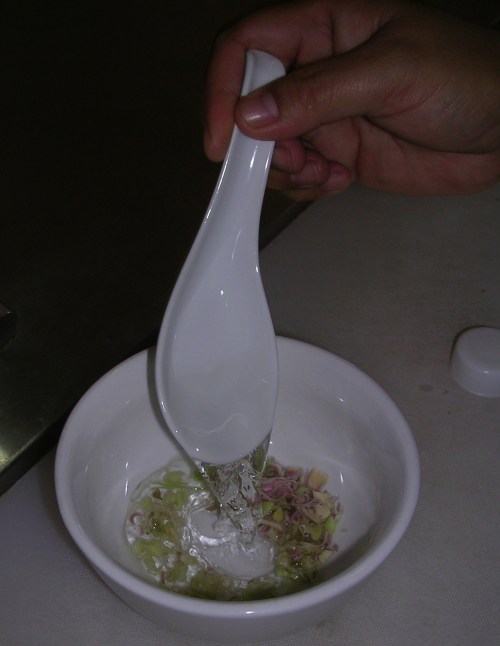
One tip is to prepare the lemongrass infused vinegar a day before making the Lemongrass Vinaigrette. The vinaigrette itself is then simple to make. Brush the asparagus with the vinaigrette before grilling and add some more of the dressing after the grilling. Garnish with any fresh herbs and edible flowers from your garden.

I learned how to make lemongrass vinaigrette from The View Point Cooking School, Inle Lake Myanmar. Thank you to Mae Mae, my sweet and talented teacher.

Lemongrass Vinegar Recipe

Nam Som Takrai

Yield: 1/2 cup

 1 lemongrass, trimmed and minced
¼ cup vinegar
1 tablespoon sugar

 Place minced lemongrass, vinegar, and sugar in a bowl and stir. Let it sit for at least 4 hours or refrigerate for a few days.

Pour vinegar over minced lemongrass

Add some sugar

Grilled Asparagus with Lemongrass Viniagrette 

Nor Mai Farang Pao

Serves: 4

 3 tablespoons minced shallot or red onion
1/4 cup fried garlic oil or shallot oil
1/4 cup lemongrass vinegar, see recipe above
3 teaspoons sesame oil
1 teaspoon salt
1 teaspoon sugar
1 pound asparagus, trim the end then keep whole
2 tablespoons chopped chives and dill or cilantro 

Pre-heat the grill.

To make vinaigrette, place shallot, garlic oil, lemongrass vinegar, sesame oil, salt and sugar in a small jar. Close the lid tight and shake well. Keep in refrigerator until needed. It will keep in the refrigerator for a week.

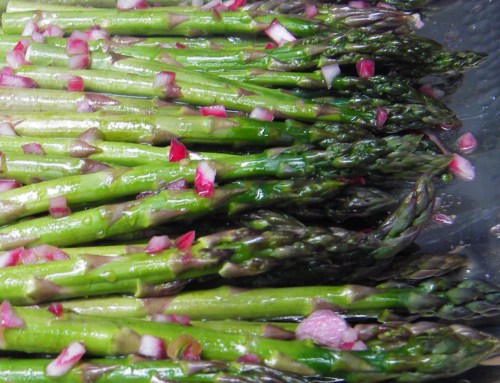
Place asparagus in a good sized bowl that will fit the whole asparagus and soak in ¼ cup of the vinaigrette. Pre-heat a vegetable grill pan on top of a hot grill then add the asparagus. Grill over medium high heat, turning the asparagus to grill all sides. Grill until cooked to a nice green and still crisp. Remove from the grill and place on a plate. Sizzle more vinaigrette as needed and garnish with chives and dill.

Asparagus dressed with lemongrass vinaigrette ready to grill

© 2010  Pranee Khruasanit Halvorsen   
 Love Thai cooking
 
Pranee teachs Thai Cooking class in Seattle areas, her website is:  I Love Thai cooking.com

Read Full Post »

I have a few bananas that are at their peak and have been thinking for several days about writing down my Banana Pancake recipe. This morning was perfect for it. While waiting for my Vienamese coffee to finish dripping, I finished making the banana pancake batter. I drank a few sips of coffee and started preparing my pancakes; three minutes later I sat down and enjoyed my breakfast in peace. Looking out the window, I saw that it was another rainy day in June in Seattle.

Banana Pancake with Sweetened Condensed Milk

In Hawaii I love to eat macadamia nut pancakes for breakfast. In Phuket I prefer a banana pancake served with sweetened condensed milk. It is not a traditional dish, but originated from the tourist industry, though it is reminiscent of Phuket Roti — a Southeast Asian thin pancake filled with banana and eggs and garnished with sweetened condensed milk.

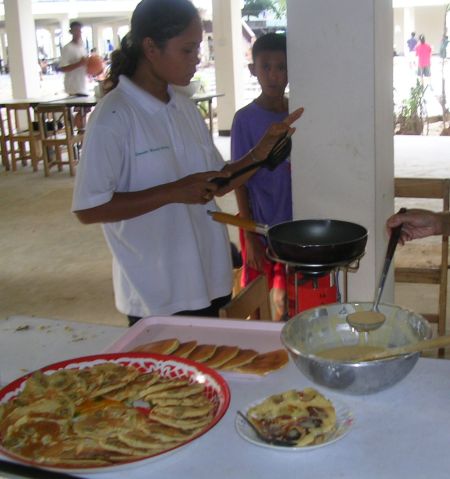
But my fondest memory of all came when I tried to duplicate the recipe that my friends and I cooked a few years ago for over 50 students at the Kamala School in Phuket.

Banana Pancake 

Pancake Kleuy Horm 

Yield: 6 pieces

1 ½ cups all purpose flour
1 tablespoon baking powder
½ teaspoon salt
2 eggs
1 ½ – 2 cups whole milk
1 tablespoon sugar
6 tablespoons butter
3 to 6 bananas, peeled and sliced to ¼-inch thick
3 to 6 tablespoons sweetened condensed milk


Place flour, baking powder and salt in a large bowl and sift a few times.

Beat eggs for 1 minute and then whisk in milk and sugar for 1 minute. With one hand, pour over flour mixture slowly in a stream while gently folding egg mixture into flour mixture–just enough to mix.

Heat an 8-inch cast iron pan or crepe pan on medium heat. When the pan is hot, melt 1 tablespoon butter in the pan then pour in ½ cup batter. Place desired amount of banana on the top of the pancake batter. Cook until the batter bubbles up and is cooked about 2/3 up from the bottom, about a minute and a half. Flip to cook the other side and cook until the bottom is nice and brown, about 30 to 40 seconds. Place the pancake on a serving plate and swirl sweetened condensed milk on the top as desired.

Repeat the process to make 5 more pancakes.

© 2010  Pranee Khruasanit Halvorsen   
 Love Thai cooking
 
Pranee teachs Thai Cooking class in Seattle areas, her website is:  I Love Thai cooking.com

Banana Pancake for Kamala School

Read Full Post »

« Newer Posts - Older Posts »