Feeds:
Posts
Comments

Archive for September, 2010

Seattle Feast with Friends, 2010

I created this recipe for Seattle Feast with Friends event (http://futurewise.org/action/SeattleParticipants) held on Thursday, September 30th, 2010. This celebration brings together local food producers, winemakers, and guest chefs.

I hope to see you there. If you cannot attend, then enjoy cooking this recipe. Cheers, Pranee


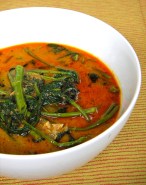
Thai Mussel Curry with Tomato and Lemongrass

Thai Mussel Curry with Tomato and Lemongrass

Gaeng Hoi Nang Rom

This recipe uses red curry paste, coconut milk and just enough lemongrass to create a flavorful soup. The sweet and sour from the tomato and the tamarind juice heighten the flavor of the mussels. It is a very well balanced dish that you can enjoy by itself as a soup, or served it with steamed jasmine rice as a mild curry dish. Dill and cilantro are the perfect herbs for a finishing touch.

Serves: 2 as a main dish

1 tablespoon canola oil
1 tablespoon red curry paste
2 tablespoons chopped lemongrass
3 tablespoons coconut milk, or more as needed
2 medium size ripe tomatoes, cut into large chunks
15 mussels, de-bearded and halved (about a pound)
2 tablespoons tamarind juice, or 1 teaspoon tamarind concentrate plus 1 teaspoon sugar
2 tablespoons chopped dill
2 tablespoon chopped cilantro

Stir canola oil, red curry paste, and lemongrass together in a pan on high heat until fragrant. Then stir in coconut milk and let it cook until the oil separates out from the rest of the mixture. Stir in the tomatoes and mussels and stir well. Cover with lid and cook until the mussels open up, about 5 minutes. Stir in tamarind juice; stir well and cook until the mussels are done (see below). Stir in dill and cilantro and serve right away.

Recipe by Pranee Khruasanit Halvorsen http://ilovethaicooking.com/

Mediterranean Mussels by Taylor Shellfish Farm http://www.taylorshellfishfarms.com/

Wine Pairing: http://www.skyriverbrewing.com/

Sky River Semi-Sweet Mead

$14.99 per bottle

“Sky River Semi-Sweet Mead, although drier, enjoys a similar depth and character to the Sweet Mead. With hints of pear and a crisper finish Sky River Semi-Sweet Mead, served well-chilled, delicately offsets the exotic notes of sesame and ginger in Pan-Asian cuisine, and the rich herbal textures of the Mediterranean.”


Cooking Tips from the Expert, Jon Rowley

The Mediterranean mussels, which are just now coming into season and will be very plump, aren’t done when they open. They need to continue cooking after they open until you see the meat contract. This makes a BIG difference in the flavor. If the mussels are not cooked enough, they have an unpleasant fleshy taste. If cooked properly they are gloriously sweet. These mussels are so fat,  you don’t have to worry about overcooking.

Also if some mussels don’t open and the others are done, the ones that are closed will also be done. They just need to be pried open. Bum mussels will be open before cooking and should be discarded. Mediterranean mussels that are closed after cooking, if you have any, are fine.

© 2010  Pranee Khruasanit Halvorsen
I Love Thai cooking
Pranee teaches Thai Cooking classes in the Seattle area.Her website is: I Love Thai cooking.com
Read Full Post »

I Couldn’t Say No to Nectarines

It was too much temptation for me! Yesterday I went to a market and saw a box of a dozen local nectarines. Off course I purchased a box to take home. I had no idea at the time what I wanted to do with them. I ate a few and still had nine left. Then I remembered the cookbook that I had purchased the day before: A Passion for Ice Cream by Emily Luchetti. It won an IACP award. It was just perfect–I looked through the index and found a nectarine ice cream recipe. I want to give it a try today since I already had my ice cream machine ready in the freezer. It is not difficult nor time-consuming to make ice cream, but it is all about planning.

I spent a good forty-five minutes prepping and cooking, and now everything is ready to chill in the fridge. I will put the mixtures in the ice cream machine tomorrow while I am working at home, then let the machine do the work.

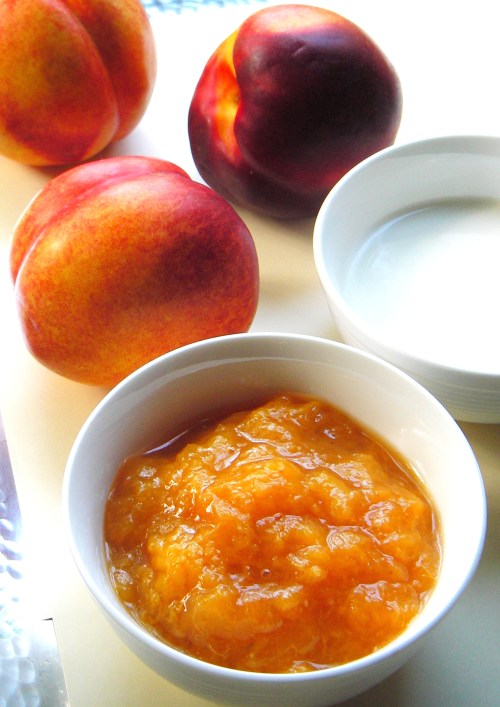
Nectarine and Coconut Cream, Ready for the Ice Cream Machine

This is my Thai adaptation with tamarind and coconut milk.

Nectarine-Coconut Ice Cream

2 1/2 pounds of nectarines (about 5 fruits), peeled, pitted and chopped
1 tablespoon tamarind concentrate, or lemon juice
8 tablespoons sugar, divided
1 pinch of salt
1 1/2 cups heavy whipping cream
1/2 cup coconut milk

Place nectarines, tamarind concentrate, 4 tablespoons sugar, and salt in a medium size pot and bring to a boil. Let it cook on medium heat until it looks like a jam, about 15 to 20 minutes. Set aside to cool. It should yield about 2 1/2 cups.

Stir cream, coconut milk and the rest of the sugar in a sauce pan on medium heat until the sugar is melted. When it steams up, remove and let it cool.

Now I have both mixtures in separate containers and ready to go into the ice-cream machine. I will keep you posted on how it goes–with photos, off course. It will take a while, though. There is no natural sunshine in Seattle today for a food photograph.

I can’t wait to try the nectarine-coconut ice cream tomorrow.

September 22

Before lunch I placed the chilled nectarine and coconut cream mixtures in my ice cream machine. By the time I finished my lunch, the ice cream was done. I left it in the container and put it in the freezer.

At 2:20pm, I tasted it. OMG, delicious!

Nectarine-Coconut Ice Cream served on a nectarine and topped with coconut flakes.

© 2013  Pranee Khruasanit Halvorsen
I Love Thai cooking
Pranee teaches Thai Cooking classes in the Seattle area.
Her website is: I Love Thai cooking.com 
 
Related articles

Read Full Post »

Phuket Red Curry Paste, My Aunt’s Recipe

I have five women in my life that I am thankful everyday for their talents, strength and kindness. I grew up with my grandmother, mom and my three aunts. It was quite an experience.  When it came to culinary skills, my three aunts each had their own specialty. My aunt Pan specializes in curry paste making and her curry paste is well known among family and friends. It was the year I left Phuket to go to Seattle that I visited my Aunt Pan to pick up a kilo of her homemade curry paste to bring with me. I kept it in the freezer for a year. But when I visited her a year later, I felt a little guilty asking her to make some more for me because it takes a week of pounding by hand. Instead, I asked her for her secret. She taught me to feel the ingredients in my left palm before putting them in the mortar. I was not sure if I got it at the time, but I was glad that I had also taken note of the amount in standard American measuring spoons. Now I even teach my aunt’s recipes in my cooking class on Southern Thai curry dishes.

Then the other day, I gave myself a final exam. I was in the kitchen preparing a curry paste, conducting every step from memory. I recalled the lesson with my aunt from over 15 years ago. She said that for four servings, start with about 1 teaspoon of salt and about 1 tablespoon of black pepper. For turmeric, she said that if I wanted to use fresh turmeric I should use about 1 inch, and she bent her index finger. If I used dry turmeric, use about 1 teaspoon. The amount for the dry red chili pepper I remember really well. She used 40 dried Thai chilies.  I used 20 for my cooking class and everyone thought that it was too hot, so generally I use 15 chilies for American 3 stars and 20 for 5 stars.

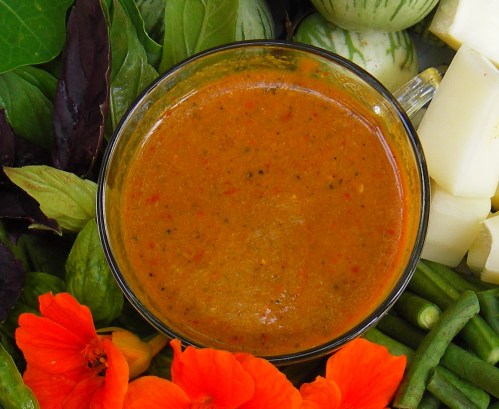
Phuket Red Curry Paste--Recipe from Phuket Village

My grandmother, mom, and three aunts prepared this curry paste with a  mortar and pestle countless times in their lives. About 30 years ago, when our village had access to electricity for the first time, I remember that the most important modern kitchen appliances that we purchased right away were a rice cooker and a blender.

My mom’s favorite way to make curry paste was with a mortar and pestle, but often she blended them in the blender. For this recipe I decided to prepare it in a blender, which only takes 5 minutes. I hope you enjoy my family recipe.

The Color of Phuket Red Curry Paste

Phuket red curry paste is so versatile. You may use it in any red curry recipe that calls for red curry paste. However, the color is yellow because our family omits dried large red spur chili pods. You may add 3 dried New Mexico Chili Pods to this recipe to add a deep red-orange color.

Phuket Red Curry Paste

Kruange Gaeng Phed Phuket

Yield: 1/2 cup

1 shallot, halved and peeled
6 cloves garlic
1 lemongrass, trimmed and thinly sliced, about 2 tablespoons
1 teaspoon salt
1 teaspoon turmeric
1 teaspoon shrimp paste
1 tablespoon black peppercorns
Place all ingredients in the blender with 1/2 cup water; blend until smooth, about 5 minutes.

© 2010  Pranee Khruasanit Halvorsen

I Love Thai cooking
Pranee teaches Thai Cooking classes in the Seattle area. Her website is: I Love Thai cooking.com
Read Full Post »

Thai Cooking with Mussels

Steamed Mediterranean Mussels with Sweet Chili Sauce

I love mussels, and Thai cuisine has so many great mussel recipes. Unfortunately, cooking classes with mussels don’t sell well in Seattle. But you can enjoy my recipe without being in my class. This delightful, easy recipe uses fresh Mediterranean mussels that are at their peak season right now. The Taylor Shellfish Farm stall at many Seattle Farmers Markets is a good place to get them.

Cooking Tips from the Expert, Jon Rowley

The Mediterranean mussels, which are just now coming into season and will be very plump, aren’t done when they open. They need to continue cooking after they open until you see the meat contract. This makes a BIG difference in the flavor. If the mussels are not cooked enough, they have an unpleasant, fleshy taste. If cooked properly they are gloriously sweet. These mussels are so fat, you don’t have to worry about overcooking.

Also if some mussels don’t open and the others are done, the ones that are closed will also be done, they just need to be pried open. Bum mussels will be open before cooking and should be discarded. Mediterranean mussels that are still closed after cooking (if you have any) are fine.

This slideshow requires JavaScript.

Steamed Mediterranean Mussels with Lemon Basil and Shallot, and Homemade Chili Sauce

Hoy Nueng Bai Meang Luck

Servings: 8 as appetizer


30 Mediterranean mussels, about 2 pounds
2 tablespoons grape seed oil
3 shallots, peeled and sliced
1 cup lemon basil leaves, or any type of basil
1 Serrano pepper, halved
1 cup sweet chili sauce (see recipe below)

De-beard mussels and clean under running water to remove sand and grit. Discard any mussels that open before cooking.

Heat canola oil in a pan and stir in shallots and basil for 30 seconds on high heat. Add mussels, cover the pan, and shake it back and forth without opening the lid until the mussels start to open, about 2 minutes. Keep cooking until the mussels contract and look plump and round, about 1 more minute.

Serve with sweet chili sauce as a dipping sauce or place ½ teaspoon sweet chili sauce on each mussel. Garnish with lemon basil leaves.

Wine Pairing: Washington Pinot Gris

© 2010  Pranee Khruasanit Halvorsen
I Love Thai cooking
 
 
Pranee teaches Thai Cooking classes in the Seattle area. Her website is: I Love Thai cooking.com

Read Full Post »

Three Kinds of Pepper Leaves in Southeast Asia

There are three kinds of pepper leaves in the black pepper (Piperaceae) family. They can be easily confused by the inexperienced. This is how I explain the three types to my students when the lesson comes to the use of wild pepper leaf.

Wild Pepper Leaf - Chapoo - La Lot

A wild pepper leaf, or Piper Sarmentosum Roxb, is a common name for cha plu in Thai, Kaduk in Malaysian and la lot in Vietnamese. It is a ground cover in my garden in Phuket. Thais use it in Hua Mok, Miang Kam and tidbits. My favorite of all is when it is put in a stink ray curry.

Black Pepper Plant

A black pepper plant, Piper Nigrum, is in the same family as chapoo and la lot but it is a climbing plant. Only the fruit is edible. Thais love to cook green peppercorns with hot pungent curry dishes. When the pepper corn matures and is sun dried, it can be used to make black peppercorn.

This slideshow requires JavaScript.

Last in the family are betel leaves, or Piper Betle. When I was young, I always picked a fresh betel leaf for my grandmother, who enjoyed chewing the leaf when it was painted with pink limestone and wrapped around a sliced betel nut. Afterwards she would enjoy her afternoon siesta. Betel leaves and betel nut are also used for worship and are special symbols in ritual events.

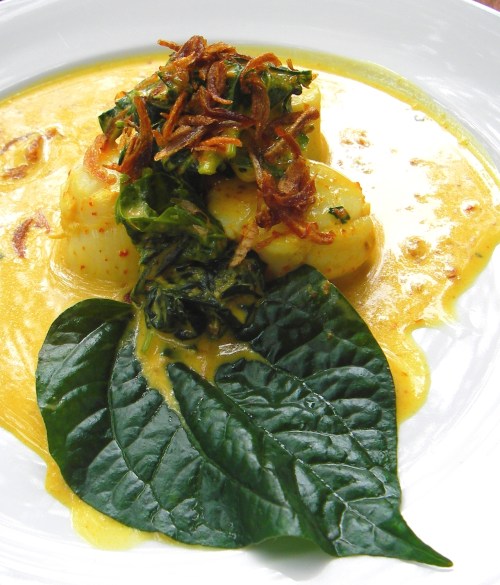
Curried Scallop with Wild Pepper Leaf — Gaeng Hoy Shell Bai Chapoo

I cook professionally during the week but at home on the weekend I cook like any home cook. Sunday is an iron chef day – I use whatever is in my refrigerator. I had some wild pepper leaf, a leftover from a Miang Kam dish during the week, and some Alaskan scallops in the freezer. I like to cook chapoo leaf in a curry with a strong flavored fish or meat; a hint of black pepper from the leaf gives a very interesting flavor to the dish, and coconut milk sweetens the bitter edge. This recipe is very quick. All you have to do is write down the word “la lot” and go to a Vietnamese market.

Curried Scallop with Wild Pepper Leaf

Gaeng Hoy Shell Bai Chapoo

Serves: 2

2 tablespoons canola oil
2 tablespoons red curry paste
2/3 cup coconut milk
1/3 cup water
6 large scallops
30 wild pepper leaves, AKA chapoo in Thai and La Lot in Vietnamese
1 teaspoon sugar
1 teaspoon fish sauce
2 teaspoons fried shallots

Heat canola oil in a medium-size pot on medium-high heat. Stir in red curry paste and fried until fragrant. Stir in 1/3 cup coconut milk and let it cook until oil is separated and fragrant; add the rest of the coconut milk and water and bring to a boil. Stir in scallops and wild pepper leaves and cook until scallops are opaque in color, about 5 minutes. Season with sugar and fish sauce and serve hot. Garnish with fried shallots. Serve warm with steamed jasmine rice.

© 2010  Pranee Khruasanit Halvorsen
I Love Thai cooking
Pranee teaches Thai Cooking classes in the Seattle area. Her website is: I Love Thai cooking.com

Read Full Post »

Ramadan 2010

Follow the Tradition of Thai Muslim Cooking on Phuket Island during the Ramadan

Now

Phuket Chicken Biryani Rice, also known as Kao Mok Gai, is a well known Thai-Muslim rice dish. Southern Thai cuisine gets its distinguished flavor from the neighboring countries of Malaysia and Indonesia. Growing up in Phuket I loved the diversity of our local cuisines. Our family cooked Thai and Chinese cuisines and at the market I enjoyed Thai Muslim cooking. After Persian Muslims settled in Phuket, their descendants took their traditional Biryani Rice and created a Thai variation, Koa Mok Gai. It is cooked for special occasions like weddings or during Ramadan. It is not a common dish to cook at home but most of the time we can purchase it from Kao Mok Gai vendors. If you want to try it when you visit Phuket, stop by an open air market in Bangtao or Kamala.

Phuket Chicken Biryani Rice—Kao Mok Gai Phuket

Over the past 10 years I have stayed in contact with a few chefs from Bangtao and Kamala Village. I learned to cook Kao Mok Gai from Varunee, my Thai chef for the culinary tour in Phuket. Her mom is a renowned caterer among the Muslim population in the Bangtao area. Over the years, I have written down many versions of her Kao Mok Gai.

Kao Mok Gai with Fresh Vegetable, Chile Sauce and Chicken Soup

The other day I wanted an easy lunch, which led to the creation of a quick and easy version of Kao Mok Gai. It took me 10 minutes to make, since I already had the ingredients in the house. It may take you 15 to 20 minutes to prepare the ingredients.

If you have an old-style rice cooker that is easy to clean, I recommend using that. Otherwise place everything in a Pyrex 9″x13″ pan and cover neatly with foil, bake in an oven at 350F for 25 minutes and let rest for 10 minutes before removing the foil and serving.

Phuket Chicken Baryani Rice

Kao Mok Gai

Serves: 4 to 6

Active Time: 10 minutes

2 cups jasmine rice, basmati rice, or any long grain rice
2 1/2 cups water or chicken broth
1 tablespoon fried garlic or shallot, plus 1 tablespoon for garnish
1 tablespoon canola oil, garlic oil or shallot oil
2 tablespoons Madras curry powder
1 tablespoon lemongrass powder
1/2 teaspoon galangal or ginger powder, optional
1 bay leaf
6 pieces fried or baked chicken
 
Rinse the rice and drain, put in a rice cooker with water, fried garlic, canola oil, curry powder, lemongrass powder, galangal powder and bay leaf. Mix well and place cooked chicken in the center of the rice cooker, cover, turn on rice cooker. It takes about 30 minutes to cook and then let it sit for 15 more minutes before serving.
 
Serving suggestions:

Buffet Style: Place rice and chicken on a nice platter and garnish the top with fried garlic or shallot. Served with condiments suggested below (please also see photo).

Individual serving: One cup rice, 1 piece chicken, garnish with fried garlic served with condiment and sauce.

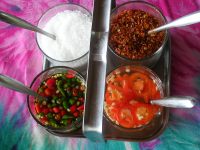
Condiments: Sweet chili sauce, sliced cucumber, sliced tomato, cilantro and green onion.

Thai Vegetarian Option: Saute shiitake mushroom, fried firm tofu, raisin and cashew nut. Thai Cooking for Kids Gluten-Free Recipe


Then

Here is a famous Kao Mok Gai prepared by Varunee’s mom for 250 children. I hosted this event for school children at the Kamala Beach School 6 month after the Tsunami. We served the food at the temporary kitchen in July 2005.


Pranee with Mama Boo, July 2005


Kao Mok Gai, Lunch for Kamala School Students July 2005

© 2010  Pranee Khruasanit Halvorsen I Love Thai cooking

Pranee teaches Thai Cooking classes in the Seattle, Edmonds, Redmond, Issaquah, Lynwood and Olympia areas. Her website is:  I Love Thai cooking.com 
 
To learn more on the history of Biryani Rice: http://en.wikipedia.org/wiki/Biryani

Read Full Post »

Som Tum, a Green Papaya POK POK 

Som Tum - Thai Green Papaya Salad

Pok Pok is the sound made when a wooden pestle hits a clay mortar. This is a classic sound in the green papaya making process and it is a familiar sound for Thais and tourists alike because Som Tum vendors are everywhere in Thailand. When I teach papaya salad recipes, I make sure to carry my clay mortar and wooden pestle with me to my cooking classes in Seattle, Lynwood, Edmonds and even Portland. I feel that it is important for students to understand the cultural and traditional aspects of  Thai cuisineFor me, making and eating green papaya salad is a cure for homesickness. But is not easy to find green papayas outside of Thailand, so sometimes we have to improvise.

Shredded Green Papaya and Carrot for Som Tum

Carrots are always a great substitute when fresh green papaya is not available. My first experience eating Som Tum made from other vegetables besides green papaya was when I was traveling in Switzerland and France visiting friends and relatives.

In Seattle you can find green papaya everyday at the Asian markets, but at farmers market events in Washington I always enjoy making Som Tum with various farm fresh vegetables. And I am always delighted that it still makes a great impression on everyone. First the Pok, Pok sound, then the flavors of chili-lime and peanuts dressing that make all fresh salad tastes so good. My favorite vegetables and fruits for this recipe are carrots, kale, green apples, green mangos, green beans and cucumbers.

Som Tum – Thai Green Papaya Pok Pok

Yesterday I was making special version of Som Tum for a Pike Place Market Sunday Event. I combined Som Tum made from local carrots and kale with cooked rice noodles and smoked local King salmon. Combining Thai and northwest flavors together using a mortar and pestle produced a delicious dish.  Let’s cook with the Thai rhythms!

Please also see Pranee’s Somtum Recipe featured in Seattle Times, Pacific Northwest Sunday Magazine

SOM TUM PLA SALMON

Green Papaya Salad with Smoked Salmon and Rice Vermicelli

Servings: 4
 
3-6 garlic cloves, peeled
5 Thai chilies, whole
2-3 tablespoons palm sugar or brown sugar
6 tablespoons dry roasted peanuts
3 tablespoons fish sauce
3 tablespoons lime juice
¼ lime, cut into 4 small wedges
8 cherry tomatoes, halved, or 2 large tomatoes cut into wedges
½ cup green beans, cut into 1 inch lengths
2 ounce smoked salmon, sliced, about ¼ cup, divided
2 cups shredded green papaya, carrot, cabbage, kale or any fresh vegetable
1 cup rice noodles or rice vermicelli, cooked using the instruction on the package

To make a dressing, use a wooden pestle to crush garlic, chilies, palm sugar and 1 tablespoon roasted peanuts in a clay mortar until it forms a paste. Stir in fish sauce and lime juice with pestle in circular motion until blended.  With pestle, gently mix in lime wedges, tomatoes, string beans, half of the smoked salmon and shredded papaya by pushing down the ingredients against one side of the mortar and using a large spoon to lift up on the opposite side. Repeat a few times until well incorporated.  Serve right away with rice noodles and topped with the rest of the smoked salmon.

Cook’s note: If you don’t have a mortar and pestle, here is an easy way to make a salad dressing. Blend garlic, Thai chilies, palm sugar, 1 tablespoon roasted peanuts, fish sauce and lime juice in a blender until smooth. Mix the rest of peanuts, string beans, dried shrimps, tomatoes and green papaya in a salad bowl. Pour the dressing over the salad and gently mix them together by hand until salad is well coated with the dressing.

© 2010  Pranee Khruasanit Halvorsen
I Love Thai cooking

Pranee teaches Thai Cooking classes in the Seattle area. Her website is: I Love Thai cooking.com
Read Full Post »