Feeds:
Posts
Comments

Archive for March, 2011

Celebrating Spring with Fresh Thai Recipes

Sunset Magazine: April 2011

Sunset Magazine: April 2011

I hope that you will help me celebrate spring with the Sunset Magazine April 2011 issue. Not only does the magazine bring a lot of bright and fresh ideas to us foodies and gardeners, it also features an article on Homeschooling: Cooking classes in the Seattle area. It is an honor to be in the article: For the next best thing to a trip to Thailand……a private class in Seattle. I hope you have a chance to check out the article and to learn how other local chefs/instructors are cooking. The magazine provides many lively ideas for your spring inspirations.

For me, spring is a warm welcome to local crops and a time to enjoy the fresh abundance from your gardens and local farms. My three favorite spring herbs and vegetables, the ones that excite me to get out into the garden and the kitchen, are garlic chive, lovage and asparagus.

If you are looking for new ideas for cooking with asparagus and lovage, the three easy and delicious recipes below will be ones that you can depend on countless times during the spring and summer. More recipes to celebrate spring are to come.

Cheers to spring.

Grilled Asparagus with Lemongrass Vinaigrette Recipe

Everyday Thai Stir-fry with Asparagus and Shiitake Mushrooms

Asparagus & Lovage Soup Recipe


Pranee teaches Thai Cooking classes in the Seattle area.
Her website is: I Love Thai cooking.com .

Read Full Post »

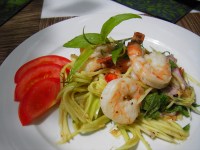
Mango season is early this year and mangoes are abundant at the supermarket. I hope you enjoy this recipe over the weekend and indulge yourself with the fresh tropical flavors. You may substitute wild shrimp or scallops for the crab.

~Thai Crab Salad with Mango Recipe~ Eat Southeast Asia. Traveling through Vietnam in 2009 as a culinary tour leader was an interesting and heartwarming experience. The local people are so eager to share their country’s wonderful cuisine and culture and spend time with you. You’re treated more like a welcome guest than a tourist. Back home in Phuket with my traveling companion, we rested and strolled on the beach and enjoyed the best food in Phuket, local seafood. We were lucky to be … Read More


via Pranee’s Thai Kitchen

Read Full Post »

The Mystery Dish of Southern Thailand

Stir-fried Fresh Grated Coconut with Phuket Curry Paste and Chapoo Leaf

I uncovered a mystery about my grandmother’s cooking during my last trip to Phuket. I asked around about Phad Maprow Khub Kruang Gaeng, a stir-fried, fresh grated coconut with Phuket curry paste. During my childhood and adult life, I had never seen it cooked or eaten or even mentioned by anyone except members of my family. And it was only my grandmother who always asked me to assist her with it when I was young. I always wondered if it was served for health or economic reasons, or simply a food that the women of the house put on the table for their large extended family. It was never served alone, but with other main dishes and steamed jasmine rice.

I described the dish to my family to refresh their memories. My mom said that mostly we prepared it with a special kind of coconut (out of a thousand different kinds of coconuts, we used one that has an interesting texture with more like a virgin coconut oil). Then my sister-in-law, who was born in Phang Nga (80 kilometers away from Phuket), recalled eating the dish in her hometown. She said she had prepared it before, but not often. Luckily for me, she was very happy to prepare this for me while I took notes and photographs. She did it exactly the way I remember my grandmother preparing it. Thank you to my sister-in-law Tim, who helped me preserve the history of this lost recipe.

We shared the dish afterwards and more than anything else, more than its just being an interesting dish, it was a moment of rediscovery of the old time flavors of the south. We bonded again with foods. I hope that some of you will try this recipe so it won’t be lost forever.

Curry paste and fresh grated coconut in a mortar mix with pestle

First, Tim pounds the Phuket curry paste. When it became a fine paste she mixed in the freshly grated coconut and pounded to combine all of the ingredients. Then she stir-fried the mixture in a wok.

Coconut and turmeric—the colors and flavors of Southern Thailand

Stir-fried Fresh Grated Coconut Meat with Phuket Curry Paste

Phad Maprow Khub Kruang Gaeng Phuket

ผัดเนื้อมะพร้าวสดขูดกับเครื่องแกงภูเก็ต

Serves: 8 (as a side dish)

Yield: 2 cups

1/2 to 1 recipe Phuket Curry Paste (please click here for the recipe)
2 cups freshly grated coconut meat, or frozen (thaw before cooking)
1 tablespoon sugar, or to taste
Salt to taste
32 chapoo or wild pepper leaves

Combine curry paste and grated coconut by hand or with a mortar and pestle. Place in a wok (without cooking oil) over medium heat, and stir constantly to allow the coconut and curry mix to become one texture. Continue stirring until the moisture in the coconut dries up and the curry paste is well-incorporated, about 5 to 8 minutes. It should be flaky with a little bit of moisture left, neither too dry nor too oily. Serve at room temperature with wild pepper leaves on the side.

Enjoy this as a tidbit by placing about 1 tablespoon on a wild pepper leaf, then wrapping it up so you can eat it in a single bite. Or simply mix it with warm jasmine rice and enjoy it as an accompaniment to curry and vegetable dishes.

Pranee’s Note:

This recipe has not been tested yet in my kitchen, so pay attention to spicy, salty and sweet when trying this recipe.

Chapoo leaf or wild pepper leaf is also known as la lot leaf (please see Pranee’s Blog Entry on Chapoo leaf)

Pranee’s Video on Youtube: How to Open a Coconut Husk: Thai Style

More Recipes by Pranee on Phuket Curry Paste

© 2013  Pranee Khruasanit Halvorsen
I Love Thai cooking
Pranee teaches Thai Cooking classes in the Seattle area.
Her website is: I Love Thai cooking.com 
 
 
Related Articles

Read Full Post »

Playing with Food: Cassava

Cassava-Sweet Potato Pancake, a delicious Thai Dessert

I noticed recently that I have told my students to play with food in almost every class. I hope they have. After learning all the essential tips and techniques, the way to become a good cook is by experiencing the ingredients and having fun.

On the weekends, I clean up the fridge and cook creatively.  This weekend I had fresh cassava and sweet potato leftover from my class. While I was holding them in my hand, I heard an echo of Rösti. Rösti is a fried, grated potato dish made in Switzerland. I made a quick decision and at almost the same time my hand reached to turn on the oven to 450°F. I will heat up my well-seasoned 8-inch cast iron pan and make this quick & easy Thai dessert, Rösti style.

Cooking with cassavas is not hard at all. After grating the cassava, Thai simply add enough sugar to sweeten to taste, and some salt to bridge the flavor; a bit of coconut milk can also be added to heighten the flavor. Then the mixture is steamed and grilled until it is cooked and translucent. But something new today that I haven’t tried before is adding grated sweet potato. Why not? It was perfect. I used about 2 parts cassava to 1 part sweet potato. The glutinous property of cassava helps the sweet potato hold up nicely, and the sweet potato gives a nice orange color and sweet compliment to the dish.

Learn something new while playing with food and discover a new excitement and a sweet reward to the lesson. Cassava-Sweet Potato Pancake makes a perfect snack or dessert with light herbal tea.

Cassava - Sweet Potato Pancake

Cassava – Sweet Potato Pancake

Khanom Man Sumpalang Oop

มันสำปะหลังมันเทศแพนเค้ก

Servings: 6-8

2 cups grated cassava, fresh or frozen (if fresh , use a 10-inch-long cassava and remove the skin before grating)
1 cup grated sweet potato, about 1 small or medium
1/2 cup palm sugar or brown sugar
1/2 teaspoon salt
6 tablespoons coconut milk
2 tablespoon rice flour, optional
1 tablespoon cooking oil
 
Preheat the oven to 450 F.
 
Combine grated cassava, sweet potato, sugar, salt, coconut milk and rice flour in a large bowl; stir until well mixed.
 
Heat 8-inch cast iron pan on medium heat and cover the entire surface with cooking oil. Pour cassava-sweet potato pancake mixture into the pan and spread out evenly. Place uncovered in the center of the oven and bake for 20 minutes, until the bottom is crusty brown. Then turn the oven to broil and place the pan right underneath. The top of the pancake should be 6 inches below the heat source. Remove when the top is brown, about 3 to 5 minutes. Keep an eye on it! A nice crusty brown is the most delicious part of the cake. Let the pancake rest for 5 to 10 minutes before serving. Serve warm or cold.
Cassava (yuca) roots, the Taínos' main crop

Image via Wikipedia

Pranee’s Thai Kitchen note:

Cassava is a root from the Cassava or Tapioca Plant (Manihot esculenta Crantz). It is a bushy plant that grows to about 3 meters tall. It is an annual plant with underground food-storing root-tubers. The tuber is large and long with a dark brown skin and pink underneath to protect and keep the white flesh moist. In Thailand, cassava is usually boiled or roasted and serve with sugar. It also is made into various sweets combined with grated coconut and/or coconut milk and sugar. Raw cassava is poisonous, but when cooked it became a delicious dessert.  Pearl tapioca and tapioca starch and flour are all products of cassava roots.

© 2011 Pranee Khruasanit Halvorsen

I Love Thai cooking

Pranee teaches Thai Cooking classes in the Seattle area.

Her website is: I Love Thai cooking.com .


Read Full Post »
Best Phad Thai on Mahachai Road, Bangkok 

The Golden Mount

Image via Wikipedia

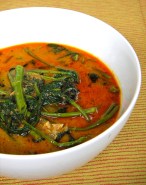
I just returned home from three weeks of savoring Thailand. I still have a little jet lag and a lingering sense of all the flavors from Thailand. My first day in Bangkok was spent with my nieces and nephew who knew the best places to eat in Bangkok. First we intended to go to Thip Samai, but the restaurant was closed. Thip Samai is open evening hours from 5:30pm till 1:30 am, but we were not in luck. Next to Thip Samai is the Lueng Pha Phad Thai restaurant, which is very good. We savored every menu item and were very happy with our lunch—we all know that good Phad Thai can make one happy! We then continued exploring the neighborhood, and decided to walk up to the top of the Golden Mountain Temple, Phu Khao Thong. It was a very pleasant day, cool and sunny, and I spent a good time bonding with my two nieces and nephew.

For Thai foodies, I strongly recommend that when you visit Bangkok, plan to go for more than a week and include Lueng Pha or Thip Samai Phad Thai on your to-do list. They are in a great location with interesting tourist sites nearby such as: San Chao Pho Suea, Sao Chingcha, Kao San Road, and the Golden Mountain Temple.

After having a good time at the Golden Mountain Temple, we were able to enjoy our afternoon visiting San Chao Pho Suea and Khao San Road. Of course, in Bangkok there were plenty of street foods to enjoy. As we walked, we tasted all of the good looking snacks along the way. It was a perfect day and a wonderful first day to welcome myself back home. We joked that it was an  “Eat Pray Love” kind of day.

Please enjoy the video below showing how Phad Thai is prepared and wrapped in an omelette.

Phad Thai Lueng Pa Mahachai Road

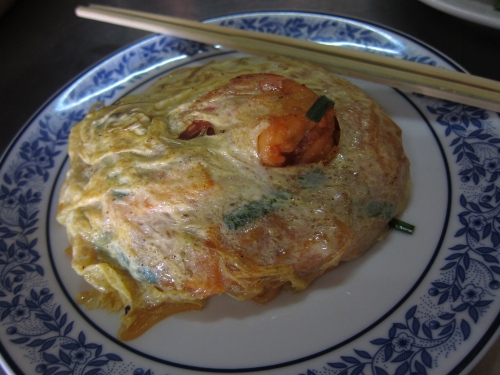
Omelette wrapped Phad Thai with Prawns


Phad Thai with Shrimp Fat, Fresh Shrimps and Egg

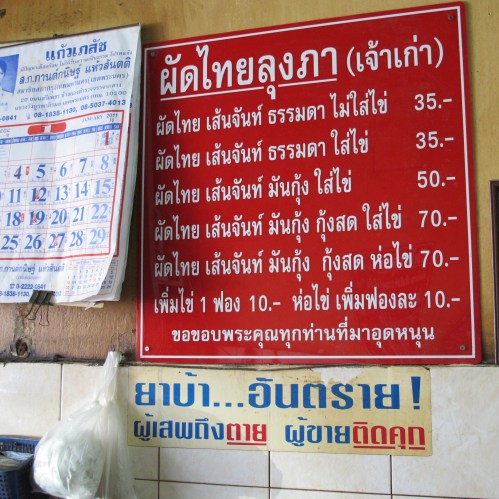
Phad Thai Lueng Pa (Jao Gao)

Phad Thai Regular without egg, 35 Baht ($1)

Phad Thai Regular with egg, 35 Baht

Phad Thai with Shrimp Fat and Egg, 50 Baht

Phad Thai with Shrimp Fat, Fresh Shrimp and Egg, 70 Baht

Phad Thai , Shrimp Fat, Fresh Shrimp, Wrapped with Omelet, 70 Baht

Additional Egg, 10 Baht each

Thank you for your support


The decor inside the restaurant

Lueng Pha Phad Thai (next to Phad Thai Thip Samai on Mahachai Road, Bangkok)

315/1 Mahachai Road
Samran Rat, Phra Nakhon
Bangkok 10200
Thailand


Read Full Post »

Rubber tree plantation in Phuket, Thailand

Image via Wikipedia

My Love for Mushrooms

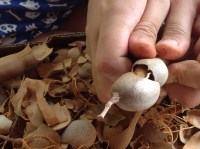
My love for mushrooms was born when I was in my teen years in my Thai village. The village is surrounded by mountains on one side and rice fields on the other. It was a perfect place for wild foods. I learned to gather wild vegetables such as bamboo shoots and green and ginger family rhizomes, and of course I picked some wild orchids for myself on the way home. There were also many rubber plantations. The dried falling branches from the rubber trees were a source of firewood and rubber tree mushrooms called Hed Kreng. They are a typical mushroom that grows only on the old rubber trees which cover most of the southern peninsula of Thailand.

In Seattle, I enjoy various mushrooms and we are in luck, there are plenty of fresh mushrooms from local mushroom growers.

If you are hesitant to cook this recipe for any reason, I want to reassure you that this dish is packed full with flavors and received a five star rating from an admirer on yelp.com.

Grilled Spicy Phuket Mushroom - Rubber Tree Mushroom


Grilled Brown Button Mushrooms with Thai Basil Leaf in Banana Leaf

HED MOK PHUKET

Servings: 4 (one parcel per person)

We used to gather Hed Kreng mushrooms from old rubber tree trunks and bring them home for my mom to make my childhood favorite, Hed Mok (Grilled Mushrooms). I recreated this recipe by using brown button mushrooms that have a flavor similar to Hed Kreng. While creating this recipe, I recalled my vivid memories of how my mom prepared them, and the taste and aroma that I used to savor. The intense flavors of basil, chili, and earthy mushrooms come alive. An important part of this recipe is to grill or bake the mushrooms over high heat to intensify the flavor. Also, use coconut cream rather than coconut milk so the mixture won’t get too wet.

1 teaspoon fish sauce
1 tablespoon red curry paste
½ teaspoon sea salt
¼ cup coconut cream
¼ cup shallots, sliced
1 pound brown button mushrooms, brushed and sliced
1 cup Thai purple basil leaf
4 Thai chilies, halved
4 parchment papers (12”X16”) or banana leaves

Preheat oven to 400°F.

In a large bowl, mix fish sauce, red curry paste, salt and coconut cream together until blended. Stir in shallots, mushrooms, and basil until mixed.

Divide mixture into four batches, and place each batch in the center of a piece of parchment paper. Fold the parchment paper over to make a bag; try to make it as flat as you can so the heat will distribute equally. Lay the bags of mushrooms on the baking sheet and bake for 20 minutes. Serve with warm steamed rice.

Pranee’s note: Oyster, button, or Portobello mushrooms would all be great for this recipe, or you can use a combination of them. Wrapping the mushroom mixture in banana leaves and then grilling them creates another depth of taste and aroma.

© 2011 Pranee Khruasanit Halvorsen
I Love Thai cooking
Pranee teaches Thai Cooking classes in the Seattle area.
Her website is: I Love Thai cooking.com .

Read Full Post »