I fell in love with Lovage at the first taste twenty four years ago in a herb garden in Zurich, Switzerland. First I saw some tall herbs and plants; my friend asked me to smell and taste some. I was excited by the aroma, and learned the story of Maggi soup and the use of Maggi seasoning sauce in Switzerland. Thais love maggi seasoning sauce from Maggi of Switzerland. Thais use it interchangeably with soy sauce or Golden Mountain sauce.
Lovage (Levisticum officinale) is a large herb that can grow to 6 feet tall in my garden but I always remove the tall stems. It is used in south European Cuisine. Lovage grows well in Pacific Northwest.
Lovage from Pranee's herb garden
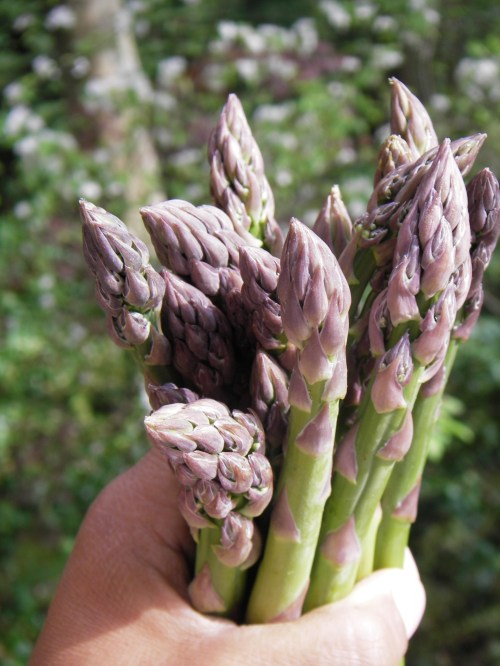
In Seattle, I had a chance to savor the lovage soup twice, once at the herb farm (Lovage & Stining Nettle Soup) and and another one at the Crush restaurant (Lovage & Leek Soup) in Seattle. With that taste memories that I have, I have prepared this soup for my family one day from the left over grilled asparagus and fresh lovage from my garden.
I hope you see a Thai connection for this recipe and I want to encourage gluten-free cooks to use more lovage in Thai cooking to gain unique flavor that is similar to soy sauce or Maggi sauce.
Serves: 4
3 tablespoons canola oil or extra light olive oil
½ cup diced onion
2 cloves garlic, minced
2 cups lovage leave, chopped plus 2 tablespoons for garnish
2 cups grilled or fresh asparagus, chopped
1 teaspoon sea salt
3 cups chicken broth or vegetable broth
½ teaspoon paprika
Heat a frying pan on medium heat and add canola oil when hot. Stir onion and garlic until fragrant and onion become translucent. Stir in lovage for 30 seconds before adding grilled asparagus and sea salt. Pour into a large pot and add chicken broth and bring to a boil. Lets it cook on medium heat until asparagus is soft. About 15 minutes. Stir in paprika. Serve as is or use a blend in the blender. Garnish with chopped lovage.
Vegetarian option: substitute chicken broth with vegetable or mushroom broth.
I was glad to stay home and cook for my family tonight. But it is not just any cooking; I was wokking up Grace Young’s recipe: Velvet Chicken with Asparagus. It was the recipe from the cooking class and the cookbook “Stir-frying to the Sky’s Edge’. This recipe was appealed to me during the class last week of how the chicken was cooked by her technique (velveting) was so succulent. She mentioned that it is also the same technique that is used by Chinese chef to prepare chicken for Kung Pao Chicken and other classic dishes. At home today I followed Grace’s advice. I purchased the best and freshest ingredients. I purchased local organic chicken and local Washington asparagus. I dropped water in a wok to test and it did evaporate in two seconds. Like I always tell my students, please try to cook the recipe from the class within a week. And I did follow my advice. While cooking, I remember every step that Grace showed us during the class. With prepping before hand, the cooking went really fast. I was glad that my husband and son were already at the table with steamed jasmine rice waiting for the dish and we enjoyed while the wok hay was still in our dining atmosphere.
It was quietness and the way we ate, I knew my family was happy with warm jasmine rice and velvet chicken and asparagus. And I was too that the cooking was easy, quick and fun altogether. The most important thing is I don’t need to search for a good Chinese restaurant any more. All I have to do now is trying new recipes from Grace Young’s cookbook. She is amazing teacher and cookbook author.Let’s Stir-fry to the Sky’s Edge.
After taking cooking class “Stir-Frying to the Sky’s Edge taught by Grace Young at the Sizzle Works, I was inspired to do more reading. There were three books on the subject by Grace Yong: The Breath of a Wok and Stir-frying to the Sky’s Edge and Martin Yan: Everybody’s Wokking. I came across the comment made by Martin Yan on the cilantro root and I am very happy to share this with you.
“I can’t understand why the Thais are the only ones who cook with cilantro roots. The roots have a deep, rich flavor, less spicy than the feathery leaves. My produce man is so fastidious he trims off the roots, so I save a spot in my garden to grow my own supply. You can omit the roots from this recipe; …..will still taste great, just not quite as authentic Thai.”
Martin Yan: Everybody’s Wokking
In Seattle you can find cilantro that come with root at farmer’s market and occasionally at PCC Natural Markets. To learn more about about Thai cooking with cilantro roots and cook up an easy recipe Garlic Prawn (Kratiem Prik Thai Prawn) please click here.
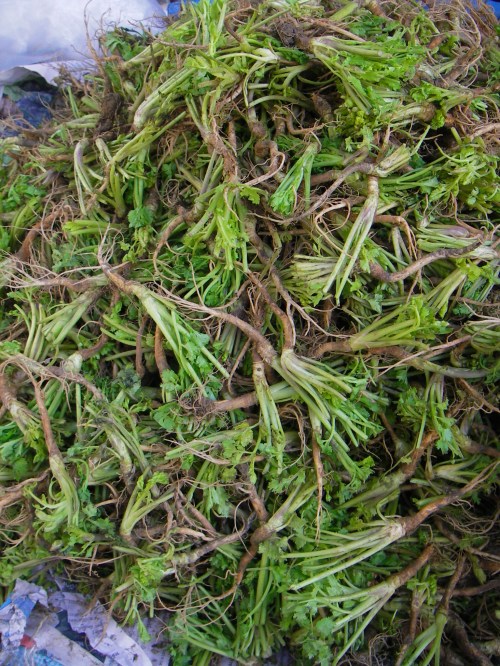
Cilantro roots is an essential part of Thai curry paste along with galangal, lemongrass, garlic and shallot
A Mountain of cilantro roots at Flower Market, Bangkok
My son loves Teriyaki Chicken and also chicken wing. After eating and inhaling fish sauce chicken wing with sticky rice at the Pok Pok Thai Restaurant in Portland , I decided to create a recipe that is close to my tasting memories. I substituted fish sauce for soy sauce in my own teriyaki sauce recipe created way back. And it works, now everyone loves the fish sauce chicken wings as well. To get a nice even brown, you have to be patient and keep turning the chicken every 5 minutes. Please remember that the high heat can burn the skin quickly due to the brown sugar used in the marinade. After a few tries, I am happy with the result. Time to get your fingers dirty by eating this dish and might as well with Thai sticky rice, because that is the best way to eat it.
Grilled Fish Sauce Chicken Wing
Gai Nampla Yang
Yield: 10 wings
4 tablespoons brown sugar
4 tablespoons fish sauce
2 tablespoons dry sherry
2 tablespoons rice vinegar
2 pounds chicken wings, about 10 wings
To make a marinade, stir sugar, fish sauce, dry sherry and rice vinegar in a large bowl until sugar is dissolved. Place chicken wings in a zip-lock bag and pour in marinade. Remove the air from the bag and seal. Let’s it marinated in refrigerator for at least three hours and flip the bag every half hour. Drain well before grilling.Pre-heat the gas grill, then set at medium heat. Grill both side until nicely brown but not burnt and it will take about 20 to 30 minutes.
Traveling through Vietnam in 2009 as a culinary tour leader was an interesting and heartwarming experience. The local people are so eager to share their country’s wonderful cuisine and culture and spend time with you. You’re treated more like a welcome guest than a tourist.
Back home in Phuket with my traveling companion, we rested and strolled on the beach and enjoyed the best food in Phuket: local seafood.
We were lucky to become friends with Chef Tony of the popular Rockfish Restaurant after savoring our first plate of his Thai crab salad. He generously agreed to share his recipe and do a cooking video for my newsletter to welcome our mango season here in America.
Chef Tony Wringley has been working at Rockfish Restaurant as executive chef for the past 6 months. His recipe was inspired by local and seasonal ingredients from PhuketIsland such as local crab, fresh mango and coconut. Chef Tony has captured the flavors of the tropical island of Phuket with this Thai crab salad.
Thai Crab Salad with Mango and Shaved Coconut
Thai Crab Salad with Mango and Shaved Fresh Coconut Recipe
Yum Pu Mamuang Maprow
Recipe by Chef Tony Wrigley
Executive Chef, Rockfish Restaurant
Kamala Beach, Phuket, Thailand Rockfish Restaurant
Serves: 1
½ cup cooked crab meat
½ cup diced mango, about half mango
¼ cup sliced red spur chili or Anaheim pepper
2 green onions, chopped into 1-inch long pieces
3 sprigs cilantro, torn into large pieces
10 Thai basil leaves or sweet basil, torn in half
¼ cup chili peanuts or dry roasted peanuts
2 teaspoons fish sauce
1 teaspoon sugar
1 teaspoon olive oil
2 tablespoons lime juice, about 1 lime
¼ cup fresh shaved coconut or dry coconut chips
1 teaspoon chili oil for presentation
Gently combine crab, mango, red spur chili, green onions, cilantro, Thai basil and chili peanuts. Add fish sauce, sugar, olive oil and lime juice, and fold just to mix. Place crab salad on the plate, garnish with shaved fresh coconut on top and decorate the plate with chili oil. Makes one serving.
Servings: 4
3 tablespoons canola oil
8 tablespoons Khmer curry paste (please see Khroeung, Khmer Curry Paste Recipe)
3 cups spinach, amaranth, la lot (wild pepper leaf) or pea vine
1 pound catfish filets or any white fish cut into a bite size
6 tablespoons coconut milk
1 egg
2 teaspoons fish sauce
½ cup Thai basil
Heat canola oil and curry paste in a frying pan until fragrant. Stir in spinach until wilted and then stir in fish. Add coconut milk and egg and fold in until the fish is cooked. Then stir in fish sauce and Thai basil until Thai basil is just wilted. Serve with jasmine rice.
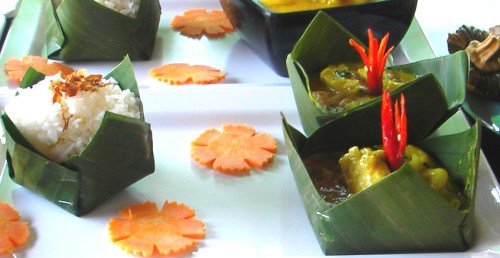
Kroeung is Khmer curry paste that is versatile for many curry dishes in Khmer cuisine such as famous national dish, Amok (fish cake), chicken curry with sorrel leaves or fish stew with seasonal vegetable. Like Thai curry paste, Khmer curry paste consists of fresh herbs which will give pungent flavor and aroma. This curry paste is easy to prepare with a food processor and keeps well in the freezer for up to 6 months. This recipe is inspired by Le Tigre De Papier cooking class, my recent trip to Siem Reap March 2010.
Kroeung
Khmer Curry Paste
น้ำพริกแกงแดงเขมร
Yield: 1 cup curry paste for making two to three curry dishes
10 fresh or dried Thai chilies
2 large fresh Thai spur chilies or dried New Mexico Chili pods or guajllo chile pods
2-inch galangal root, trimmed and sliced to about 1/4 cup
4-inch fresh turmeric, sliced to about ¼ cup or 2 teaspoons turmeric powder
6 cloves garlic, peeled and sliced
2 lemongrass stalks, trimmed and finely sliced
2 shallots, peeled and sliced to about ¼ cup
10 Kaffir lime leaves, finely shredded
1 teaspoon black peppercorns
1 teaspoon salt
1 teaspoon shrimp paste
¼ cup canola oil
Cut and soak dried New Mexico chili pods in hot water water for one hour; then drain. Place New Mexico chili pods, fresh or dried Thai chilies, galangal, turmeric, garlic, lemongrass, shallots, Kaffir lime leaves, black peppercorns, salt and shrimp paste in food processor and blend until it forms a smooth paste, about 15 minutes. Use spatula to clean the edge a few times. It is ready to use for cooking.
Thai Vegetarian option: omit shrimp paste and replace with 2 teaspoons mushroom powder
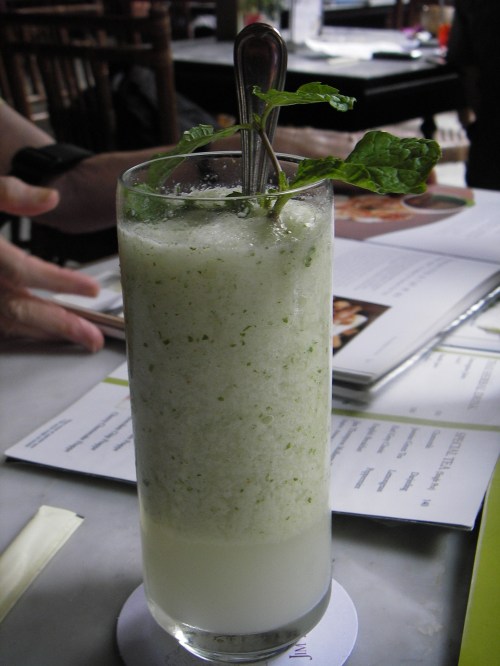
Just two weeks ago I was in Bangkok at the famous Jim Thompson’s house near the National Stadium. I always enjoy taking a break at the restaurant near the lily pound. I had Lychee & Mint smoothie, a very simple refreshing drink that was just perfect for a mid-day break in the month of March when the heat can climb up to 95 degrees during the day.
To make this smoothie is as simple as putting all these ingredients in a blender: 5 Lychee fruits and ½ cup juice from a can plus ½ cup crushed ice and ¼ cup fresh mint leaves. Add sugar to taste before blending in a blender and serve. Garnish with a mint sprig. That’s all there is to it, but don’t forget to imagine that you are looking at a beautiful old Thai house surrounded by a beautiful garden while sipping this refreshing smoothie.
Both of my parents are Phuket Hokkien Baba (similar to Paranakan in Malaysia and Singapore), descendants of Chinese men and Siamese women. After Chinese immigrants married local Thais and they settled down in Thailand. The first generation born and their children are called Baba. We preserve Chinese traditions with day-to-day Thai lifestyle and local culture. As a result of the blended Thai and Chinese cultures, our traditions are celebrated in a unique way.
As a child growing up in Phuket, Chinese New Year was my favorite time of year. The week before was set aside for a thorough cleaning of the house – a time when my grandmother said to brush away all the bad luck and to welcome the prosperous New Year. And a special communal feast dedicated to our spiritual ancestors was intended to contribute to our family’s future fortune. Several days in advance, we would focus on preparing the banquet feast and creating red paper cut out decorations to depict symbols of good blessings. Early in the morning before sunrise, I would wake up to the sounds of a chopping clever, a swirling spatula and a sizzling wok – these meant it was time for me to get up and help in the kitchen. By 11 am, the table was filled with traditional foods and in front of the ancestors’ altar. My family typically celebrated with the dishes I’ve shown in the photo above: tea, whiskey, steamed rice, roasted duck, stir-fry Phuket Hokkien Mee, 3 to 5 different kinds of vegetable stir-fries, and braised pork with five spices. Fruits and sweet delicacies were important desserts to complete the meal.
After the worship and burning of paper money, all family members gathered around the dinner table to enjoy the feast. And this is the only time my family served foods with chopsticks!
PHUKET HOKKIEN MEE RECIPE
Stir-fried egg noodles Phuket style
Serving: 1
Prep Time: 15 Cook Time: 5 minutes
On Chinese New Year Day, I always enjoy Phuket Hokkien Mee – an egg noodle dish similar to stir-fried chow mien.
In America, I use Miki noodle or yakisoba. For this recipe you may use any fresh egg noodles but I prefer ones the size of spaghetti. For vegetable choices, select a combination of mixed vegetables that you like, personally I love Choy sum or Chinese broccoli. For meat choices, substitute pork and/or seafood combination for tofu and mushrooms. To serve, I always enjoy eating it with chopsticks and a little kick of Sriracha hot sauce.
3 tablespoons cooking oil
1 garlic, minced
¼ cup sliced pork
¼ cup sliced pork liver, optional
3 shrimp, peeled and deveined
1 cup egg noodles, yakisoba or Miki noodles
1 cup cut Chinese kale or Choy Sum
2 teaspoons dark soy sauce
2 teaspoons light soy sauce
½ cup chicken broth
1 teaspoon sugar
A dash of white pepper powder
Heat a wok or cast iron pan over high heat; add canola oil. Stir in garlic, sliced pork, pork liver and shrimp. Continue to stir until the meat is almost completely cooked, then stir in egg noodles, Chinese broccoli, and dark soy and light soy sauces. Stir for 10 seconds, then add chicken broth. Stir and continue to cook until the broth is almost absorbed. When the sauce has reduced to ¼ cup, add the white pepper powder. Place in a noodle bowl and serve with chopstick and spoon.
Vegetarian option: omit meat and substitute it with 1/4 cup cut extra firm tofu and 1/4 sliced brown button mushroom
Gluten-Free option: use wheat free soy sauce and rice stick or rice vermicelli instead of egg noodles.
Cabbage is the most popular vegetable in Southeast Asia. It belongs in the Brassica Oleracea family along with bok choy and gai larn (Chinese kale or broccoli). It’s commonly used in stir-frying, curry and soup dishes.
My favorite way of preparing cabbage at home is to stir-fry it with salt and pepper for a side dish. This month I enjoy stir-frying cabbage with leftover turkey and lots of ginger and garlic.
Nutritionally, cabbage is high in Vitamin C and fiber, and contains anti-inflammatory benefits. With the two additions of garlic and ginger (flu prevention aids), what a great recipe for healthy eating.
Heat canola oil in a wok on high heat and stir in garlic and ginger. When garlic is golden, stir in turkey and cabbage. Then add oyster sauce, soy sauce and 3 tablespoons of water. Cover and quickly braise until cabbage is cooked but still has a slight crunchy texture. Season with salt and pepper to taste. Serve hot as a side dish with steamed jasmine rice.
Vegetarian option: omit turkey, use vegetarian oyster sauce
After three months of busy schedules, Chef Rachel Duboff, my colleague and owner of personal chef services Thyme to Nourish, and I finally had an opportunity to visit our favorite Thai restaurant in Wallingford. It’s called Sea Thai. I have known the owner, Renoo Ramstad, for 18 years, as long as I have lived in Seattle. Many local Thai chefs love Renoo’s Southern Thai cuisine and desserts, and her impeccable attention to fresh ingredients. The restaurant “takes pride in offering the finest homestyle cooking available without going to Thailand.” Both Chef Rachel and I have been long time fans of Sea Thai.
After looking over the menu, Rachel and I decided that we would each order our favorite dishes and share. To tempt your appetite, I’ve included photos of our dishes on Facebook here for you.
When the waiter asked how spicy we would like our food, I replied “as the chef recommends what is best for the dish.” Rachel and I love spicy Thai foods, but we wanted the chef to decide which heat level is appropriate for each dish, based on the dish’s personality.
The first dish we ordered was a tidbit, Miang Kao Tod, a crunchy fried rice and pork. At it turns out, it’s not a fried rice dish at all but almost like a salad and is eaten with a leaf. Americans usually use iceberg lettuce; in Asia, the most common choice is Chapoo (also know as la lot in Vietnam). This is a great starter dish.
Phad Kee Meo is a drunken noodle dish that features stir-fried fresh rice noodles (chow fun). This dish is almost as popular as Phad Thai. The noodles are usually served with a pork/Chinese kale combo, but Sea Thai’s version has an unusual twist. Instead of pork, it contains seafood with rice stick flake, a type of dried noodle about 2 inches by 2 inches that rolls when it’s fried. The texture is so seductive that I could have the dish all by itself for lunch and dinner.
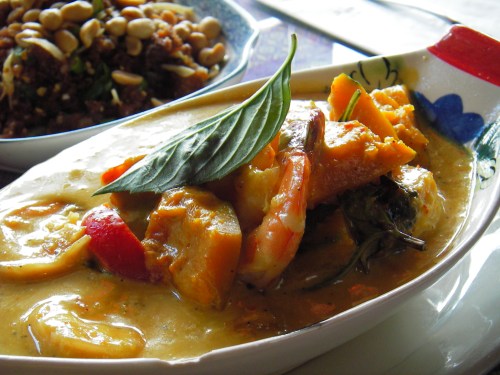
Pumpkin Curry with Prawn is a must this time a year. Renoo blends her own curry paste every week for her restaurant. Hers has a very good heat that cools down perfectly with the texture of pumpkin. To serve with the curry, Sea Thai uses Khanom Jean, a fried rice vermicelli noodle. Most restaurants in Seattle have this noodle available by request, as well as steamed sticky rice.
Sea Thai head chef is Pa Juk, a delightful 69-year old cook who came to the table to greet us. After seeing our sweaty foreheads and red cheeks, she sent us complimentary black sticky rice with custard dessert to cool down our palate. Before leaving Sea Thai, Renoo generously gave me a box of her red curry paste with citrus flavor to bring home.
I hope you too will visit Sea Thai and sample some of these dishes. Tell Renoo that Pranee sent you, and be sure to let me know what you think about Sea Thai’s food.
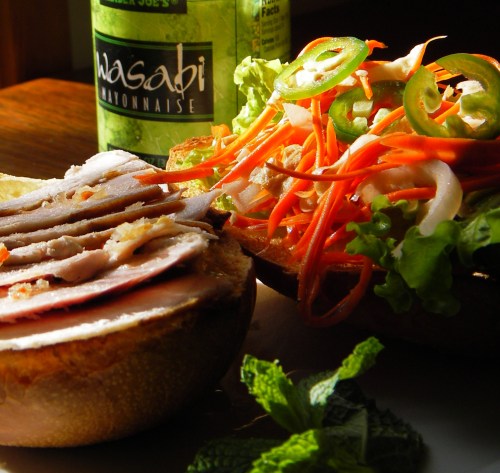
My obsession for food this week is all about Banh Mi, a lucious Vietnamese baguette sandwich filled with meats, crunchy pickled veggies, herbs, mayo and heat from chilies. It’s the product of the French influence on Vietnamese culture at its tastiest.
As much as I have heard about Banh Mi and sampled it in Seattle Vietnamese sandwich shops, my real love affair with Banh Mi began less than a year ago in the Banh Mi home city of Saigon. I still remember the experience vividly – I was on a mission to find the best Bahn Mi in town. Late at night and by myself, after managing to get lost a few times, I was finally munching my sandwich on the street corner while watching a wave of motorbikes flow by. It was a blissful culinary moment.
I admit to not being much of a sandwich fan – with the exception of a French baguette – but everything about this Vietnamese sandwich and its explosion of flavor was perfect – the aroma of fish sauce and vinegar, the texture of cucumber, carrot and daikon, piles of savory meat and pate on light, crusty bread. I fell in love at first crunch.
Now back home in Seattle, I have made many versions of Bahn Mi, as I continue to create recipes for my Vietnamese cooking classes. By chance, the one I prepared today in my kitchen was the closest in taste to the ones I had in Saigon. And I included my own special ingredient – Washabi mayonnaise. Let’s keep it a secret between us!
Next time, you’re wanting to expand your Vietnamese culinary horizons, search out a Bahn Mi sandwich shop and enjoy.
When I visited my mom in Phuket in March 2009, I dropped by to see her everyday for her home cooked meal. I didn’t plan to tape this video with Kabocha and pork, but at that moment, I wanted to record her cooking and share it with my students. My mom loves to surprise me with my favorite childhood dish. And she knew best. I love her recipe with shrimp paste but you can omit it and use fish sauce and soy sauce instead to give it a flavorful salty flavor. Shrimp paste, soy sauce and fish sauce are Thai umami. http://en.wikipedia.org/wiki/Umami.
Phad Namtao Moo Stir-fried Kabocha Pumpkin with Pork
This recipe combines pumpkin with pork – and it may not seem like one that appeals to you at first. Think of it as mashed potato with chicken broth next to pork chop gravy. The Kabocha melts in your mouth with a sweet taste and creamy texture. The shrimp paste leaves a hint of saltiness to contrast the sweetness of Kabocha, and the fried garlic enhances the flavor. Be adventuresome and try this as a side dish with steamed jasmine rice and curry dishes.
3 tablespoons canola oil
3 cloves garlic, peeled and sliced
2 teaspoons shrimp paste or 2 tablespoons fish sauce
¼ cup minced pork
3 cups Kabocha pumpkin chunks, seeds and skin removed
½ cup water or more as needed
Heat a wok on high heat, pour in canola oil and stir in garlic. When garlic is yellow, stir in shrimp paste and pork and cook until fragrant. Stir in Kabocha and add water to reach the top. Stir well, cover and let it cook until Kabocha is cooked in the center. Test by pressing a fork against Kabocha; it should break easily. You should taste a balance of salty and sweet from Kabocha.
Vegetarian option: omit pork, egg also popular instead of pork
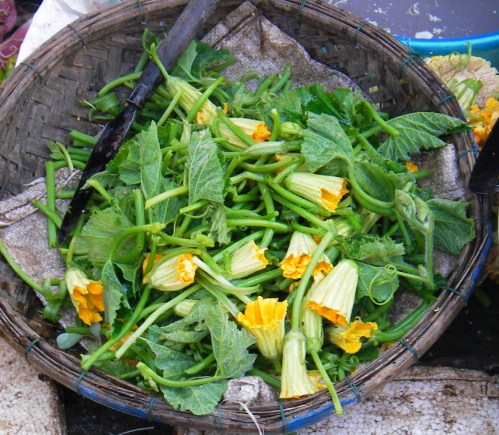
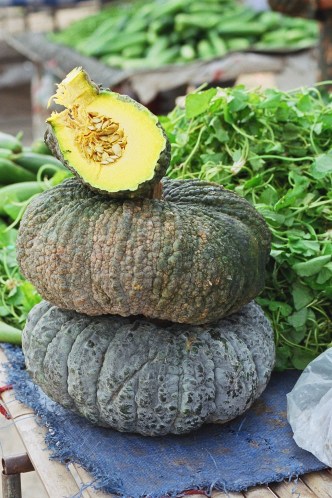
Kabocha is a hard skinned variety of Japanese pumpkin and winter squash. It has an amazingly sweetness, dense and silky texture and almost fibreless with dark green thick skin and bright yellow-orange flesh. This variety is preferred for Thai cooking and Thai people incorporate it in soup, curry, stir-fry and dessert dishes. Buttercup squash or Hubbard belongs to the same species and can be substituted for Kabocha. Pumpkin is a squash, but pumpkin is also a term that applies to almost all hard-skinned winter squash, not summer squash like zuchini. There are two known types of pumpkin that are used in Thai cooking – niho kabocha with a bumpy surface and kuri(seiyo) kabocha that has pale vertical stripes.
How to pick a good Kabocha squash
Kabocha should be fully ripe 45 days after it is harvested – when the starch has had a chance to convert to carbohydrate content. The flesh color then will change from yellow to a deeper color or orange. I choose a dark green skin pumpkin that has a hollow sound when I thump it. The best way to judge whether the Kabocha is ready is to buy a cut one so you can see its color and the texture inside.
Pranee’s Tips
To cut Kabocha in half, I first use a big knife and hammer to open it. The rest is easy. I then cut it into 1 – 1½ in wedges, and use the back of the knife or spoon to remove the seeds. I only peel it based on the recipe. Personally, I love the skin and it has more nutrients than the yellow part.
To prepare Kabocha for dumpling or pie, simply remove skin and seeds and cut into 1- inch chunks, steam about 15 minutes until tender and use a ricer to make a fine mash.
For soup, you may choose to leave the skin on which is tender when cooked. Remove the seeds and cut into the size according to the recipe.
Thai stir-fried catfish with red curry paste is a typical fast food wok-frying dish served over steamed rice. My sister’s recipe is a southern-rustic version that is very pungent. But at home and cooking school in Seattle, I prefer coconut milk instead of chicken stock. Then I recommend to omit oyster sauce when coconut milk is used. This is a great quick and easy Thai cooking for anyone who tries out Thai cooking for the first time.
1 cup steamed jasmine rice1 fried egg5 sliced cucumber2 tablespoons canola oil1 to 1 ½ tablespoons red curry paste¼ cup chicken stock or coconut milk (see note)2 tablespoons oyster sauce1 teaspoon sugar1 spur chili or Anaheim chili ¼ cup basil leaves4 pieces fried catfish steaks (see note)
Place steamed jasmine rice on a serving plate and fried egg on top of the rice. Garnish with sliced cucumber on the side.
Heat a wok on high heat, when it is hot add curry paste and stir well until fragrant. Stir in chicken stock, oyster sauce, sugar and salt. Mix well. Stir in chili, basil and fried catfish and cook until the fish absorb the flavors and moisture from the sauce.
Pour the hot catfish curry next to steamed rice and serve right away.
Cooknote: My sister coated her catfish with corn starch before frying. She likes it crunchy.
Thai Vegetarian Recipe Option: omit catfish and substitute it with 1/4 cup cut extra firm tofu and 1/4 sliced brown button mushroom. Use coconut milk instead of chicken stock
As far back as I can remember, my family kitchen contained only a few cooking utensils and cookware. The most versatile cookware was a wok. We use woks for all tasks, from stir-frying, steaming and blanching vegetables to making cooking oil from lard and coconut milk. It is possible that every household in Thailand will have an average of 3 woks in various sizes. For a community kitchen, the wok can be as wide as three to five feet wide. This wok is used for cooking curry, frying and steaming rice for a function with more than 300 people. A wok allows you to have total control to stir and mix a large quantity of foods with a large shovel. Owning a new wok is a new beginning of your culinary adventure in your kitchen.
A wok made of mild steel will rust; therefore a well-seasoned wok will protect it and make it easy to cook foods and prevent them from sticking.
Ladle & Shovel (Spatula)
Depending on the style of your wok, a ladle or spatula can be used. A ladle fits well in a deep bowl shaped wok and a shovel can be used for either a flat bottom or deep bowl wok.
How to Season a Wok
This is the summary on how to season a wok according to the “The Breath of a Wok” by Grace Young.
First step to handling your new wok is to clean it with hot soapy water to remove the protector. Then season it by using a few tips below.
~ Cook pork in a bone in boiling water.
~ Pan fried tofu to absorb metallic taste, and then stir-fry chives.
~ Use scallions, garlic chives, pork and ginger to remove the metallic taste.
~ Use high heat with salt.
This is a recipe for seasoning a wok for the first time before cooking a meal for serving:
2 to 3 tablespoons pork fat
1 cup garlic chives
½ cup ginger, shredded
Clean the new wok according to instructions. In general, clean and rinse well with hot water. Dry with a paper towel. Open all of the windows and turn the range hood on high. Bring the wok to a high heat, when it starts to make a layer of smoke, add in a pork fat, ginger and chives, and with a shovel or spatula stir-fry the ginger/chive mixture to cover the entire surface area of the wok. Reduce the heat to medium-high and keep stirring until the wok darkens. Discard the ginger/chives. Rinse the wok with hot water and bring back to high heat to dry the wok. Your wok is now ready.
The best way to season and to develop the wok patina is to constantly use it. I like to use the wok for deep frying, and the shape of the wok also helps to use less cooking oil.
My first visit to Jhanjay restaurant in the Wallingford neighborhood was by chance. My friends and I were planning on meeting at a well-known Thai restaurant nearby for lunch but it was closed. Some of my students had previously mentioned Jhanjay, with its modern setting and friendly, relaxed atmosphere, so we decided to give it a try.
There were many interesting, tasty dishes listed on the vegetarian menu. Here were the choices which appealed to us.
Jhanjay Sampler Platter (an assortment of finger food appetizers that included spring rolls, corn patties, wonton cream cheese, wonton buckets, and Asian fries. Served with three kinds of sauce.)
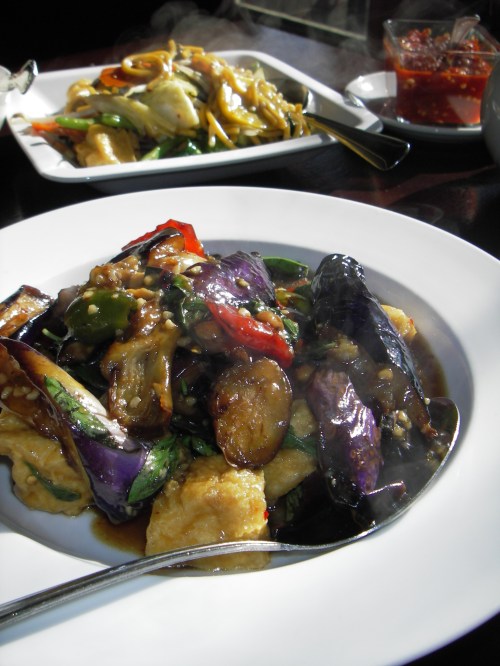
Spicy Eggplant (Chinese eggplant, garlic, bell peppers and sweet basil stir-fried with special sauce)
Monk’s Noodles (Miki noodles stir-fried with shitake mushrooms, assorted vegetables, topped with ground peanut)
Black Rice ice cream (coconut ice cream topped with black rice pudding)
We enjoyed everything we tried, and I highly recommend this place to you. The service was professional and very customer friendly.
I invite you to add a comment from your experiences about eating out at Thai restaurants.





























 Pranee's Thai Kitchen
