Feeds:
Posts
Comments

Archive for July, 2011

Drink Me

It has been exactly a week since I returned from Thailand and I am still trying to catch up with our Seattle summer. My friends have all assured me that I didn’t miss much during the past month as we are still having the same cold weather we had in June. This July, Seattle hit the record lowest temperature for summer, so all I really need to catch up on is eating the plentiful seasonal fruits and vegetables from the local farmers markets and nearby towns.  

Hami Melon

During my first grocery shopping back here in Seattle, my cart was full with all sorts of berries. And then my eye caught on a good-looking melon that I haven’t tried: Hami melon. It is grown in California and available from mid-May to July and from September to December. I let it ripen at home for a few days and its sweet aroma was inviting me to taste it. The sweet scent reminds me of the Thai long muskmelon that I used to grow a long time ago in my organic garden in Phuket—it grew abundantly despite my lack of knowledge and farming experience.

Hami Melon

Hami melon is a type of muskmelon, a Chinese melon variety. A good one can taste sweeter and have a higher sugar content than most other varieties of melon. I decided to make a smoothie with coconut milk to duplicate Taeng Thai Kati, a famous Thai muskmelon dessert made with coconut milk, but we will drink ours instead of eating it. I kept the flavor profile and the amounts of ingredients the same as in Taeng Thai Kati, but added a generous amount of crushed ice and simple syrup to turn it into a nice cold smoothie. I used only one-third cup coconut milk in my recipe, a perfect amount to make a smoothie, a healthy summer drink. But if you are looking for a nice milkshake-like drink and dessert combo, add a scoop or two of coconut ice cream; it would taste heavenly. When a sweet flavor is needed, honey or palm sugar simple syrup are good choices to add a dimension of sweetness and aroma.
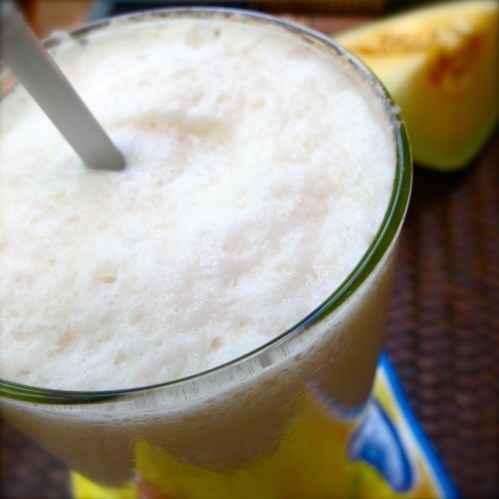
Coconut Melon Smoothie

Stock up on a few cans of coconut milk, then anytime the sweet floral scents of melon invite you, all you have to do is prepare this recipe. Hami melon is hard to resist, especially when it is combined with alluring fresh coconut milk. Drink me.

Coconut Melon Smoothie

Nam Kati Taeng Thai Smoothie

น้ำกะทิแตงไทยสมูทตี้

Serves: 2 to 4

Yield: 3 cups

16 ounces (see note) diced Hami melon, seeded, peeled and diced, or substitute honey-dew melon
⅓ cup coconut milk or coconut ice cream, more as desired
1½ cups crushed ice
2 tablespoons palm sugar simple syrup, optional (see note)
pinch of salt

Place melon, coconut milk, ice, sugar and salt in the blender and blend until smooth. Pour into a tall glass and serve right away with a straw.

Pranee’s Note

A 4-pound Hami melon (medium size), seeded, peeled and diced will yield about 2 pounds of diced melon.
 
To make palm sugar simple syrup, place a disc of palm sugar (about 4 tablespoons) and about ¼ cup water in a saucepan.
Bring to a boil and cook on medium heat for 5 minutes. Cool and chill. Keeps in the refrigerator for up to a week.   Yield: ¼ cup.
 
© 2011 Pranee Khruasanit Halvorsen  
I Love Thai cooking 
 Pranee teaches Thai Cooking classes in the Seattle area. Her website is: I Love Thai cooking.com .

Read Full Post »

Your Bilimbi, My Taling Pling

My favorite plant and fruit to watch as it grows is Taling Pling. It is also known as bilimbi and other countries have their own names for it as well. Its flowers and fruits grow in a cluster from the trunk and the main branches of the tree. First the cluster of maroon flowers comes out, then within a few days a cluster of cucumber-like fruits appears. The mature fruit can grow to 2.5 inches long. Because of its greenish color and the shape of the fruits, this tree has been nicknamed the Cucumber Tree. Its young leaves can be cooked and eaten or it can be used as an herb. The leaves have a sour flavor similar to sorrel and they are also know as Tree Sorrel.

Bilimbi or Taling Pling (Averrhoa bilimbi) is a relative of carambola or star fruit (Averrhoa carambola); it belongs to the genus Averrhoa and family Oxalidaceae. Bilimbi is native to Indonesia and the Malayan Peninsula and known throughout Southeast Asia, though it was not introduced to other parts of the world until the late 17th century. It is easy to grow and I grew up with a Taling Pling tree in my backyard. Most of the children growing up in my village had the experience of getting the fruit from the tree with a stick. We used to snack on it with sugar, salt and chili powder, just like we often did with green mango.

The Taling Pling that grows in Thailand is a sour variety. I cut it into small cubes to substitute for lime wedges in Miang Kam, a Thai snack dish. My family often adds it to sour curry as an alternative to tamarind chunks. The fruits are usually plentiful all year round, but we often neglect them.

Bilimbi Fruits

Bilimbi serves as an inspiration when the fruits are available and plenty. We use Taling Pling creatively in place of other sour fruits such as tamarind, lime and mango, depending on the dish. As I mentioned above, I also use it in place of star fruit. But there is no other fruit around quite like it, so it is hard to find a substitute for its distinctive sour flavor. The two ways that I can think of to cook this dish outside of Thailand would be to substitute two star fruits plus one to two tablespoons lime juice to whatever you are cooking, or you could substitute 1 cup sorrel leaves in the recipe below. Star fruit will give you the flavor and aroma of Taling Pling, but you will need to add lime juice to get the sour that the star fruit is lacking. Sorrel leaves, on the other hand, provide the same nice sour taste, but not bilimbi’s distinct aroma and texture.

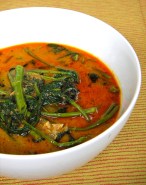
Fish Head Sour Curry with Bilimbi – Southern Thai Cuisine

Fish Head Sour Curry with Bilimbi

Fish Head Sour Curry with Bilimbi

Gaeng Som Hue Pla Taling Pling

แก้งส้มหัวปลากับตะลิงปลิง

Serves: 4

2 cups water
3 tablespoons sour curry red curry paste aka Gaeng Som Curry Paste
2 fish heads, cut in half, or 1 pound black cod or halibut, cut into large pieces with the skin on
8 Taling Pling, cut in half lengthwise, or 2 star fruits, sliced, plus 2-4 tablespoons lime juice
1 ½ to 2 tablespoons brown sugar

Add water and curry paste to a large pot and bring to a boil on high heat. Stir well before adding fish head or fish chunks and let it cook on medium heat for 2 minutes. Add Taling Pling or star fruit with lime juice and let it cook on medium heat until the fish heads are cooked and the Taling Pling is soft and juicy but still firm enough to hold it shape, about 5 minutes. Gently stir in sugar. Taste to find the balance of spicy, sour and sweet and adjust the flavor to your liking before serving. Serve warm with steamed jasmine rice.

Pranee’s Note:

There are many kinds of Fish head curry in Southeast Asia. I have more stories and tips to share in the future.

© 2011 Pranee Khruasanit Halvorsen  
I Love Thai cooking 
 Pranee teaches Thai Cooking classes in the Seattle area. Her website is: I Love Thai cooking.com .
 
Related articles

Read Full Post »

Kamala Beach, Phuket Thailand

A Walk for Remembering

When I visit home, I often take a leisurely walk—Dern Kin Lom—เดินกินลม—in Thai this means “walk to eat the wind.” Today I walked on the beach and in the village just a bit before the sunrise, around 6am. During the first walk of each visit my mind can’t help but wander off a bit to the aftermath of the 2004 tsunami. But as each year goes by, it is like a memory lost, and it does not stay in my mind as long. The rebuilding is beautiful with a park and the new-old town now filled with hotels, guest houses, shops and restaurants. And the people are moving on. Their daily lives are back to normal with cheerfulness as before.

I started my walk from the south end of the beach, then went along a canal through the tsunami memorial park. My first stop was to join locals at the breakfast stand.  (Please click here to see my  Breakfast on Phuket Island on YouTube.) After catching up with old friends and villagers at the coffee stand, I returned through the park and walked to the north end of the beach then back again. It takes about an hour and I become totally lost in the serenity.

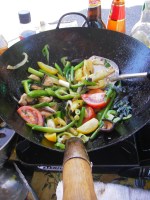
I walked back passing the Kamala Beach School and stopped by the school kitchen to say hi to an old friend. As usual, I ended up joining the chef team and had a second breakfast. Today, however, was different. Khun Taeng, the head chef, was in the middle of preparing Phad Phed Talay Tua Fak Yao for 500 students for lunch. I hung around and took a bunch of photos and caught up on the good old days and how we used to cook together with my family and friends. I have more recipes from Kamala Village and the school kitchen to share with you later on during the year. For today it was a perfect way to share my morning walk with you as well as recipes from the Kamala School. Our greetings to you all — from Kamala Village with love!

This slideshow requires JavaScript.

Thai Spicy Stir-fried Seafood with Yardlong Bean

Phad Phed Talay Tua Fak Yao 

ผัดเผ็ดทะเลถั่วฟักยาว

My students enjoy all sorts of Chinese style stir-fries with a little spice and herbs. It is a very common practice in Thai kitchens to use a wok for a quick and easy approach, but to add a pungent, spicy curry paste and herbs. This creates a meal that bonds flavor and satisfaction and is served with steamed jasmine rice. This quick and easy one-dish dinner is called Aharn Jan Deow (อาหารจานเดียว)—”A Dish Deal.” Most Thai cooks cleverly combine their choice of protein and vegetable to create this Phad Phed (meaning “Spicy Stir-fried”). If this dish is too pungent for your taste buds, you can add a few tablespoons of coconut milk to lower the heat. And if you wish to create the same flavor as Phuket Phad Phed, please prepare it using my Phuket Curry Pasteinstead of store-bought curry paste.So I hope you like the Thai flavorful approach to Chinese-style wok cooking. Let’s add Thai spicy stir-fried to your repertoire

Thai Spicy Stir-fried Seafood with Yardlong Bean

Preparation: 10
Cooking time: 5
Servings: 2-4
 
2 tablespoons cooking oil
3 tablespoons red curry paste, Phuket Curry Paste or Prik Khing curry paste (Mae Sri)
5 Kaffir lime leaves 
1/2 cup calamari rings
1/2 cup shrimp, peeled and deveined
1 cup yardlong beans beans or green beans, cut into 1 inch-lengths
1 cup cauliflower florets
1 tablespoon brown sugar
½ cup Thai basil
  
Heat the wok on high heat. When it is hot, add the cooking oil, then the red curry paste and Kaffir. Cook until fragrant, about 30 seconds. Then stir in calamari, shrimp, beans, yardlong beans, cauliflower and sugar. Stir until the seafood cooks through and the vegetables are cooked, but still crispy. Add a few tablespoon water as need to create steam and sauce for the cooking. Then stir in basil for 10 seconds. Serve over jasmine rice.
 
© 2011 Pranee Khruasanit Halvorsen  
I Love Thai cooking 
 Pranee teaches Thai Cooking classes in the Seattle area. Her website is: I Love Thai cooking.com .
 
 Related articles
 

Read Full Post »