Feeds:
Posts
Comments

Archive for November, 2012

Oops! Excuse Me – ขอโทษค่ะ

What is considered good or bad manners can change when you take cultural differences into consideration. A slurping sound, for example, is acceptable in Southeast Asia when you are enjoying a food moment with your soup. My sister and I encountered an awkward experience at the dining table when we visited Kho Samui, an island off the east coast of the Kra Isthmus in Thailand. Later, though, it all made sense to us. Since November is a national peppercorn month, please let me tell you a story of my Thai family trip to Koh Samui and our discovery of Thai Green Peppercorn Dip – Nam Prik Prik Thai Sod – น้ำพริกพริกไทยสด

Samaui sunset

In 2011, on the day after Chinese New Year, my brother drove his pick-up truck with three passengers – my sister, sister-in-law and I — to Samui Island, or Koh Samui. We left Phuket before the sunrise around 5am and arrived at Koh Samui at sunset. We went to Nathon, the island’s main town, and stayed at the  Grand Sea View Resortel. A friendly staff person who was native to the island recommended that we dine at the hotel restaurant, which had a set menu of local Koh Samui cuisine. While we enjoyed the sun setting right in front of us, we feasted on six dishes that highlighted Koh Samuicuisine: Pork & Mackerel with Pickled Mustard Green Soup, Green Peppercorn Chili Dip, Stir Fried Sweet Pork with Soy Sauce, Grilled Tuna in Red Curry with Cumin Leaves, and Stir Fried Glass Noodle with Green Papaya and Minced Pork. Though we are southerners from the other side of the peninsula, we discovered that our southern cuisines are prepared in much the same ways, though with a different combination of ingredients.

Koh Samui – Green Peppercorn Chili Dip

We lingered over our dinners. The sunset was beautiful, though the air was still with a high humidity we could feel. Half way into the meal, while my sister and I talked about the unique green peppercorns chili dip, we both began to experience many light small burps that continued randomly throughout the rest of the meal. Finally we looked at each other and laughed. Suddenly I could not feel the humidity any more, just a refreshing cool air conditioning on my skin where there was sweat. It felt like a little fan was blowing air near my skin. We realized that the chili dip was total genius! This may be the answer to why people eat such spicy foods in hot and humid climates—spicy foods provide an instant remedy. They help you acclimate to the weather, they aid digestion, and they act as a diuretic. I think this will be a good recipe to share with you during the holiday seasons because black or green peppercorns are a natural food that you can use instead of Pepto Bismol to help your digestion. Oops! Excuse me. –  ขอโทษค่ะ
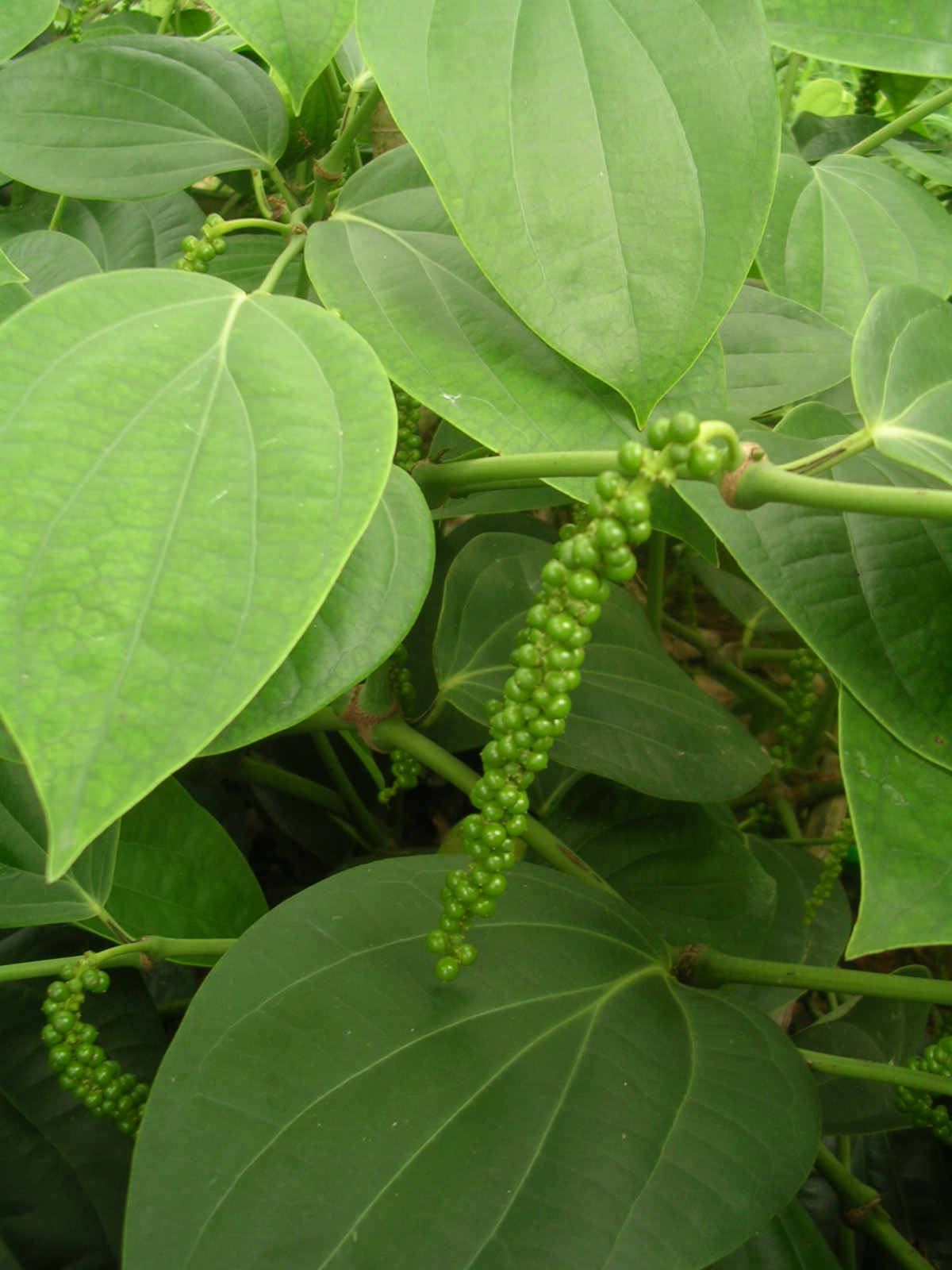
Green peppercorns – piper nigrum – perennial vine

Green Peppercorn พริกไทยสด

Green peppercorns are widely used in Thai, French and Western European cuisines. In Thailand, you can find fresh green peppercorn everyday in wet markets and as a staple ingredient in Thai restaurants. They are very aromatic, fresh tasting, and have a mild flavor of black pepper. Though you can use green peppercorns in the place of black peppercorns in Western cooking, that is not a practice in Thai cuisine, where green peppercorns have their own place and they define such dishes such as Phad Cha, Klue GlingPhad Ped, Green Curry, and any stir-fry that has curry paste or pungent herbs as a component. Green peppercorns create a playful flavor in all of these dishes, which generally have a rustic Thai style of cooking. In-depth Thai cuisine  is a healthy cuisine. Our ancestors cleverly disguised spices and herbs in our foods to accentuate and distinguish the flavors, but as we eat and enjoy the tastes, we are also taking in a healthy  benefit for our bodies. As for green peppercorns, the instant benefit is to promote appetite and aid digestion, and to serve as a diuretic to promote body sweat.

Fresh Green Peppercorn Dip – Recipe from Samui

The executive chef at Grand Sea View Resotel gave us a lesson on Samui local cuisine the following day. If you visit Koh Samui, please call ahead to arrange a time. The restaurant doesn’t have a regular schedule, but is available on request.

Green peppercorn, garlic and Thai chili

 I improvised with what we have here in Seattle: dry green peppercorns, garlic and Thai chili.

Thai Green Peppercorn Dip

Now the dip is ready for the dining table.

I use it as a condiment to add extra flavor to Thai and non-Thai dishes or to aid digestion.

Green Peppercorn Chili Dip

Nam Prik Prik Thai Sod

น้ำพริกพริกไทยสด

Yield: 2 tablespoons

This recipe is inspired by Samui green peppercorn chili dip – Grand Sea View Resotel, Kho Samui, Thailand

Since I remade this dish at home, I enjoy it often. Not always as a chili dip like in Thailand, but often as a condiment like salt and pepper. When I prepare a Thai meal, I use shrimp paste in place of the sea salt I would use in a western dish. Simply treat this green peppercorn chili dip as a new way you can use anytime to serve salt and pepper to your family and friends—especially during the holiday season when a seasoning can be a home remedy to aid the digestion of a large meal. No need for Pepto Bismol!

1 tablespoon fresh, dry or frozen green peppercorns
1 fresh Thai chili
1 clove garlic
1/2 teaspoon sea salt or shrimp paste

In a mortar with pestle, pound green peppercorns until they form a fine paste. Then add Thai chili, garlic and sea salt or shrimp paste and pound until the mixture blends into a paste. Place in a small bowl and set on the table with a small spoon to use it as a condiment to rice or a main dish.

Grand Sea View Resotel

175/4 Moo 3, Angthong, Koh Samui,
Surathani 84140, Thailand

Website: http://www.grandseaviewbeachresotel.com/

Tel. +66 (0) 77 421481, 426152-3, 426058-9
Fax : +66 (0) 77 426061

I Love Thai cooking
Pranee teaches Thai Cooking classes in the Seattle area.
Her website is: I Love Thai cooking.com 

Read Full Post »

How to Cook Peeled Split Mung Beans

Any time you come across Thai or Asian recipes that require cooked peeled split mung beans, you will find that you need to stop and learn about mung beans before you can proceed any further. Therefore I decided to do this blog post with step-by-step instructions that will simplify and demystify the process. This will make rest of the recipe less daunting and you will be able to make it with ease.

This is a technique that my mom and villagers use to prepare split mung beans before cooking them into sweet and savory dishes. Please prepare more than you need so you can keep some in the freezer for your convenience the next time you need them.

split muang bean

Peeled split mung beans are available in plastic bags at Asian grocery stores or online stores. They keep for a long time on the shelf, so I always make sure to have at least one bag on hand. They are made from mung beans that have been hulled, or peeled and split. Thai cooks always purchase them in the peeled and split form. Peeled split mung beans are one of the staple ingredients of the Indian subcontinent, Southeast Asian, and neighboring countries, and they are available in all Asian markets.

Step-By-Step Instructions for Cooking Peeled Split Mung Beans

Split mung bean soaking in water

Remove any dirt, sticks or debris that may come in the package, then place the split mung beans in a large bowl. Add water to cover at least 3 inches above the top of the beans. Let stand for at least 2 hours, or for the best results, overnight.

Split mung bean in a steamer

Strain the water from the beans then place them in the steamer with 2 inches of water in the bottom of the pot.

Steamed split mung beans

Cover the steamer and bring the water to a boil. Reduce the heat and steam on medium-high heat for at least 30 minutes. Check the texture of the beans. They should hold their shape, but when squeezed between the fingers they should have a soft texture. They can be creamy, but not grainy. If needed, steam longer until you get the fine result. When the beans are cool they are ready to place in a freezer bag and freeze, or prepare them according to your recipe.

Steamed Peeled Split Mung Beans

Tua Keow Lawh Puak Nuang

ถั่วเขียวเลาะเปลือกนึ่ง

Here is the first step for you to learn to prepare steamed, peeled, split neans, the basis of many sweet and savory recipes. You will be able to refer back to this recipe often. My favorite recipes with peeled split mung beans that I cooked often when I was in Thailand include Met Khanon (mock jackfruit dessert), Tao Suan (mung bean pudding), and Tua Pap (mock bean pods). There are many more ways to enjoy cooking with cooked split mung beans as well.

Yield: 2 1/2 cups

1 cup peeled split mung beans

Remove any dirt, sticks or debris from your package of mung beans, then place them in a large bowl. Add water to cover to at least 3 inches above the top of the beans. Let soak for at least 2 hours, or for the best results, let the beans and water sit overnight.

Strain. After soaking, 1 cup peeled split mung bean yields 1½ cups. Place mung beans on the steamer with 2 inches of water in the bottom of the pot.

Cover the steamer and bring the water to a boil. Reduce the heat and steam on medium-high for 30 to 60 minutes. Check the texture of the peeled split mung beans. They should hold their shape, but have a soft texture when squeezed between your fingers. They should be creamy, but not grainy. If needed,steam longer until the beans have the desired fine texture. Remove from heat.

When the beans are cool, they are ready to be placed in a freezer bag and frozen, or to use to prepare your intended recipe. After steaming, this recipe yields 2 ½ cups cooked mung beans.

© 2012 Pranee Khruasanit Halvorsen

I Love Thai cooking

Pranee teaches Thai Cooking classes in the Seattle area.

Her website is: I Love Thai cooking.com 

Read Full Post »

My Candy

This is not a Halloween Pumpkin Candy, but it is the Thai kabocha candy I enjoyed when I was growing up in my village in Thailand. Kabocha pumpkin is a squash that Thais cook to make a variety of dishes, sweet or savory. It is my tradition for the blog to share a new kabocha recipe with you every year. (Past years’ recipes include Kabocha Pumpkin Soup, Thai Kabocha Pumpkin Custard, Spiced Rum Kabocha Pumpkin Mousse, Pumpkin Curry and my mom’s Stir-Fried Kabocha with Pork.) This year, many aspects led me to choose a recipe for Thai Kabocha Pumpkin Candy-น้ำเต้าเชื่อม–Namtao Chuam. It is easier than a pumpkin pie, with more pumpkin satisfaction as there are not many ingredients involved—just kabocha pumpkin and brown sugar. Thais are fond of cooking fruit or root vegetables such as bananas, kabocha, and sweet potatoes in brown sugar. The results comes out well-covered with caramelized sugar and taste like candy. This technique is called -Chuam – เชื่อม in Thai.

Thai Kabocha Pumpkin Candy

Another reason that I chose this recipe is that in Seattle, fall is the beginning of kabocha pumpkin season. My friend Pee Som Sawan brought Thai kabocha pumpkin candy to the potluck for the first time this year, as she has done every Sunday for the past 10 years. Then another day at a dinner party, I reconstructed my kabocha pumpkin custard with kabocha candy and the custard instead of following the regular recipe. This was because it can be hard to find the small kabocha pumpkin needed for that recipe and the timing was complicated. But most of all, I chose the Kabocha Pumplin Candy recipe for this year because it can be hard to compete with the many food bloggers out there to come with an exotic recipe and I thought what could be better than my Thai grandma’s recipe? So I hope you enjoy this old time, easy and simple recipe that you can prepare at home.

Kabocha Pumpkin Candy

I want to thank to my friend Pee Som Sawan who shared her easy tips for simplifying the cooking technique. She suggested that I cut and lay the kabocha pumpkin slices in a pan that has a glass lid, sprinkle them with brown sugar or any type of sugar, then add enough water to the bottom of the pan to create steam when they cook. My only tip to add is how to find the right kabocha pumpkin for the best results. (Please see Pranee’s tips on selecting a kabocha pumpkin.)

Kabocha Pumpkin Candy

Cover the pan with the glass lid and cook on medium heat until the kabocha is soft and tender when tested with a fork, but still holds its shape. Remove the lid. If there is too much water left, let it cook without the lid until the syrup has thickened. Serve for dessert or as a snack.

Thai Kabocha Pumpkin Candy

Namtao Chuam

น้ำเต้าเชื่อม

Serves: 4

The total time for this dish, including cutting and cleaning and cooking should be about 3o minutes. The cooking itself is about 20 minutes. It is delicious warm or cold, with whatever syrup is left behind in the pan or with salted coconut milk. It tastes so heavenly! Skin and flesh are all good together. It is like a cheesecake with a natural crust. This recipe has sugar to just the right amount. For a more decadent dessert, please add more sugar. Enjoy this any time of day!

3 to 4 wedges of Kabocha pumpkin (see instructions)
1/2 cup brown sugar
2 pinches salt
3/4 cup water
6 tablespoons coconut milk plus 2 pinches of salt, optional
 

Remove any bad skin from the kabocha squash but keep all of the green skin; wash and dry. Cut into wedges about 2 inches wide, then cut each wedge in half across the middle to get two pieces from each wedge. Lay the pumpkin in the bottom of the pan and add the water. Cover with a glass lid and cook on medium heat until the kabocha is soft and tender when tested with a fork, but still holds it shape—about 15 minutes. Remove the lid. If there is too much water left, let it cook some more until the syrup has thickened. Remove the kabocha pumpkin candy to a serving plate and pour the syrup on top. If desired, stir the salt into the coconut milk until combined, then pour it on the top of each kabocha candy as a garnish before serving.

I Love Thai cooking
Pranee teaches Thai Cooking classes in the Seattle area.
Her website is: I Love Thai cooking.com 
 
Related articles

Read Full Post »