Feeds:
Posts
Comments

Archive for June, 2012

Stink Bean: Top Ten Facebook Photo

Can you smell that? Stink bean, called sator in Thai – สะตอ – is also known as Parkia or Petai. It is a flat edible bean that is large, but dense in texture. Whether fresh or cooked, it has a taste and aroma similar to asparagus, but 3 to 5 times more powerful. You may never have heard of it or seen it before. Sator looks a like a large fava bean but is found on a large tree that only grows in southern Thailand, the neighboring countries south of Thailand, and near the equator. At home in Thailand, I have 55 Sator trees in various stages of development. It happens to be a native plant that survives on hilly mountains and thrives side by side with my durian tree. A perfect pair, stinky fruits and stink bean.

The scientific term for sator is Parkia speciosa. One cluster has from 3 to 15 pods and each pod can have 6 to 16 beans. Sator, like asparagus, has an amino acid that is responsible for the noticeable smell. Southerners, like my family and friends, are delighted when the short sator season finally arrives and they prepare and share sator dishes and photos. Below is a picture my niece posted on Facebook on May 30th; many of my friends and other chefs from Thailand did the same. Perhaps the famous smell of this rare edible bean is precious for those who value its deliciousness and take culinary pride in this special bean.

Phad Phed Sator Goong – ผัดเผ็ดสะตอกุ้ง

One of many food photos of a stink bean dish. This is one my niece posted on Facebook. The dish was prepared by my sister Rudee. It is a one dish meal of Stir-fried Spicy Stink Beans with Prawns served over steamed jasmine rice.

The middle of May is the beginning of sator season in southern Thailand. As the bean starts to make its appearance, sator fans get so excited. The most famous stink bean dish of all is Phad Phed Sator Goong – Stir-fried Sator with Prawns.

Sator and durian grow side by side in Phuket

Sator, สะตอ, grows wild in Phuket, a twisted cluster bean that grows on a tall tree, often side by side with durian.

What is Sator, Parkia or Petai?

It is an honor to once again present you with a local dish cooked by a local home cook, my friend Varunee who also teaches southern cooking on my culinary tour. Varunee will present you with Phad Phed Sator Phuket – Stir-fried Spicy Stink Bean with Prawns, Phuket Style. This is the way my mom and her mom and the local people in Phuket would cook it in their kitchens for family and friends. Please feel free to modify the recipe to suit your liking. There is no substitute for sator, however you can enjoy this recipe with any seafood or with other vegetables such as asparagus, fava beans or edamame for a similar texture.

Phad Phed Sator (Parkia) Goong – ผัดเผ็ดสะตอกุ้ง

Stir-fried Spicy Stink Beans with Prawns, Phuket Style

Phad Phed Sator Goong Phuket

ผัดเผ็ดสะตอกุ้งภูเก็ต

Serves: 4

3 tablespoons vegetable oil
3 cloves garlic, peeled and chopped
2 tablespoons Phuket red curry paste, or any brand from Thailand
1 teaspoon shrimp paste, optional (omit it if you use Mae Ploy Brand red curry paste)
8 prawns, shelled and deveined
1/4 cup water
1 tablespoon soy sauce
1 teaspoon palm sugar or brown sugar
1/2 cup Sator or Parkia beans, fresh or frozen
3 Kaffir lime leaves, center vein removed 

Heat a wok on high heat until it is hot, pour in vegetable oil and then stir in garlic, curry paste and shrimp paste. Stir well until fragrant, about 1 minute. Stir in prawns and stir for 30 seconds. Pour in water. Stir well until curry paste and oil are well-combined and prawns are cooked well in the sauce. Stir in soy sauce. Stir in palm sugar until well-combined.

Fold the Kaffir lime leaves lengthwise, remove the vein, then add the leaves to the wok. Stir in sator. Stir back and forth until the sator is partially cooked. Be careful not to overcook the prawns or the sator, which doesn’t need to be cooked very long. A shorter time is better for sator to keep its crunchy texture. Remove Kaffir leaves. Serve hot with steamed jasmine rice.

Please see instructions and photos below for cooking step by step.
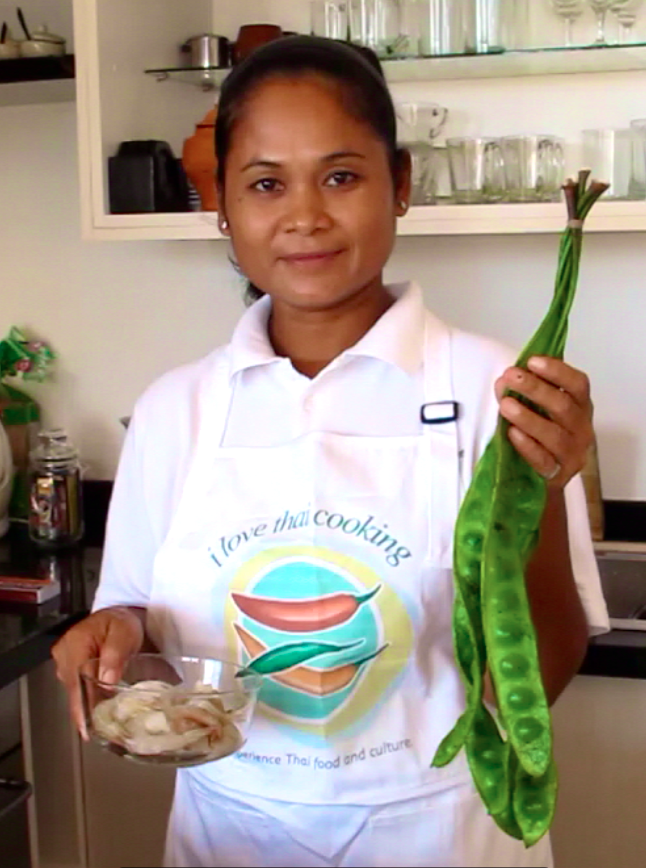
Varunee shows you how to prepare her Phad Phet Sator Goong Phuket Style


My friend Varunee will show you how to prepare a famous Phuket dish Phad Phed Sator Goong, Stir-fried Spicy Stink Beans and Prawns, Phuket Style. Please enjoy her cooking.

Red curry paste and shrimp paste

In Phuket there are two kinds of red curry paste. One is for coconut-based curry and one is for stir-fries without coconut milk or with very little—just about 2 to 4 tablespoons coconut milk to make the sauce or to tone down the spicy level of the dish. Please do not be overly concerned with this level of complication, use Mae Ploy or Thai kitchen brands as you wish. For the best results, I recommend my Phuket Red Curry Paste Recipe.

Cooking oil and curry paste

Heat a wok on high heat until it is hot, pour in vegetable oil and then stir in garlic, curry paste and shrimp paste.

Phad Phed Sator (Parkia) Goong – ผัดเผ็ดสะตอกุ้ง

Stir in prawns and stir for 30 seconds.
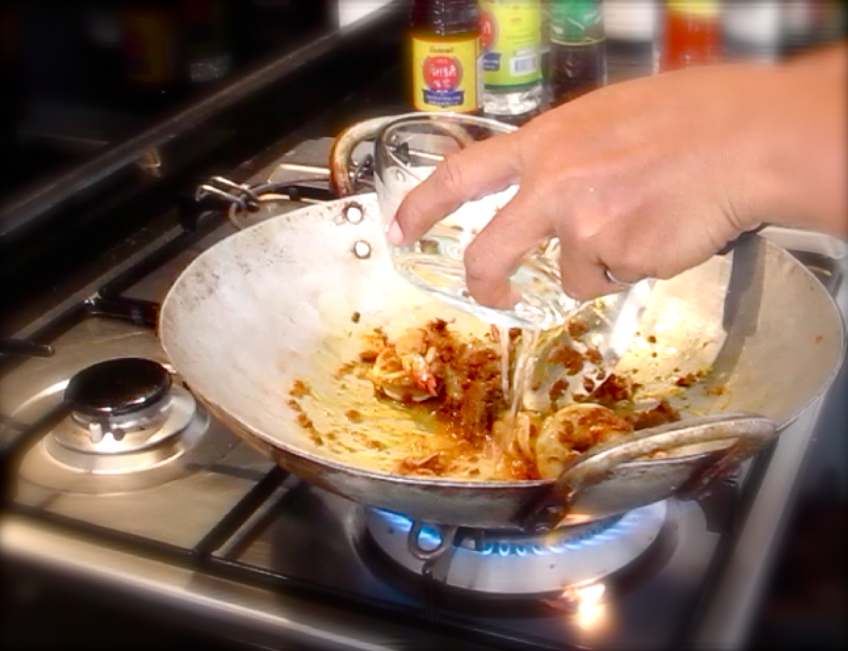
Phad Phed Sator (Parkia) Goong – ผัดเผ็ดสะตอกุ้ง

Then pour in water and stir well until curry paste and oil are well-combined, making a good sauce, and the prawns are cooked well.

Phad Phed Sator (Parkia) Goong – ผัดเผ็ดสะตอกุ้ง

Stir in soy sauce.

Phad Phed Sator (Parkia) Goong – ผัดเผ็ดสะตอกุ้ง

Stir in palm sugar until well-combined.

Phad Phed Sator (Parkia) Goong – ผัดเผ็ดสะตอกุ้ง

Fold the Kaffir lime leaves, remove the veins, then add the leaves to the wok.

Stir in Sator – Stink bean

Stir in sator.

Phad Phed Sator Goong – ผัดเผ็ดสะตอกุ้ง

Stir back and forth until the prawns are cooked and sator is partially cooked. Be careful not to overcook the prawns or sator. A shorter time allows sator to keep its crunchy texture.

Credit: Khun Varunee

© 2012 Pranee Khruasanit Halvorsen
I Love Thai cooking
Pranee teaches Thai Cooking classes in the Seattle area.
Her website is: I Love Thai cooking.com 

Read Full Post »

Applied Thai Culinary Art

Gai Yang Amphawa – ไก่ย่างอัมพวา

Grilled Thai Chicken Gai Yang, shown here from my visit in 2011, is famous Thai street food.

On May 29th—just about two weeks ago—The New York Times published the article “Cuisines Mastered as Acquired Tastes.” It told the story of some cooks that have become stars of authentic cuisines from other than their native countries.

One person mentioned in the article is Superstar Thai chef, Andy Ricker, the James Beard Best Chef in the Pacific Northwest in 2011. The article was fascinating reading and brought to mind my last week’s post on Thai basic seasoning paste.  Andy Ricker uses Kratiem Prik Thai paste – a basic Thai seasoning – in his restaurant kitchens as intensively as a Thai would in his. I have been to Andy’s Pok Pok Restaurant in Portland, Oregon a few times. Several of the dishes on his current menu obviously use this basic Thai seasoning paste, including Kai Yaang: Charcoal, rotisserie-roasted natural game hen stuffed with lemongrass, garlic, pepper and cilantro), Moo Paa Kham Waan (Boar collar meat rubbed with garlic, coriander root and black pepper glazed with soy and sugar grilled over charcoal) and Kung Op Wun Sen (Wild caught gulf prawns baked in a clay pot over charcoal with pork belly, soy, ginger, cilantro root, black pepper, chinese celery and bean thread noodle.). Andy uses Kratiem Prik Thai as a marinade sauce in the first two dishes and as a seasoning in the third.

Goong Oob Woon Sen – กุ้งอบวุ้นเส้น

Goong Oob Woon Sen, a famous Thai hot pot dish served on a banana leaf. I enjoyed this dish served from a clay pot or on a banana leaf by street vendors in Amphawa. The grass noodles were soaked with the delightful flavors of soy, cilantro root, garlic and black pepper. A short gentle braising brings out all the great flavors.

It is great to see non-Thai become super stars in Thai cuisine because it is important to educate both Thai and non-Thai about our truly amazing cuisine. We would like non-Thai to appreciate and learn about authentic Thai cuisine in restaurants in America and elsewhere. And most importantly, we would like for Thai restaurant owners to work hard to preserve our culinary heritage through menus that don’t just offer dishes laden with sugar and coconut milk. If you are looking for a Thai cookbook, here are some authorities on Thai cuisine whose work I admire: David Thompson, a restauranteur and cookbook author; Nancie McDermott, cookbook author and historian; Robert Carmack and Robert Danhi, cookbook authors and tour leaders to Southeast Asia; and Naomi Duguid and Jeffrey Alford, cookbook authors, writers, travelers and photographers.

Fried Thai Garlic and Pepper Fish – Kratiem Prik Thai Pla – ปลากระเทียมพริกไทย

Fried Thai Garlic and Pepper Fish – Kratiem Prik Thai Pla

My friend Kratiem Prik Thai Pla at Kamala Beach village Pavilion Beach Restaurant with its signature garlic-black pepper sauce, topped with a lot of fried garlic.

Now that you have learned about Kratiem Prik Thai paste from this and the previous post, you can have fun learning to be a food detective, reading menus and finding the tastes of garlic, black pepper, and cilantro toots in Thai restaurants.

Cilantro roots alternative. In Seattle, when I see cilantro roots at a farmers market or at PCC Natural Markets, I buy a bunch so I can have a supply on hand in the fridge and the freezer. When  cilantro roots are not available, I use 2 teaspoons of finely chopped cilantro stems as a substitute for 1 cilantro root.

I hope you enjoy my photos from a famous restaurant in Bangkok, street food in Amphawa, and a beach restaurant in Phuket. The creators of these dishes may vary as to their preferences for white pepper or black pepper, soy sauce or fish sauce, palm sugar or white sugar, but they all use the secret ingredients of garlic, black pepper and cilantro root.

Please let me know if you have any suggestions for using Thai Basic Seasoning Paste Recipe.

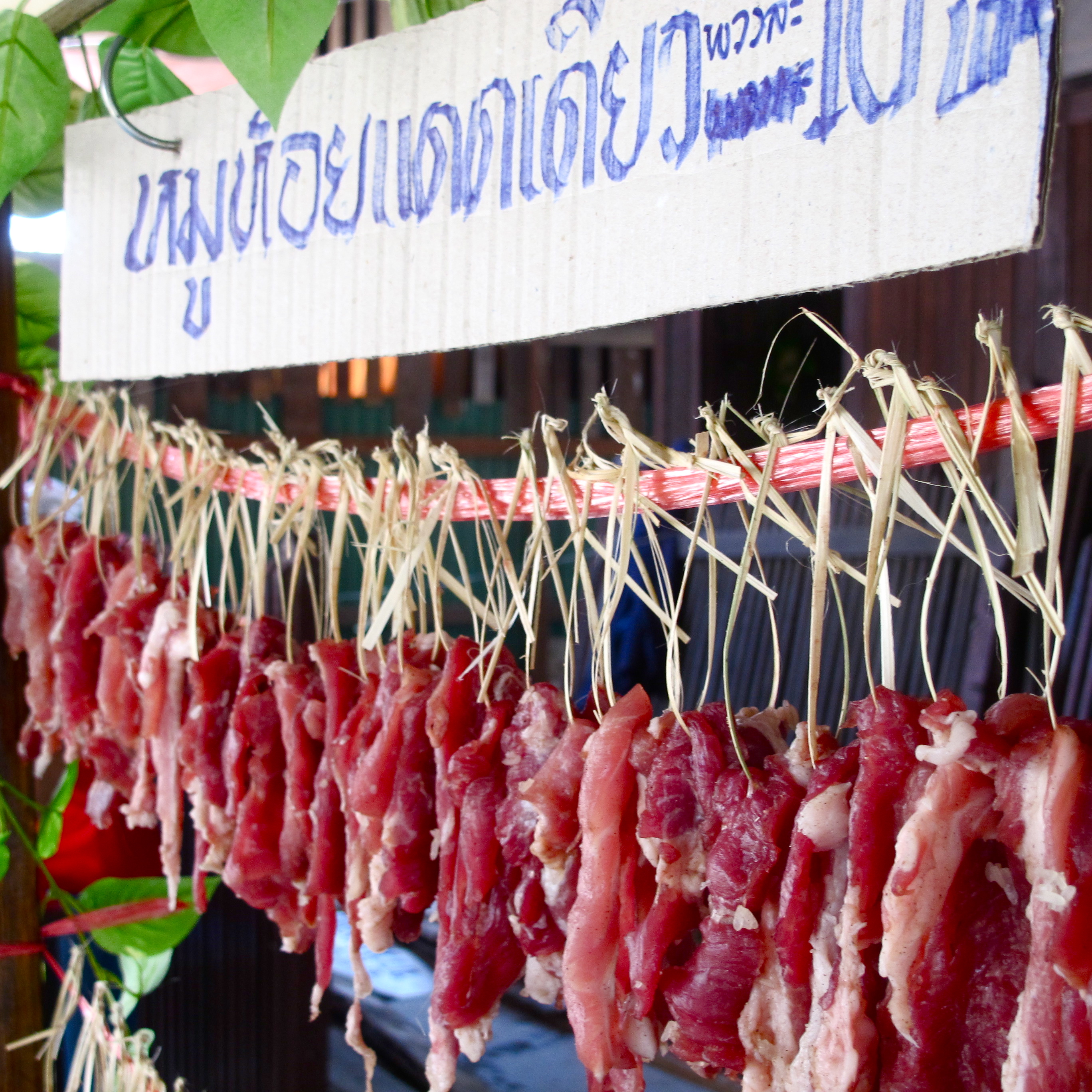
Sun-dried Pork – Moo Daet Deow – หมูแดดเดียว

Amphawa, Thailand
Sun-dried pork on the street at Amphawa, ready to deep fry to order.
Some Thai cooks prefer to use fish sauce rather than soy sauce and white peppercorn powder rather than black pepper corns in making Kratiem Prik Thai Rak Puk Chee paste.

Kratiem Prik Thai Goong – กระเทียมพริกไทยกุ้ง

You will find the nationally famous garlic prawns in many forms and under many names in Thai restaurant menus. The traditional Thai version doesn’t mix in vegetables but has a few fresh sliced cucumbers on the side. This photo of garlic prawns was taken at Harmonique Restaurant, my favorite restaurant in Bangkok.

© 2012 Pranee Khruasanit Halvorsen
I Love Thai cooking
Pranee teaches Thai Cooking classes in the Seattle area.
Her website is: I Love Thai cooking.com  
 
Follow Me on Pinterest

Read Full Post »

Three Best Friends

สามสหาย – Saam Saahai

To consider oneself a Thai cook, one should understand the fundamentals of  Kratiem Prik Thai—garlic-black pepper-cilantro root seasoning paste. Like Nam Prik or chili dip, it is a truly Thai invention without any influences from neighboring countries. Like the classic pesto sauce that originated in Genoa in the Liguria region of northern Italy, Kratiem Prik Thai is a classic Thai culinary seasoning that has been around for as long as the existence of Siam.

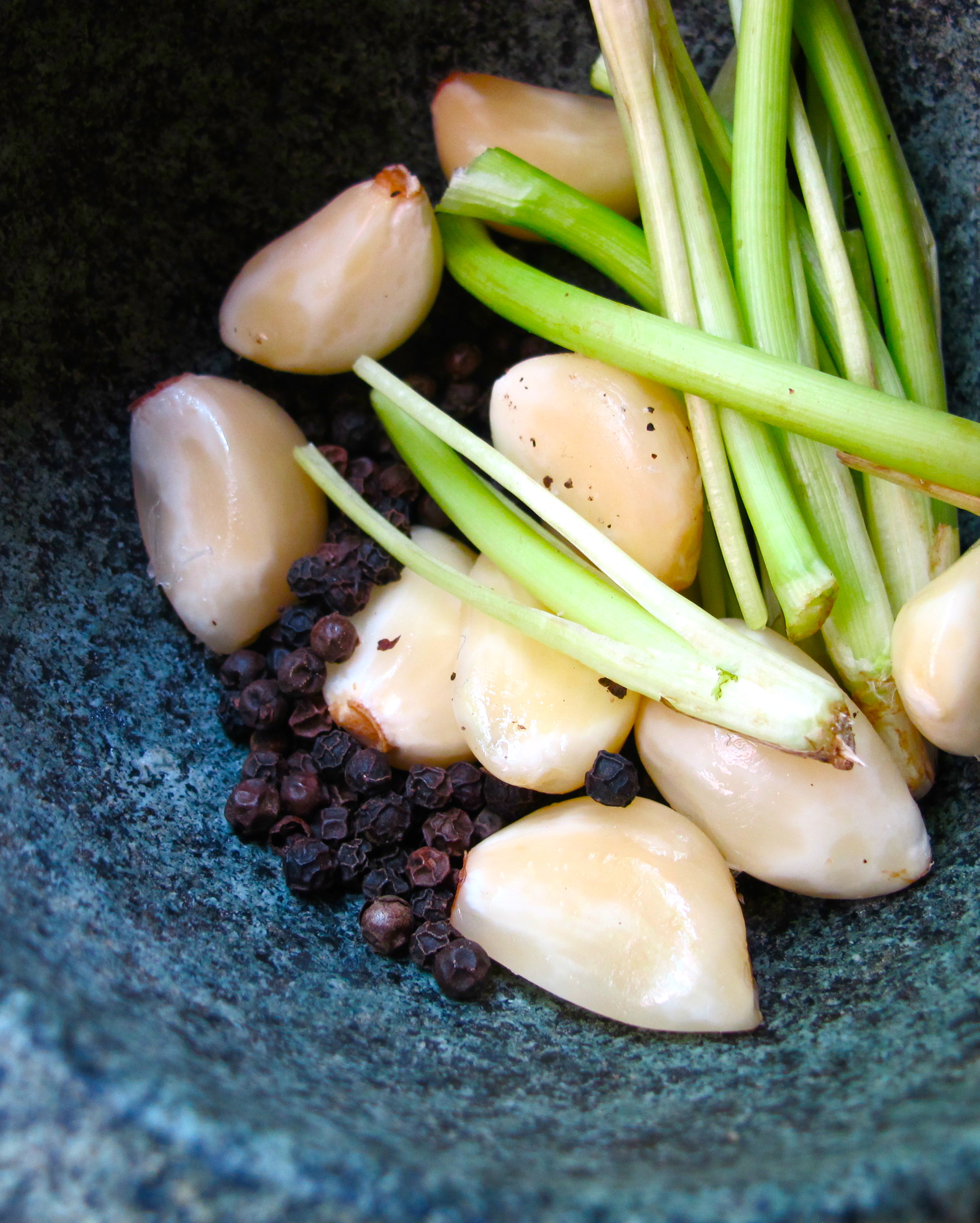
Garlic, black pepper and cilantro roots

Pounding a mortar and pestle to make a Kratiem Prik Thai paste is a classic Thai culinary technique, and this paste is prepared practically everyday in every Thai kitchen where it serves as a seasoning for any meat or seafood. There is no need for more herbs than just this awesome three: garlic, black pepper and cilantro root. I like to call them the “three best friends” or, in Thai, สามสหาย – Saam Saahai. They often appear together in Thai recipes. Like The Three Musketeers, they are”All for one, one for all.”

Garlic – Black Pepper – Cilantro Root

Kratiem – Prik Thai- Rark Puk Chee

กระเทียม – พริกไทยดำ – รากผักชี

The Kratiem Prik Thai paste is simply made with just the three main ingredients of garlic, black pepper and cilantro. When balanced with salty and sweet from soy sauce and brown sugar, they deepen the flavor of grilled meat, appetizers, meat patties for soup, or marinades for meat before deep-frying. Then sweet chili sauce and Sriracha hot sauce may be served alongside the meat with a vegetable condiment. I hope you have a chance to learn how to make the Kratiem Prik Thai paste below and experiment with it in your cooking at home, from marinating your steak to adding it into a meat patty or simply sauteing it with seafood for a quick and easy main dish.

Garlic – Black Pepper – Cilantro Root Kratiem – Prik Thai – กระเทียม – พริกไทยดำ – รากผักชี

Place garlic, black pepper and cilantro roots in a mortar.

Garlic – Black Pepper – Cilantro Root, the three ingredients in  Kratiem – Prik Thai – กระเทียม – พริกไทยดำ – รากผักชี

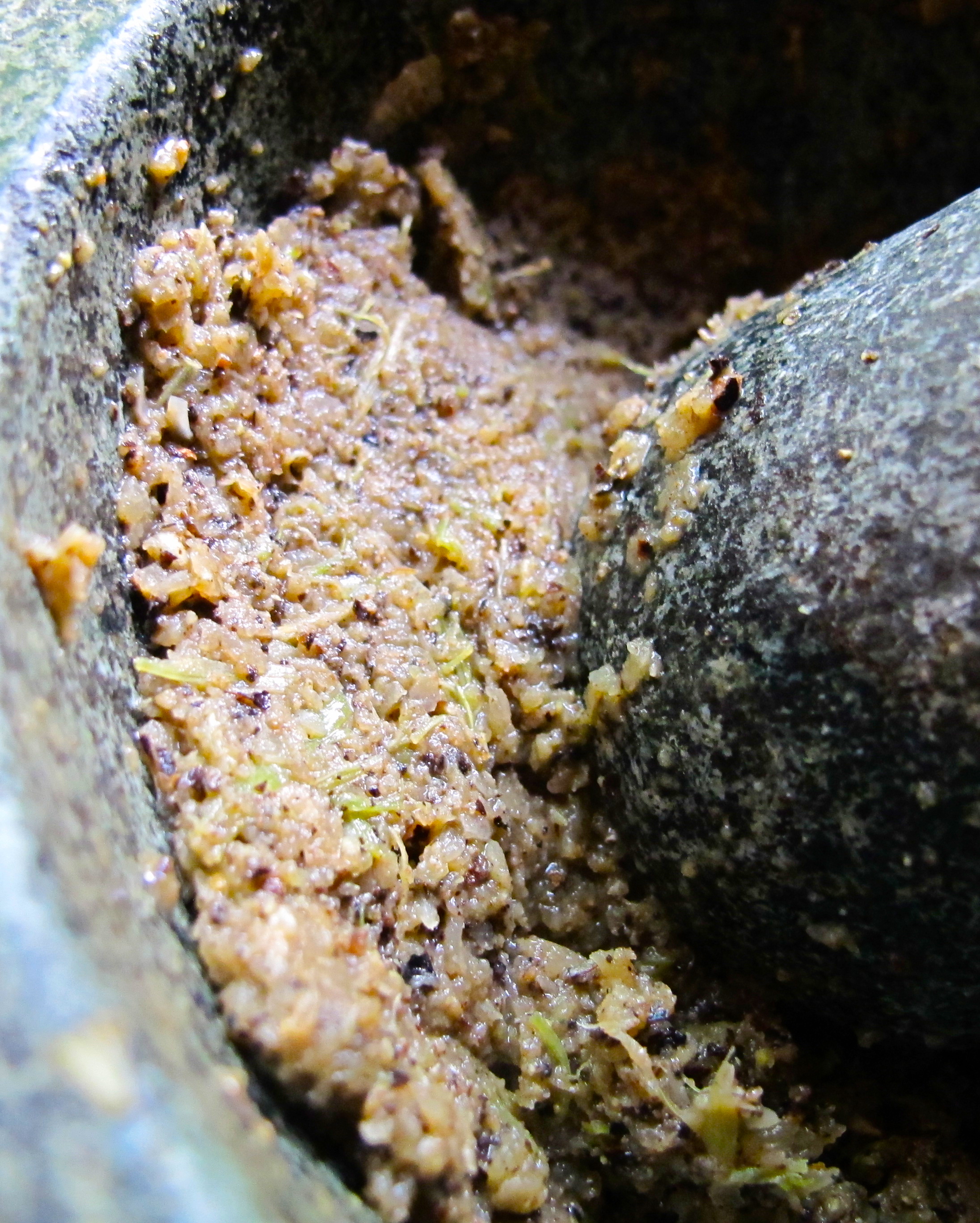
With pestle, pound garlic, black pepper and cilantro root in a medium-size mortar

Garlic – black pepper – cilantro root Kratiem – Prik Thai – กระเทียม – พริกไทยดำ – รากผักชี

until it forms a fine paste, about 2 to 3 minutes.

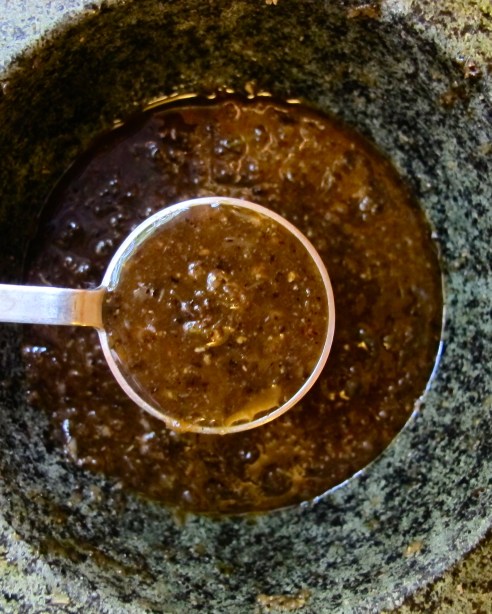
Garlic, black pepper and cilantro roots with brown sugar and soy sauce: Kratiem – Prik Thai – กระเทียม – พริกไทยดำ – รากผักชี

Add brown sugar and soy sauce and stir in circular motion with pestle until it is well-blended and smooth.

Thai Basic Seasoning Paste

กระเทียม – พริกไทยดำ – รากผักชี

This recipe makes a large quantity. You can store it in the refrigerator and use it as needed, or freeze it in convenient quantities in an ice cube tray. Use 2 tablespoons of the finished paste per pound of meat or seafood as a marinade before grilling or frying. You can also use it as a basic seasoning paste in ground meats cooked for Thai appetizers. Please click on the photo for a link to a recipe for using the paste with seafood or shrimp.

 
Yield: 1/2 cup
 
1 tablespoon black pepper corns, or more
10 cloves garlic, peeled and minced
8 cilantro roots or 4 tablespoons chopped cilantro stems
6 tablespoons soy sauce
1 to 2 tablespoons brown sugar
 
Place garlic, black pepper and cilantro roots in a medium size mortar. With pestle, pound the ingredients until they form a fine paste, about 2 to 3 minutes. Add brown sugar and soy sauce and stir in circular motion with the pestle until it well-blended and smooth. Store in a mason jar in the refrigerator for a week, or freeze for up to 6 months. Please see suggestion above on how to incorporate this seasoning paste in your cooking.
 
Alternative preparation method: Place garlic, black pepper, cilantro roots, soy sauce and sugar in a blender and blend until it reaches the desired texture. I like the consistency shown above which still maintains a little texture.
 
Note: Please wait to see my next post when I will discuss in depth how to incorporate Kratiem Prik Thai Rark Puk Chee seasoning in your daily cooking.
 
© 2012 Pranee Khruasanit Halvorsen
I Love Thai cooking
Pranee teaches Thai Cooking classes in the Seattle area.
Her website is: I Love Thai cooking.com  
 
Follow Me on Pinterest

Read Full Post »