Feeds:
Posts
Comments

Archive for June, 2011

Chasing the Monkey Tails

Early Morning around Surathani Province

Coconut Trees along the Roads, Southern Thailand Scenery
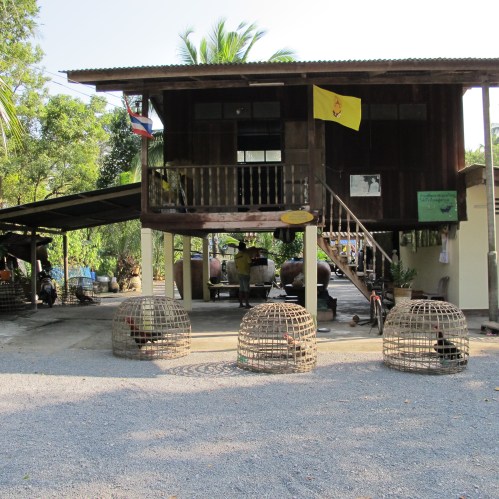
Kadaejae Monkey School, Surathani

I have been home again on Phuket Island for a few days now but still haven’t gotten used to the weather yet. Not that I want to complain about 94°F weather that feels like 104° F because of the humidity. I always love my visits with family and the foods here are truly exquisite.

While allowing myself to acclimate to the weather by drinking cool coconut water, I pulled out a lot of my notes, pictures and videos from my previous trip to Surathani. I was searching for information about a monkey school in Southern Thailand where monkeys learn how to pick coconuts from the coconut trees. My video took place at the monkey school.

Before leaving Seattle, I had been enjoying cooking with all forms of coconut: spicy-lime coconut chips, green or red curry with coconut milk, cucumber salad with coconut water vinegar and stir-fried fresh grated coconut with Phuket curry paste. Perhaps today is an appropriate time to learn about coconuts. What is a coconut anyway?

Before I answer this question, I want to first share some of the highlights of my trip to Surathani, a province in Southern Thailand that is famous as the land of a million coconut trees. I was lucky to have my brother as my tour guide taking me to all the famous Thai food restaurants and important sites along the way. He is a professional tour guide  and an expert on the Southern region. Most importantly we had a good time visiting the monkey school. Everyone was so warm and agreed to give me information and be part of the video taping, which you will see below. Thank you for P’ Paew, the owner of Kadaejae Monkey School and brother Sumit for the insight and patience. I had so much fun “Sanuk.”

When you start Thai cooking at home, you will encounter a lot of terms and types of coconut, so I think it is a good idea to start at the beginning with what is a coconut? In short, it is a seed, a fruit and a nut (in the botanical sense) What part of the coconut is used in cooking? In my Thai kitchen I cook with palm sugar which is made from the sap of the coconut flower. I use the heart of a coconut palm, which is nice and crunchy, in Sour Curry with Fish, and the heart of coconut palm (Gaeng Som Pla khab Yod Maprow). I also use coconut water vinegar, coconut milk, coconut cream, young coconut with coconut water and grated fresh and dry coconut—to name a few.

So here is a quick lesson on a coconut: coconut cream, coconut milk and coconut water.

When you remove the coconut husk (mesocarp) from a whole coconut, you can see the coconut shell (endocarp). After cracking the coconut shell, you get to the natural water inside the nut and this is called coconut water. The white meaty part inside the shell is the coconut meat (endosperm). Grating a chunk of white of coconut meat with a coconut grater gives you fresh wet grated coconut. To extract coconut milk, add a cup of water to 2 cups fresh grated coconut, then squeeze out the white milky liquid; this is concentrated coconut milk. (Thai call this the “head” of coconut milk). Add 1/2 cup water to the used grated coconut to extract  a thin coconut milk (Thai call this the “tail” of coconut milk). Let the coconut milk sit, and a fat creamy layer will form on the top; this is the coconut cream.

Back to the coconut water. Coconut water occurs naturally and has nothing to do with the process of making coconut milk. Nature provides the coconut meat and water as nutrients for shoots to grow near the three germination pores, or “eyes,” on the coconut. This coconut water inside the coconut shell is very good for the coconut plant, but it is also very good for you. It is full of vitamins and minerals. It is especially high in potassium and electrolytes, and has a neutral ph level. I strongly recommend that tourists traveling to paradise island drink this natural drink to help with rehydration, and it has the added benefit of being a sterile juice inside the shell.

I have  over 20 recipes on this blog that use coconut milk, coconut cream, coconut water vinegar and palm (coconut) sugar.

I hope this is a good start and I hope that my next trip to Thailand I will bring more inspired recipes to share with you.

Related articles

Read Full Post »

From Las Delicias with Love

It was Mother’s Day, May 8, 2011, when I arrived as part of a team of eight gracious women in the Nicaraguan village of Las Delicias. The village is situated in the hilly northern area in the Matagalpa region and is surrounded by coffee plantations. We were there with the organization BuildOn to present  the community with a new school on behalf of many generous donors from the United States.

May 8, 2011, Las Delicias

The welcoming and celebrating event was an indescribably heart-warming experience. It took place right on the grounds of the future school. For the next four days, our host families shared their food, their houses and their children with us and our lives were enriched by their culture, foods and hospitality.

Dinner with Rice, banana and bean

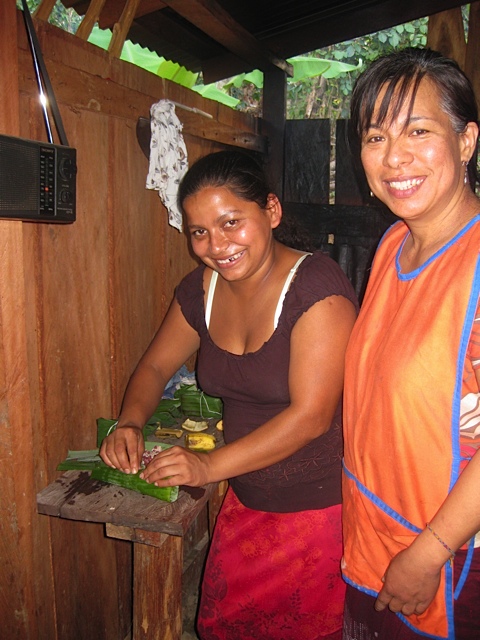
Jacqualee, one of my group members, and I were fortunate to have Thelma and Ricardo and their daughter Helene as our host family. A typical day began around 5:30am with the sound of Thelma’s tortilla-making or the rooster’s cock-a-doodle-doo. Then we would have breakfast at 7am before going to work on the building project with local volunteers. A typical meal for breakfast, lunch or dinner was corn tortillas, rice, bananas, and beans, accompanied by either eggs or chicken.

Jacqualee and I were very excited when Thelma and Ricardo asked if we could teach them the cuisine we ate back home. We happily agreed and I cooked up the menu with Jacqualee. I wanted something practical that Thelma would enjoy cooking for her family and that would use ingredients that were available in her backyard or the local market—forget about Tom Yum Goong and fancy Thai dishes. We decided on Son-In-Law Eggs, Mango Salad and Sweet Rice, Bananas & Beans Wrapped in Banana Leaf.

Banana leaf just right outside

We started with Kao Tom Mud. First Ricardo helped with cutting the banana leaf from the tree which was right outside in their yard. I removed the stems and tore the leaves into pieces 8 inches wide, then cleaned them well with a damp cloth to remove dirt. I only had to show Thelma once how to use the banana leaf for wrapping, then she took over the task with confidence. We made enough of them to give some to her neighbor.

While it was in the steamer, we prepared mango salad and son-in-law eggs. While we were cooking, Danilo, our translator, translated our cooking lesson from English into Spanish. Danilo helped me explain the most important part of Thai cooking was the harmonious blend of the four essential flavors of Thai cooking: sweet, sour, salty and spicy. The sweet was the sugar, the sour available to us was mango and two citrus juices, the spicy was Nicaraguan chili and, the salty was salt and the salty peanut that Jacqualee brought from home. I loved listening to Danilo speaking in Spanish explaining to Thelma about sweet, sour, salty and spicy. It was one of the highlights for me personally and professionally, and cooking for Thelma and Ricardo gave us a chance to thank them for their warm welcome to their home.

Thelma wrapped rice, banana and bean with banana leaf

I have used my recipe below countless times in cooking classes. It is basically a two-stage process. In the first stage, the sticky rice cooks until it has a sticky texture but it is still grainy and raw and is ideal for wrapping around a banana. It is pliable like playdough to form or shape and then it gets wrapped by the banana leaf. The second stage is the actual cooking of Kao Tom Mud, which is generally done by steaming. We steamed the rice and banana all the way through, which can take from 30 to 50 minutes. After 30 minutes of steaming, open one up to check if more steaming time is needed.

Kao Tom Mud

In my Seattle kitchen, I love to put the wrap on the grill or in the oven for the second stage, which is how I teach it in my classes. Now that summer is finally here, I hope that you will enjoy preparing this recipe either in a steamer or on your grill. Banana leaves are easy to find in local Asian markets in the freezer section.

I hope that you will enjoy cooking rice, banana, and beans wrapped with banana leaves. You will feel like you are in the tropical countries of Thailand or Nicaragua.

Kao Tom Mud, Steamed Sweet Rice and Banana Wrapped in Banana Leaf

Sweet Rice and Banana Wrapped in Banana Leaf

Kao Tom Mud 

ข้าวต้มมัด

Servings: 8

2 cups Thai sticky rice, soaked for 3 hours or overnight, and drained
¾ cup coconut milk
¼ cup water
2 tablespoons granulated sugar, optional
1 cup canned black beans, drained, optional
1 teaspoon salt
2 bananas, peeled, cut in half lengthwise and also crosswise to get 4 pieces from each banana
8 (8 X 8-inch) banana leaves or pieces of parchment paper
 
Stir sticky rice, coconut milk, sugar and salt together in a large pan over medium heat. Stir until all the coconut milk is absorbed. Stir in black beans and fold gently to mix.

Divide sticky rice mixture into 8 equal portions. Spread each portion onto a banana leaf, spreading to cover an area 6 by 4 inches, then place a section of the banana in the center. Fold the banana leaf to wrap the sticky rice around the banana.

Then fold the banana leaf into tamale-like envelope and secure both ends with a toothpick that pokes down and then up through the banana leaf. Grill for 5 minutes on each side, or until the sticky rice is translucent and cooked.

Pranee’s note:

If banana leaf is not available, you can use parchment paper. See Pranee’s Grill Sticky Rice in Bamboo Tube Recipe for details.

Pulut Lapa

Image by chooyutshing via Flickr

Read Full Post »

My Everyday  Asian Vegetable

Choy Sum - Flowering Cabbage

Choy Sum (also known as flowering cabbage) is a most popular vegetable in Southeast Asia. It belongs to the Brassica family along with Bok Choy and Gai Lan (Chinese kale or broccoli). The most common uses are in stir-fries and soups. My favorite way of preparing this is to stir-fry it as a side dish with salt and pepper or stir-fry with any rice noodles or egg noodles. It takes a short time to cook and is easy to pair with other ingredients. 

Stir-fried Choy Sum as a Side dish

Stir-fried Choy Sum

Phad Pak Gwang Tung

ผัดผักกวางตุ้ง

Servings: 4

Preparation: 5 minutes

Cooking time: 5 minutes

3 tablespoons canola oil
3 garlic cloves, peeled and minced
12 choy sum 0r about 12 ounces, cleaned and cut into 2 inch-lengths
Salt and pepper to taste

Heat canola oil in a wok on high heat and stir in garlic. When garlic is golden, stir in choy sum. Stir in a few drops of water and season with salt and pepper to taste, stirring well. Serve hot as a side dish with steamed jasmine rice.

© 2011 Pranee Khruasanit Halvorsen 
I Love Thai cooking
 Pranee teaches Thai Cooking classes in the Seattle area.
Her website is: I Love Thai cooking.com .
 

Stir-fried Phuket Hokkien Mee with Choy Sum

 
Related articles

Read Full Post »

Texas BBQ Pork Ribs, Thai Side Dishes and a Nicaraguan Cocktail 

I had heard so much about Austin, Texas that I was excited to get a chance to visit there. For me, the best way to get to know the town was by attending my 6th International Association of Culinary Professionals (IACP) conference. Many local culinary experts organized fun excursions in and around Austin.

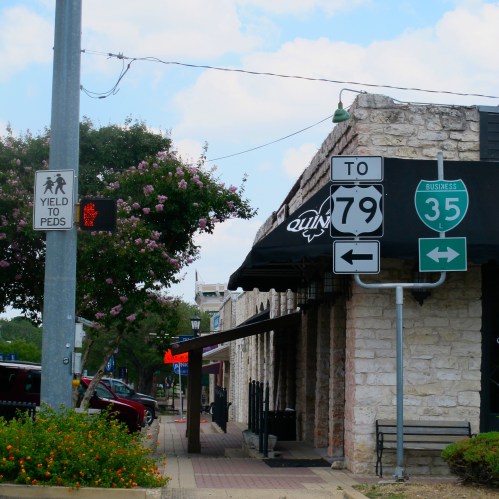
Down town Round Rock, Texas

I also spent two days with my dear friend and her family who moved to Round Rock, Texas a year ago. The weather was just perfect this week. No doubt the sun and warm people had something to do with it. It was 90°F with very little humidity; the Texas sun was hot and satisfying.

Round Rock, Image by city-data.com

The second night at my friend’s the plan was to have Texas BBQ ribs. I volunteered to do Thai side dishes and Nicaraguan cocktails. I have had a longing for El Macua—a national cocktail of Nicaragua—since my return from Granada a few weeks ago and it was in my mind to do a fusion cocktail with Texas grapefruit. After the side trip to visit Round Rock’s historic Old Town, we went to several grocery stores and a liquor store and we got what we wanted. Most importantly, we found Nicaraguan rum—Flor de Caña, guava juice and Red Ruby Texas grape fruit juice. Perfect.

Ruby Red Sunset at Round Rock, Texas

The dinner was scrumptious and the ribs were tender and delicious. The Thai side dishes were interesting and the best, as you can imagine, was El Macua. Leaving the cold Seattle weather behind and with a vague memory of Granada, I sat with my friend in the backyard enjoying the warm air and the beautiful ruby sunset. With El Macua in our hands, we enjoyed laughing and catching up, between sips, on the past year. Cheers to the moment.


Nicaragua Rum and Texas Ruby Red Grapefruit Juice

When I was in Granada, Nicaragua in early May of  this year, I had a chance to have El Macua. It is easy to love as it is essentially a tropical fruit juice cocktail. The bartender at the Hotel Plaza Colon combined two ounces each of orange juice, guava juice and white rum over ice in a highball glass and decorated it with sliced oranges. The original drink, however, calls for ½ portion of lemon juice to 1 portion each of white rum and guava juice, with sugar to taste.

For fun I wanted to try Ruby Red Texas grape fruit juice in place of the lemon juice, then I used the original ratios according to my notes from my trip. My friend and I started with 1 portion each of rum, grapefruit juice and guava over ice, then we would stir and sip. In my recipe below I use Thai palm sugar simple syrup to balance the sour of the grapefruit juice; the amount to use depends on the brands of juices you get. If you want your drink to be more sweet, add guava juice, but if you want it a little sour, add more grapefruit juice. It was a very pleasant summer cocktail and it goes very well with Thai cuisine. Cheers!

El Macua with Ruby Red Grapefruit Juice

El Macua

มาเก๊า ค็อกเทล

1 cup crushed ice in a highball glass
2 ounces white Nicaraguan rum such as Flor de Caña
2 ounces guava juice
2 ounces Ruby Red Grapefruit Juice
1 to 2 ounces palm sugar simple syrup (see note)
1 grapefruit slice for garnish

Pour rum, guava juice, grapefruit juice and palm sugar over ice in a highball glass. Stir. Garnish with grapefruit slice and serve.

Makes one serving in a highball glass or share with a friend in two martini glasses.

Pranee’s note:

To make palm sugar simple syrup, place a disc of palm sugar (about 4 tablespoons) and about ¼ cup water in a saucepan. Bring to a boil and cook on medium heat for 5 minutes. Cool and chill. Keeps in the refrigerator for up to a week.    Yield: ¼ cup.

© 2011 Pranee Khruasanit Halvorsen 
I Love Thai cooking
 Pranee teaches Thai Cooking classes in the Seattle area.
Her website is: I Love Thai cooking.com .
 
 Related articles

Read Full Post »