Feeds:
Posts
Comments

Archive for May, 2011

Two Uncommon Ingredients in a Pot of Curry Stew

My sister and I once had a dream that we would work together in our own restaurant in Phuket. But as it turns out, she has her restaurant and I am a culinary instructor here in Seattle. But we do share with each other what we have learned over the years. During my last trip home I learned about an herb in the mint family called Bai Lah. It is an herb used in Thai cuisine. I took a picture of my sister’s Lah plant. I believe that Lah is a Thai word that is short for perilla.

Green Perilla—also called Green Shiso or Beefstalk—is a member of the mint family Lamiaceae, but it doesn’t taste like mint. The  Purple Perilla is more common in the markets, but it belongs to a different species in the botanical world. Purple Perilla is also known as Japanese basil or purple mint. It has a very refreshing taste. To me it tastes like lemon verbena, cinnamon and grass.

In Seattle, I was familiar with the plant Green Perilla because I am a Vietnamese food fanatic and I have a passion for herbs. I even made Jerry Traunfeld’s Green Apple & Green Shiso Sorbet once. But seeing Lah in Thai cuisine is a new experience for me.

Thai Bai Lah ~ Green Perilla, my sister’s plant in Thailand

The second unusual ingredient in my stew is stingray. In Thailand, stingray is hard to come by so my mom would be sure to bring some home whenever it appeared in the market. In Phuket, stingray is available in the market already barbecued and ready to be eaten. The venders would grill it in pieces about 2 to 3 inch wide and the length of half of the wing.

We eat stingray with spicy chili and lime dipping sauce and steamed jasmine rice. It is simply delicious. Another delicious way to eat stingray is to cook the flesh from a barbecued stingray in a curry with a flavorful leaf such as wild pepper leaf (please see Pranee’s Blog entree on wild pepper leaf). Stingray is eaten in Southeast Asia in Malaysia, Singapore and Southern Thailand. We eat the wings or flaps and the flesh, but not the bone and skin. Because they have such a strong flavor and aroma, the first thing we do with fish like stingray, tuna and catfish is to barbecue them with salt to temper the strong fishy flavors and aromas.

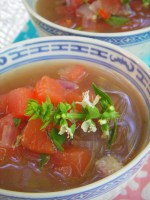
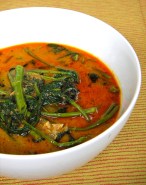
One day I decided to cook stingray and Green Perilla leaves together in a curry. It turned out to be a splendid idea. The perilla leaves left behind a unique flavor and aroma of lemon, cinnamon and cloves in my new creation of fish curry stew ~ Pla Kraban Kub Bai Lah ~ Stingray Curry Stew with Green Perilla.

Two uncommon ingredients - Stingray and Green Perilla

Through I haven’t had stingray curry for over 20 years, seeing a frozen stingray at Mekong Rainier Asian Market inspired me to cook it for the blog and for myself to revisit the flavor. I bought small portions of the stingray flap at the Asian market, then took them home and baked them instead of grilling or barbecuing them. It needed to be cooked first before I did anything else because we never handle fresh stingray.

Stingray curry with green perilla

This recipe is not  hot like most curries. This allows you to enjoy the flavor of the fish more than in a hot curry sauce.  But if you wish it to be hot like any curry, follow the steps below, but double the amounts of curry paste and coconut milk.

This recipe is for anyone who might  find stingray in the market and be interested in learning how to cook it. It was fun to make this recipe with stingray, but on a regular basis I am more likely to make this recipe using halibut cheeks or grilled catfish.

Stingray Curry Stew with Green Perilla

Gaeng Pla Kra Baen Bai Lah 

เคี่ยวแกงปลากระเบน

Serves 4

1 ½ pounds stingray, prepared as describe below (or halibut or grilled tuna)
2 tablespoons canola oil
1 ½ tablespoon red curry paste
6 tablespoons coconut milk, divided
1 cup water
1 cup green perilla leaves, stems removed
1 teaspoon fish sauce

Pre-heat oven to 350F.

Place parchment paper on the bottom of a baking sheet and place the stingray on top. Bake stingray for 30 minutes, or until the meat pulls away from the bone as shown in the photo below. Using a fork, remove the cooked fish from the bone and the skin; it should come off easily. Discard the bone and skin.

Heat a heavy bottom pot and stir in canola oil;  pan-fry curry paste in the oil until fragrant. Add coconut milk and let it cook on medium-high heat until oil is separated and the curry is fragrant. Stir in coconut milk and water and bring to a boil. Stir in the previously prepared stingray and boil for 3 minutes. Add green perilla. Let it boil for 1 more minute to allow the flavor of perilla into the soup, but not so long that the fresh herb flavor disappears. Serve with steamed jasmine rice.

© 2011 Pranee Khruasanit Halvorsen
I Love Thai cooking
Pranee teaches Thai Cooking classes in the Seattle area.
Her website is: I Love Thai cooking.com .

This slideshow requires JavaScript.


Read Full Post »

Let It Stew

I love having a stew cooking on my stove top while I am catching up with a pile of work. I have had a frozen pork belly in my freezer for a month now, waiting for the time when it will become Moo Palo, or Stewed Pork Belly with Cinnamon and Star Anise in Soy Sauce, a delightful dish of Thailand. I could no longer make excuses that I was too busy too cook—I can accomplish both working and cooking: Just let it stew.

I worked at my home office all last week to meet my deadline for editing recipes and writing a proposal. When I saw the frozen pork belly in my freezer I pulled it out to thaw so that I could cook it the next day.  The rest was simple. I cut the pork belly into pieces, placed them in a Dutch oven and sprinkled the remaining ingredients randomly on top. Then I let the stove top (or you can use the oven) do the work of cooking. I took a break from work from time to time to check on the stew. While it cooked itself on the stove top for 2 hours, in my office I enjoyed the aroma of soy and cinnamon and star anise interacting with each other.

Stewed Pork Belly with Cinnamon and Star Anise in Soy Sauce, Moo Palo

This dish is similar to Thai Moo Palo but I omitted the hard-boiled eggs and instead of using five spice powder, I used Vietnamese cinnamon and star anise.  What I was looking for was a sweeter and more delicate flavor than from the Vietnamese version with cinnamon and dark soy sauce. It was surprising good and sophisticated. When I checked with my family they had no idea that there was a tablespoon of black pepper in it. It had just a hint of black pepper deepening the sauce.

In Phuket, this dish is called by its Phuket Hokkien name: Moo Hong – หมูฮ้องสูตรภูเก็ต. I cooked it the same way my mother would, with the fat and skin attached to the pork belly to keep it sweet and moist. The important ingredients that give  Moo Palo or Moo Hong Phuket its unique flavor are dark soy, crushed garlic cloves, black pepper, cinnamon powder, cinnamon sticks and star anise.

This slideshow requires JavaScript.

Stewed Pork Belly with Vietnamese Cinnamon and Star Anise in Soy Sauce

Moo Palo

หมูพะโล้

Serves 4

Preparation time: 10 minutes

Stewing time: 2 hours on medium heat on stove top

2 pounds pork belly (aka side pork) with fat and skin attached, cut into 1½-inch thick pieces
2 tablespoons dark soy sauce (Bengal)
3 tablespoons light soy sauce, more as needed
2 tablespoons Vietnamese cinnamon powder
1 tablespoon whole black peppers, crushed
8 cloves garlic, crushed and peeled (don’t chop, keep them whole)
3 star anise, whole
5 cloves, whole
2 cilantro stems, see Pranee’s explanation on cilantro root
2 teaspoons brown sugar

Place cut up pork belly in a dish and stir in the dark soy sauce, light soy sauce, Vietnamese cinnamon powder and black pepper; mix well. Marinate overnight or for several hours.

Place the pork belly and marinade in a Dutch oven over medium-high heat, then add garlic, star anise, cloves and brown sugar on top of pork. Brown the meat a little, then add water to cover the top of pork by 1 inch. Bring to a boil, then turn heat down to medium or medium low (depending on the burner) to create a nice gentle boil. Let it cook for 1 hour. Stir occasionally and add water if needed.

After an hour and a half, cover the Dutch oven with a lid and let the pork simmer for about a half hour, or until tender. (It is tender when you can cut it with a fork and it breaks up nicely without an effort.) Reduce the sauce to 1 cup, about ¼ cup per serving.

Serve warm with steamed jasmine rice.

 Pranee’s note:

Vietnamese Cinnamon or Saigon Cinnamon has more essential oils and 25 percent more Cinnamaldehyde  than other kinds of cinnamon.

You may add 4 shelled hard boil eggs during the last 1 hour of stewing time. It is also delicious served with cooked thin rice noodles.

An alternative cooking method is to braise the stew in the oven at 300°F for 3½ hours.

© 2011 Pranee Khruasanit Halvorsen
I Love Thai cooking
Pranee teaches Thai Cooking classes in the Seattle area.
Her website is: I Love Thai cooking.com .
 

Read Full Post »

A Stir-Fry from the Palm of My Hand

When I was growing up, in the mornings my grandma would often drop a few coins in the palm of my hand and tell me to go purchase Tao Gua (Tofu), Tao Nge (Mung Bean Sprout), and Guiy Chai (garlic chives) from a mobile market—a pick up truck filled with ingredients. I would return with a bag full of three pieces of tofu cake, mung bean sprouts, and a bunch of garlic chives. Together they made the cheapest and best stir-fry and we ate it about once a week. We would usually stir-fry them later for lunch; if it were for dinner, my grandma would soak the bean sprouts in cold water to keep them fresh in the tropical climate. This was back before we had a refrigerator. When I was at the Asian Market yesterday, I purchased these three ingredients in almost the same quantities as I did then and it came up to $ 2.75, only a few dollars and some coins.

Thais call bean sprouts Thua Ngok (ถั่วงอก), but in my hometown of Phuket we call them Tau Nge, a  Phuket Hokkien word. Hokkien is a Chinese dialect spoken by many Chinese throughout Southeast Asia. Tauge, is the word for mung bean sprouts in Chinese Hokkien and in Indonesian and Malaysian languages as well. Perhaps not surprisingly, the Dutch also use taugé for bean sprouts, probably a holdover from the time when they occupied Indonesia.

Mung bean sprouts, tofu and garlic chives are long-time favorite vegetables of Chinese Hokkien cuisine and culture, even though bean sprouts are actually native to Bangladesh.

Firm Tofu, Mung Bean Sprouts and Garlic Chives

Green onions or regular chives are usually a good substitute for garlic chives, but in this case I strongly recommend that you use garlic chives in order to maintain the flavors and authenticity of this dish. Garlic chives are available all year round at the Asian Market and it is a perennial herb in the Northwest. You may find other recipes where you will want to use them as well.

The other day when I was dining with a friend, I was so impressed to find a similar dish served at the Tamarind Tree Restaurant in Seattle. Their dish was almost identical in flavor, but instead of tofu, it used shitake mushrooms. I hope when you are at the Tamarind Tree Restaurant, you will please try Nấm xào giá ~ Bean sprout mushroom.

Phuket Stir-fried Mung Bean Sprouts and Tofu with Garlic Chives

Stir-fried Mung Bean Sprouts and Tofu with Garlic Chives

Phad Tao Gua Tao Nge Phuket

ผัดถั่วงอกกับเต้าหู้ภูเก็ต

5 minutes total preparation and cooking time, 3 ingredients and less than $3. It is my all time favorite stir-fry.

Serves: 4
 
3 tablespoons canola oil, divided
1 (16 ounce) package  firm tofu, cut into large pieces about 1/4-inch thick
1 cup garlic chives cut into 1-inch lengths (about 15 garlic chives),
6 cups mung bean sproutss, washed with cold water and strained
2 tablespoons soy sauce, or 1 tablespoon soy sauce plus one tablespoon oyster sauce
1 teaspoon sugar

Heat the wok on high heat, then test it with a few drops of water. If the water evaporates in two seconds, pour in 1 tablespoon canola oil. Cover the surface with oil by using a spatula or other utensil, then spread out tofu in the wok and fry on medium heat until they firm up and turn a golden color. This will take 1 to 2 minutes. Transfer to a plate.

Heat the same wok on high heat and add the remaining canola oil and the garlic; stir until golden, about 10 seconds. Stir in bean sprouts and cook on high heat for 45 seconds to 1 minute, stirring constantly. It will sound really interesting and steaming. It is the moisture from the bean sprouts creating the sounds against the hot wok. You will see steam, but not smoke. Then stir in garlic chives to cook lightly, about 45 seconds. Stir in tofu, soy sauce and sugar. Mix together, then serve promptly with hot steamed jasmine rice.

Pranee’s note:

The bean sprouts should not cook longer than 2 minutes, or they will lost their crunch. This dish is very simple and the flavors depend on having the freshest bean sprouts, tofu and chives—and that is enough! I love this dish because it has a clean and simple flavor and texture. The moisture released from the bean sprouts makes a sauce. If that doesn’t happen, add one or two tablespoons of water.

Another variation of this dish that you might see in Thailand substitutes calamari, prawns or pig blood cake for the tofu.

© 2011 Pranee Khruasanit Halvorsen 
I Love Thai cooking
Pranee teaches Thai Cooking classes in the Seattle area. 
Her website is: I Love Thai cooking.com .


Read Full Post »