Feeds:
Posts
Comments

Archive for April, 2011

My Very First Fresh Garbanzo Beans

Fresh Garbanzo Bean or Chickpea

Please don’t think that I always play cat and mouse with my food before eating it. But when I am teaching myself how to cook something new, I often think of it as playing with food. And that is what I did with my very first fresh garbanzo beans.

I had never seen fresh garbanzo beans before. I found them at the store in a 10-ounce package. They were in a plastic container for $2.99 on the shelf among many vegetables. I purchased them thinking they would provide a good opportunity to learn something new.

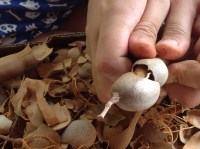
In my kitchen, I enjoyed opening up the individual beans to see how they looked on the inside. A beautiful rounded bean was snuggling in the pod. Some pods had one large bean and some had two smaller beans. I pressed some beans between my fingers and found that they were pretty airy—less dense and not creamy like edamame or peas. Another night I dropped a few beans in boiling water while cooking spaghetti; 12 minutes was way too long for the beans. Finally I felt I knew enough to make an educated guess about a better cooking time and method. Yes, I steamed the whole package of beans as-is for 10 minutes. Then I placed them in a bowl and sprinkled on generous amounts of sea salt and ate them like edamame. They turned out just perfect for eating warm or cold.

Fresh Garbanzo Beans from Mexico

In Thailand we don’t use garbanzo beans—fresh, dried or canned—in Thai cuisine. But we do use them when cooking Indian or middle eastern dishes. The beans are grown in India, but in Southern Thailand many Indian or Bengal merchants sold a variety of spicy legumes from village to village. When we were kids at a festival or open-air movie, I always loved cracking and eating dried, salted, spicy chickpeas. They were served in a paper bag, just like popcorn, and were good for sharing with friends.

A beautiful bean in a green pod, garbanzo beans, also known as chickpeas, belong to the legume family. They are full of protein and fiber. Interestingly, the flavor of garbanzo beans is mild and unassertive and they have a soft (not dense) texture that holds it shape well in gentle cooking, like in a rice soup or a salad. It is healthier to snack on steamed garbanzo beans than anything else. So if you happen to see fresh garbanzo beans, don’t hesitate to take some home to try. It is fun and everyone is kept busy opening the pods while they enjoy the conversation.

© 2011 Pranee Khruasanit Halvorsen I Love Thai cooking
Pranee teaches Thai Cooking classes in the Seattle area.Her website is: I Love Thai cooking.com .
 
Related articles

Read Full Post »

Celebrating New Year with Thai Sticky Rice and Alms Giving

Alms Giving with Jasmine Rice or Sticky Rice

Yesterday, April 17, 2011, I celebrated Thai New Year’s Day~ Songkran~ with Thai and American friends at the Songkran Festival at the Washington Buddhavanaram (Buddhist temple in Auburn, Washington ) It was so much fun, Sanuk.

First, we started with the alms-giving ritual. We gave offerings to the monks of steamed jasmine rice and steamed sticky rice, and for the first time I offered Chicken Biryani Rice (Kao Mok Gai) instead of the two other kinds of cooked rice.

Som Tum ~ Green Papaya Salad

Outside in the yard there were tents with prepared street foods of Thailand, just like at festivals in Thai villages. I sampled almost everything including grilled Thai sausage (Sai Grok Isan), sticky rice (Khoa Neow), green papaya salad (Som Tum), and noodle soup (Kuey Tiow Nahm), to name a few.

A majority of the guests at the festival were from Laos, northeastern Thailand and Cambodia. Steamed Sticky Rice (Khao Neow) is an important part of the day at many Thai gatherings, and Khao Neow and Som Tum are well-loved dishes for Thais who live abroad. As I have mentioned before, these two dishes are a good cure for homesickness for Thais.

Thai Chili Dip ~ Nam Prik

We walked around, enjoying the sunny day and buying street food like Thai Chili Dip (Nam Prik) to take home. I got three different versions of this red-hot chili paste to season my steamed jasmine rice: Red Eye Chili Dip (Nam Prik Ta Daeng), Tilapia Chili Dip (Nam Prik Pla Nill) and Crunchy Pork Chili Dip (Nam Prik Moo Grob). Now these three Nam Prik are in my freezer for days when spicy hot food will comfort my mood.

Bathing and Placing Gold Leaves On the Buddha Image

In Burma, Laos, Thailand, Southern China and Cambodia, a part of celebrating Solar New Year is bathing and cleaning an image of Buddha. I celebrated this ritual here in Washington with many people from these countries.

Flags on Sand Mount

Building a sand hillock and decorating it with flags is also a common practice. 

Dancing to the Laotian Music

Eating a lot of sticky rice and dancing  to Laotian live music was a perfect “sanuk” day to welcome the new year.


Steamed Sticky rice

Khao Neow Nueng

ข้าวเหนียวหนึ่ง

Serves 6 to 8

Sticky rice is a long-grain rice with a sticky and soft texture. There are several names for sticky rice, including sweet rice and glutinous rice. Sticky rice is ideal for desserts as well as for serving with Northeastern dishes such Som Tum (green papaya salad) and Laab Neua (beef mint salad). There are also main dishes on my blog that are great to serve with steamed sticky rice, such as Green Papaya Salad with Smoked SalmonGrilled Fish Sauce Chicken Wings (Peek Gai Nam Pla Yang), and Green Papaya Salad with Salted Crab and Rice Noodle (Som Tum Sua). This last recipe includes a video of my sister-in-law preparing the salad.

After 30 minutes, flip the sticky rice over

I hope you have a chance to learn how to cook steamed sticky rice. You may use a double boiler/steamer or purchase a bamboo steamer.

2 cups sticky rice

Cover sticky rice with room temperature water at least 3 inches above the rice. Let rice sit for 2 hours or overnight, then drain off any excess water.

Steam sticky rice in a steamer with a lid over high heat for about 30 minutes, or until the rice is soft. Flip the rice over so that the sticky rice on the top will go on the bottom and steam with the lid on for 5 more minutes. You can keep the rice warm for a few more minutes with the steamer on simmer, or remove it and keep it in a thermal-controlled container.

The steamed sticky rice is ready to serve with main dishes or to use in a dessert that requires steamed sticky rice.

© 2011 Pranee Khruasanit Halvorsen 
I Love Thai cooking
 Pranee teaches Thai Cooking classes in the Seattle area. 
Her website is: I Love Thai cooking.com .

Read Full Post »

泼水节

Image via Wikipedia

Sanuk Mai? This is a question Thais ask each other when they share experiences of any activities you do in life.

สนุก-Sanuk means to have a good time, to enjoy or to get pleasure and joy from anything we do. Tiew hai sanuk means travel and have a good time. Tum Ngan hai snuk, is to work and to enjoy working. When making choices in our life,“Sanuk” is a factor in our decision making: some pleasure has to be combined with whatever we do.  And when life is lacking Sanuk, then let’s plan it. This week in Seattle, I am going to do something I actually planned a month ahead to “Sanuk” with friends and that is to celebrate Thai New Year’s Day, or Songkran, with friends at the Washington Buddhavanaram.

Songkran is Thai New Year’s Day. It is is a national holiday in Thailand celebrated on April 13th. It is also a New Year’s Day for Lao, Burma and Cambodia. The Thai New Year is a solar new year, and not to be confused with the Chinese New Year, which is a lunar new year. In Seattle, the Thai community celebrates the holiday on Sundays so that locals can take time off on the weekend to celebrate. Please click here to see how these countries celebrate: Cambodia, Laos, Mon-Burmese and Thai. Many westerners know this celebration in Southeast Asia as the Water Festival.

Songkran is such a special day that we can’t complete our Sanuk without sharing food. Everyone brings food to share, which is set out on the table, then a bell is rung to signal lunch time. Sticky rice is well-loved, and the most popular dish to share.

Thai Community Potluck in Washington

I decided to do Kao Mok Gai (Phuket Baryani Rice) as a main dish, and sticky rice in bamboo tubes (my version with parchment paper in the oven) for a dessert. I chose these recipes because I wanted to do something that was easy to cook in large quantities and also something that is a traditional dish and a crown pleasure. Kao Mok Gai is a special dish from Phuket for a special event. In Cambodia,sticky rice in a bamboo tube, known as Kralan, is a traditional dish to be eaten on New Year’s Day.  Here are links to recipes for these dishes that are already available on this blog: Kao Mok Gai and Kao Lam.

Phuket Chicken Baryani Rice--Kao Mok Gai Phuket

Thai Kao Lam, Sticky Rice in Bambo Tube

I hope to get some more recipe ideas at this event as well as some photos to share with you.

May I wish you a Happy Thai New Year and have a lot of Sanuk in the coming year.

สวัสดีปีใหม่ค่ะ

Pranee

Read Full Post »

Pandanus leaf (Bai Toey), a Thai Culinary Treasure

Something about spring made me want to share my favorite cup of tea recipe with you. Maybe it is the fragrance of fresh pandanus leaf, which is like fresh green grass, or jasmine rice that makes me anticipate more spring. The long narrow leaf looks like a gladiolus leaf however pandanus belongs in the screw pine genus. It is known in Southeast Asia as Pandan. Besides using the leaf for cooking, I grow Bai Toey as a decorative plant and use it in flower arrangements. In my village in the old days, every household grew them near a damp place in their garden. If you are interested in growing Pandan as a house plant, please check with your local nursery. The scientific name for Bai Toey is Pandanus Amaryllifolius.

Pandanus Leaf-Bai Toey

Thai cooking depends on Bai Toey much like Westerners depend on vanilla. That is a simple comparison I often use when I introduce this plant in my cooking classes. But pandanus leaf has so many uses I would need many pages and recipes to show and tell you all of them. But I will try to make it short and just highlight the plant’s significant qualities. Over time I will provide recipes in upcoming posts that highlight the broad uses of Bai Toey.

Below are pictures and short descriptions of how I have used pandanus during the past four months while I was in Thailand and in my classroom and my kitchen here in Seattle.

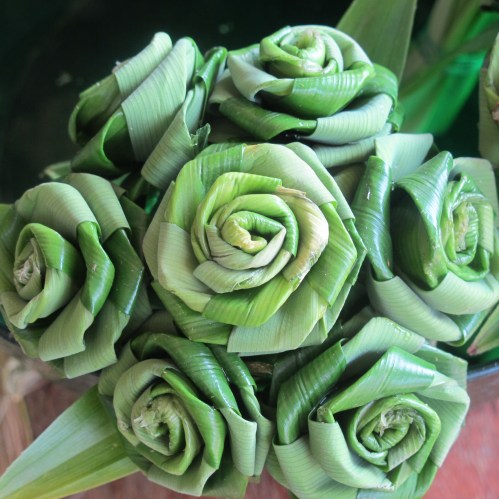
Roses made from Pandanus leaves for worship or air freshener

Thais use pandanus leaves to make  rose flowers for worship or to use as an air freshener.

Please click the picture to see Pranee’s YouTube video and learn how to make rose flowers from pandan leaves.

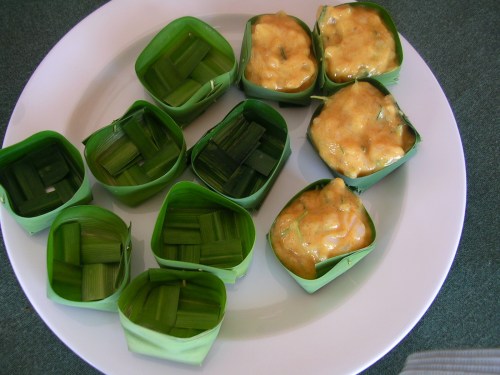
Pandanus leaf cups

Thais use Pandanus leaves to make decorative containers.

Adding green color extract from pandanus leaf to pearl tapioca pudding

Thais extract the green color from Pandanus to use as food coloring in Thai desserts.

This slideshow requires JavaScript.

A Perfect Thai Herbal Tea

My usual cup of tea is a light tea that I brew from a combination of pandanus leaf and jasmine tea. I grew up with this tea in a village where, in addition to the famous Thai Ice Tea, it seemed to be available everywhere,  rain or shine, in everyone’s kitchen, or to welcome guests at a big gathering. For funerals or other large  functions, this tea is brewed in large quantities, steeped in a pot that can serve up to 100 people. I love this tea both warm and cold. The fragrance and flavors of pandan leaves and jasmine tea seems to be a perfect pair – my favorite combination. Not to mention that my favorite hand lotion from Thailand is a combination of pandan leaf and jasmine—classic Thai aromatherapy. Please click here to learn more about pandan leaves and their medicinal benefits.

Pandan leaf is available fresh or frozen at Asian markets.

Jasmine Pandanus Tea

Cha Mali Toey Horm

ชามะลิใบเตย

Jasmine and pandanus is a classic fragrant infusion for Thai tea and desserts. This tea is very popular,  but it is served mostly at large group functions such as funerals. In my village it is prepared in a large pot three feet in diameter by three feet tall, ready to serve tea for the whole village. It can be served with a snack, dinner or dessert. Serve plain without sugar. The tip is don’t make the tea too strong.

1 to 2 teaspoons loose jasmine tea
1 pandanus leaves, torn lengthwise into narrow strip and tied in a bun, or folded to fit the teapot
2 cups boiling water

Place jasmine tea and pandanus leaf in a teapot. Pour boiling water over all and let it steep for 5 minutes. Serve right away.

© 2011 Pranee Khruasanit Halvorsen
I Love Thai cooking
Pranee teaches Thai Cooking classes in the Seattle area.
Her website is: I Love Thai cooking.com .


Read Full Post »

Oodles of Flavors at Chinese Noodle House

I have  finally found my place to have oodles of noodles. And I have to thank to my friend Ron who introduced me to his favorite restaurant: Hue Ky Mi Gia, a Chinese Noodle House in in the Seattle International District’s Little Saigon. My first visit with Ron was in October 2010, then we went again in November to explore more noodle dishes right after the restaurant celebrated their first anniversary. Each visit we enjoyed the personal touch of a friendly conversation with the owners. That’s how we learned that they are now planning to open a new restaurant soon in another location.

Egg Noodle Dry Style at Hue Ky Mi Gia, Chinese Noodle House

I loved my first bowl of noodles there and knew that all of their dishes would be good. After a few visits and many oodles of noodles, I am sure that noodle fans will appreciate this review. The noodle dishes at  Hue Ky Mi Gia are simply delicious and satisfying. The flavors are authentic and provide the same tastes that one could savor while traveling in Southeast Asia. The dishes are not prepared to Americans tastes, but according to Asian soup traditions, from preparing the broth to using real ingredients in each dish that truly represent the original dish. Tiu, the owner, told us that most dishes on the menu are prepared here the same way that they are made in their restaurant in Vietnam, which also operates under the same name “Hue Ky Mi Gia.” “We cook according to tradition,” Tiu says with pride. I love the fact that they use garlic chives to heighten the broth; the pungent mellow broth left behind a delicious sweet and sophisticated aroma. I love the use of fried garlic, crunchy pork rind, garlic chives and freshly sliced green onions and lettuce in the soup. The noodles come in two versions, soup style or dry style. I always end up choosing the dry style with the broth on the side.

My favorite noodle dish here is Egg Noodle Dry Style (pictured above). It reminds me so much of my hometown cookery of Mee Hang. Tiu said a family ancestor was originally from China and found a new home in Vietnam. Her family is Vietnamese but the restaurant features mainly Chinese noodle soups, recipes that have been passed on in families for generations. Perhaps now I could make a connection; Chinese descendants my hometown  also came from the same part of China. When I eat her egg noodle dry style it feels like being in Phuket. Most of all, I am thankful to her for preserving the authenticity of the dish.

Without hesitation, I recommend Hue Ky Mi Gia to you highly. I judge the noodle restaurant by the broth and the noodle quality, and the rest is all about the authenticity. The price is very reasonable and the service is warm from this family owned business.

I recommend going to the restaurant before the lunch crowd. The setting is casual, so don’t worry if occasionally there are slurping sounds accompanying the meal.

Braised Duck Egg Noodle-The Signature Dish

Appetizers: Deep Fried Tofu, Honey Walnut Prawns, Crab Wonton with Tangy Sweet & SourSauce

Soup: Crab Meat with Fish Maw Soup, $ 5.50

Egg Noodles Dry Style: BBQ Pork, Sui Kau Pork & Shrimp, Dumpling Egg Noodles, $7

Braised Duck Egg Noodles, $7

Pork Intestines Egg Noodles, $6

Steamed Rice, $1

This slideshow requires JavaScript.

Hue Ky Mi Gia, Chinese Noodle House

1207 South Jackson Street, Suite #101

Seattle, WA 98144

Telephone: 206 568 1268

Pranee teaches Thai Cooking classes in the Seattle area.
Her website is: I Love Thai cooking.com .


Read Full Post »